.png)
A Guide to Loft Conversion Southampton: Highcliffe & Bournemouth
- Dan Hall
- Dec 10, 2025
- 17 min read

Thinking about a loft conversion in Southampton? It’s one of the smartest ways to upgrade your home, turning that forgotten attic space into a genuinely usable room without the hassle and cost of a traditional extension. It's a go-to for homeowners wanting to add a bedroom, a home office, or just some extra living space, all while giving their property’s value a serious boost.
Unlock Your Home's Potential in Southampton
Feeling like you're outgrowing your current home but can't bear the thought of leaving your neighbourhood? Moving is a huge upheaval, not to mention expensive. But what if the extra space you desperately need is already there, just waiting to be unlocked with our in-house services?
For so many homeowners across Southampton, the answer is right above their heads. A loft conversion is more than just another room; it's a clever investment in your home and your lifestyle.
That dusty, underused attic is packed with potential. Just imagine it as a light-filled master bedroom with its own en suite, a quiet home office away from the daily chaos, or a brilliant playroom for the kids. Our team is here to make that happen, handling everything from the first sketch to the final coat of paint with our in-house services. We help homeowners not just in Southampton, but right across the region, from Poole to Highcliffe.
A Smart Investment for Your Property
One of the biggest draws for a Southampton loft conversion is the financial upside. It’s not just talk; local estate agents consistently report that a well-designed conversion can lift a property's value by 15% to 25%.
The return is especially strong when you add a new bedroom and, crucially, an en suite bathroom. In a competitive property market like Southampton's, where every square metre counts, that extra functionality makes a huge difference.
And this isn't just a local trend. Across the UK, loft conversions are known for offering one of the best returns on investment of any home improvement project. It's simply a brilliant way to expand your living area without the stress of moving. Our in-house services ensure a high-quality finish that maximises this return.
More Than Just Extra Space
Beyond the numbers, a loft conversion is about improving your quality of life. It’s a space designed around your family’s actual needs—whether that’s a dedicated workspace to escape the noise or a peaceful retreat to relax in at the end of the day.
Our team takes care of the entire process, making it seamless for you. You can see the kind of stunning, functional spaces we’ve brought to life by looking at some of our previous projects.
Before you dive in, it’s good to have a clear picture of what's involved. Here’s a quick rundown of the key things to think about for your Southampton project.
Key Considerations for Your Southampton Loft Conversion
Consideration | Why It's Important | Key Takeaway |
|---|---|---|
Head Height | You need a minimum of 2.2m of usable standing height in the main part of the loft for it to feel spacious and meet building regulations. | Measure from the top of the floor joists to the bottom of the ridge timber. If it's tight, our in-house services can provide solutions, but they add complexity. |
Roof Structure | The type of roof (traditional 'cut' roof vs. modern 'truss' roof) dictates the scale of structural work needed. | Trussed roofs require more extensive structural changes, which will affect your budget and timeline. Our in-house experts can advise. |
Planning Permission | Many loft conversions fall under 'Permitted Development,' but some, especially in conservation areas, will need full planning permission. | Always check with Southampton City Council first. Our in-house services will guide you through this process. |
Access & Stairs | The location of the new staircase is critical. It needs to feel natural and not compromise the space on the floor below. | A well-placed staircase can make or break the flow of your home. This is where our in-house design services really pay off. |
Thinking through these points early on helps ensure your project runs smoothly and delivers the results you’re hoping for.
A loft conversion is the ultimate way to maximise your home's footprint. Instead of building out, you build up, preserving your garden space while adding a beautiful and functional new level to your property.
Whether your home is in Ringwood, Christchurch, or Bournemouth, the core principles are the same. Our in-house specialists are here to guide you, turning that unused attic into a space that truly enhances your home. We manage everything, from the initial designs and structural calculations to the finishing touches with our in-house services, guaranteeing a stress-free experience from start to finish.
Getting to Grips with Southampton's Planning and Building Rules
Let's be honest, the paperwork side of a loft conversion in Southampton can feel like the biggest hurdle. When you start hearing phrases like 'Planning Permission' and 'Building Regulations', it's easy to feel a bit overwhelmed. But breaking it down is simpler than you think, and getting this right from the start is the secret to a smooth, stress-free build with our in-house services.
At their core, these rules exist for two very different reasons. Planning Permission is all about how your new loft affects your neighbours and the look of the local area. Building Regulations, on the other hand, focus squarely on the safety and structural integrity of the work itself. They make sure everything meets national standards for fire safety, insulation, ventilation, and more.
The good news for many homeowners in Southampton and surrounding areas like Poole and Ringwood is that you often don't need to go through a full planning application. Why? Because many loft conversions fall under something called Permitted Development rights.
What Are Permitted Development Rights?
Think of Permitted Development rights as a pre-approved green light from the government for certain home improvements. It allows you to get started without a formal planning application, which can save you a huge amount of time and money. But—and this is a big but—these rights only apply if your project sticks to a strict set of conditions.
For a loft conversion, the main rules are:
Volume Limits: The new space you create can't be more than 40 cubic metres for a terraced house or 50 cubic metres for a detached or semi-detached home.
Height Restrictions: Your extension can't poke up higher than the highest part of your existing roof.
Matching Materials: Any materials used on the outside of the conversion need to look similar to the rest of your house.
No Balconies: Features like balconies, verandas, or any kind of raised platform are not allowed under Permitted Development.
As part of our in-house service, we carry out a thorough check to confirm your plans fit within these rules. It’s a crucial first step for every loft conversion in Southampton to make sure your project starts on solid legal ground.
This shows just how an unused attic can become a valuable and functional new room.
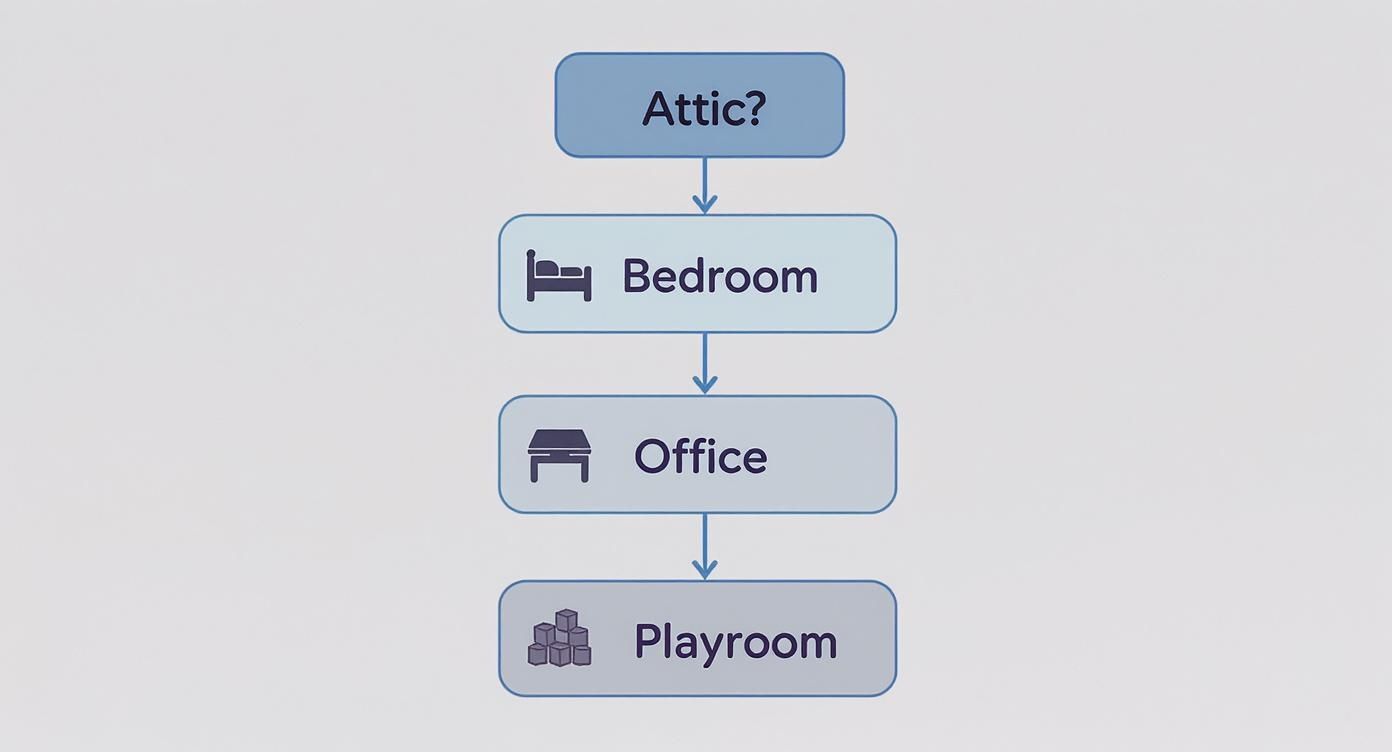
As the graphic shows, some of the most popular goals for a loft conversion—like adding a new bedroom, a quiet home office, or a dedicated playroom for the kids—are all fantastic and achievable options with our in-house services.
When the Rules Get Tighter
It’s really important to know that Permitted Development rights aren't a blanket pass for everyone. If you live in what's known as a 'designated area', the rulebook changes completely. This includes Conservation Areas in historic parts of Southampton or Christchurch, as well as National Parks like the New Forest.
In these locations, the council is much stricter to preserve the area's unique character. Even small external changes will almost certainly need a full planning application. For example, a sleek, modern dormer with big windows might get rejected in favour of traditional Velux rooflights that sit flush with the existing roofline.
Navigating the specific regulations of Southampton City Council is our speciality. Our in-house team handles all the paperwork and communication, so you don't have to worry about missing a crucial detail or facing unexpected delays.
Even if your project sails through under Permitted Development, you will always need Building Regulations approval. This is non-negotiable. It covers all the critical structural and safety parts of the job. To keep things on track, an ultimate building permit checklist is an essential tool for any Southampton loft conversion. Our team manages this entire process for you with our in-house services, from submitting the structural calculations to arranging the necessary site inspections.
We believe you should be excited about your new space, not buried in bureaucracy. If you have any questions about the planning process for your property, our experts are here to help. To chat about your project and get clear, straightforward advice, feel free to get in touch with our Southampton team today.
Choosing Your Ideal Loft Conversion Style
Once you've decided a loft conversion in Southampton is the right move, the really exciting part begins: picking a style that fits your property, your needs, and your budget.
Every home is different, from the classic terraced houses in central Southampton to the detached properties you find out in Highcliffe. Each has its own character and structural quirks. The type of conversion you choose will ultimately define the look, feel, and function of your new space.
This isn't just about what looks best. It's a practical choice that depends heavily on your roof's existing shape, the head height you're working with, and what you actually want to use the room for. Our in-house design and build experts are here to walk you through all the options, making sure the final result is a seamless, natural addition to your home.
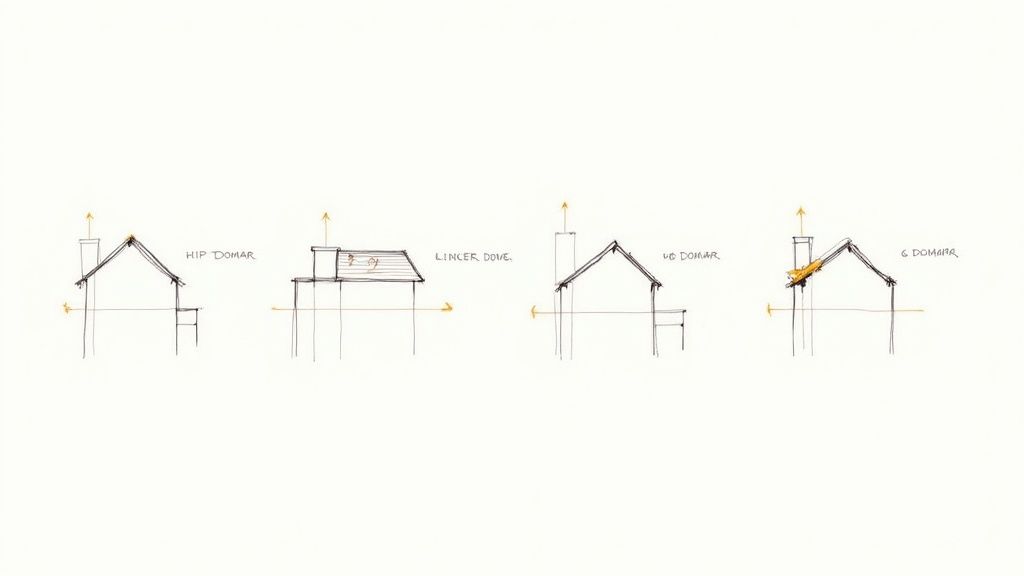
Let's break down the most popular conversion types you’ll come across in the Southampton, Bournemouth, and Poole areas.
The Ever-Popular Dormer Conversion
A dormer is essentially a structural extension that juts out vertically from the slope of your roof, creating a box-like shape. It’s easily one of the most common choices for a loft conversion in Southampton, and for one simple reason: it gives you the most usable space.
By building outwards, a dormer conversion creates vertical walls and a flat ceiling. This instantly transforms a cramped, sloping attic into a bright, airy room with proper headroom. It’s the perfect solution for adding a full-sized bedroom, a spacious home office, or even a master suite complete with an en-suite bathroom.
There are a few different dormer styles to consider:
Flat-roof dormers: The most cost-effective option, offering the biggest increase in internal space.
Gable-fronted dormers: Often called 'dog-house' dormers, these have a pitched roof and can be more visually appealing.
Shed dormers: Similar to a flat-roof dormer, but its roof slopes down at a shallower angle than the main one.
Because they change the external look of your home, dormers sometimes need planning permission. However, a surprising number fall within Permitted Development rights. Don't worry about the paperwork—our in-house services include handling all the necessary checks for you.
The Minimalist Velux (Rooflight) Conversion
If you're looking for the simplest and most budget-friendly route, a Velux conversion is the way to go. This style keeps things simple by adding rooflight windows (like those made by the brand Velux) directly into the existing roofline without altering the structure at all.
This approach is perfect for lofts that already have decent headroom. It’s a fantastic way to flood the space with natural light, creating a bright, welcoming atmosphere for a home office, a craft room, or a cosy snug. The big advantage here is that Velux conversions very rarely need planning permission, making the whole process much quicker.
A Velux conversion is the least disruptive type of loft project. By working within the existing roof structure, our team can complete the work efficiently with our in-house services, often with minimal impact on your daily life.
The Expansive Hip-to-Gable Conversion
You'll often see these on semi-detached and detached homes in areas like Ringwood and Christchurch. A hip-to-gable conversion is specifically for properties with a 'hipped' roof—one that slopes inwards on three or four sides. Our in-house services include extending the 'hip' side of the roof outwards to create a vertical wall, known as a gable end.
This simple change dramatically increases the loft's internal volume, giving you more than enough space for a proper staircase and a functional room. It's common to combine a hip-to-gable with a rear dormer to create a truly substantial amount of new living area. While it's more structurally involved, the results can be spectacular.
The Premier Mansard Conversion
When you want to maximise every last inch of space, the Mansard conversion is the top-tier choice. This style involves a major alteration to the roof structure, creating a flat top with a back wall that slopes inwards at a steep 72 degrees. The side walls are typically built up with brickwork to match the house.
Mansard conversions create a huge amount of internal space and are often found on older terraced properties. Because of the significant structural changes, they almost always require full planning permission. The payoff, though, is a space that feels less like a converted attic and more like a brand-new storey. This kind of project is also a great opportunity to add other high-value features, and our in-house services can advise on everything from stunning bathrooms and kitchens to bespoke storage, ensuring a beautiful, cohesive finish throughout your home.
Budgeting Your Southampton Loft Conversion Project
Right, let's talk numbers. It's usually the first question on everyone's mind: "How much is my loft conversion in Southampton actually going to cost?" Getting a handle on the budget early on is absolutely crucial, as it will shape everything from the type of conversion you choose to the taps you pick for the en-suite.
The final figure isn't just plucked out of thin air; it's a blend of several factors that makes every project's price unique.
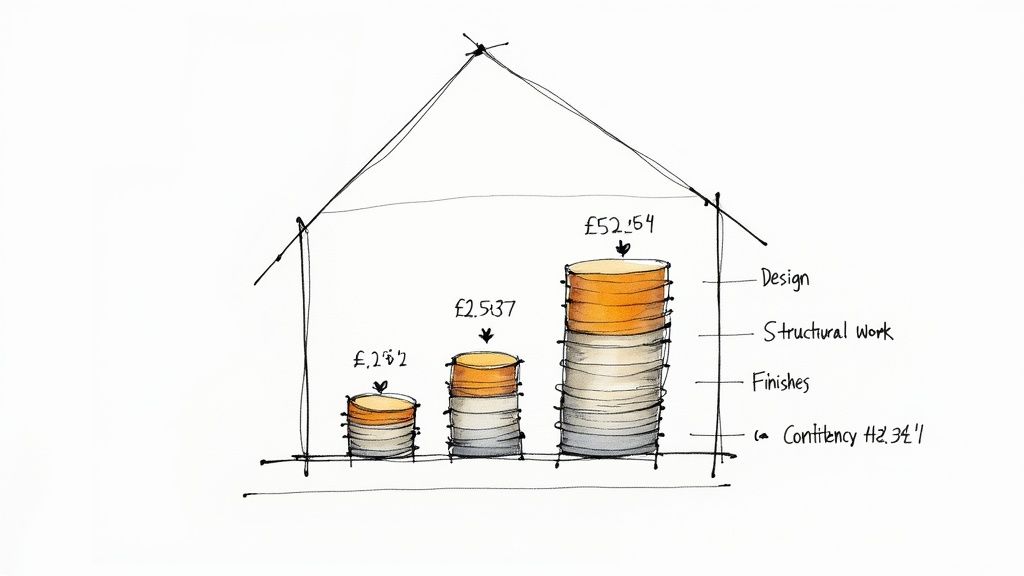
We believe in total clarity from day one. That means you get a detailed, fixed-price quote breaking down exactly where every penny is going. This way, you can plan with confidence and avoid any nasty surprises down the line.
What Influences the Final Cost?
Several core elements will steer your project's total budget. The single biggest driver is the type of conversion you go for. A simple Velux (rooflight) conversion is always going to be more budget-friendly than a complex Mansard conversion, which involves completely altering the structure of your roof.
Naturally, the size of your loft plays a big part, as does what you plan to do with it. Adding a single bedroom is one thing, but creating a master suite with a full en-suite bathroom introduces a lot more complexity with plumbing, tiling, and sanitaryware. Our in-house services can handle all of this.
Finally, your choice of finishes—from flooring and lighting to bespoke built-in storage—will have a significant impact on the final total.
A Look at Typical Costs in the Southampton Area
To give you a realistic starting point for your planning, loft conversions in Southampton and the wider Hampshire area generally fall into a specific price bracket.
Here's a quick look at what you might expect to invest, depending on the scale of your project.
Estimated Loft Conversion Costs in the Southampton Area
Conversion Type | Estimated Cost Range | Best Suited For |
|---|---|---|
Velux (Rooflight) | £25,000 - £40,000 | Maximising space on a tighter budget where headroom is already good. |
Dormer | £40,000 - £60,000 | Creating significant extra headroom and floor space; the most popular choice. |
Hip-to-Gable | £50,000 - £70,000 | Semi-detached or end-of-terrace homes needing to extend the roof ridge. |
Mansard | £60,000+ | Maximising space in conservation areas or where a full rear extension is needed. |
This gives homeowners in Southampton and surrounding areas like Christchurch a solid baseline. While prices across the UK vary, this £40,000 to £60,000 range for a dormer is a common and practical figure for our region, offering better value than major cities like London where costs often start north of £70,000.
Where Your Money Goes: A Detailed Breakdown
It helps to see exactly how that budget gets carved up. While every job is different, the costs for a loft conversion in Southampton typically break down into these key areas:
Structural Work: This is the biggest slice of the pie. It covers the new floor joists, steel beams for support, any roof alterations, and building the dormers or gable ends.
Design and Management: This includes architectural drawings, structural calculations, and project management fees to ensure everything runs smoothly and meets all regulations.
Exterior Finishes: Think roofing, cladding, high-performance insulation, and installing quality windows and rooflights.
Interior Finishes: This is the exciting bit! Plastering, electrics, plumbing, flooring, decorating, and fitting bathroom suites or built-in wardrobes.
Our in-house service really simplifies this. Because we have all the trades under one roof—from plasterers to plumbers—we can manage the project far more efficiently. This helps keep costs predictable and guarantees a high standard of quality from start to finish.
Smart Ways to Manage Your Budget
A loft conversion is a serious investment, but there are definitely smart ways to manage costs without cutting corners where it matters. For instance, opting for standard-size windows over custom-made ones can lead to significant savings. Likewise, choosing high-quality but mid-range bathroom fittings can give you that premium feel without the eye-watering price tag.
However, there are a few areas where you should never skimp. Cutting back on insulation or structural work is a false economy. Getting these fundamentals right ensures your new space is safe, comfortable, and built to stand the test of time.
Our team can walk you through where to spend and where you can save to get the absolute most from your budget with our in-house services. For a precise breakdown tailored to your home, you can get a detailed full renovation estimate from our specialists.
Finding the Right Loft Conversion Specialists in Hampshire
Choosing the team to build your loft conversion is hands down the most important decision you'll make in this entire process. A loft conversion in Southampton is a major project, and the final finish, the structural integrity, and your overall experience all hinge on the skill and reliability of the specialists you hire. This is where our in-house services make the dream a reality.
It can feel a bit overwhelming trying to find a trustworthy builder, especially with so many options across Hampshire. But if you have a clear plan for vetting companies, you can move forward with confidence, knowing you’ve picked a partner who will deliver on their promises and make the journey a positive one.
Starting Your Search in Southampton and Bournemouth
You can't beat a good old-fashioned word-of-mouth recommendation. Start by asking friends, family, or neighbours in areas like Highcliffe or Poole who they’ve used. A personal referral is often the most honest and unfiltered insight you’ll get into a company's quality of work and how they treat their customers.
Beyond your immediate circle, look for specialists with a strong local footprint and a portfolio packed with completed projects in your area. A company with a proven track record in Southampton or Christchurch will know the local property styles inside out and understand any specific planning quirks.
Demand for this kind of work is definitely on the rise. We saw an 8% increase in people asking for quotes for a loft conversion in Southampton and the surrounding region between October and November alone. It’s part of a wider trend of homeowners looking to get more out of their current property instead of moving. Our in-house services are designed to meet this growing demand.
Vetting Potential Building Partners
Once you've got a shortlist, it's time to do some digging. Your goal is to find a team that not only produces beautiful work but also communicates well and runs a tight ship. Our own in-house service is built around this, giving you a single point of contact and a dedicated team managing every last detail.
Here are the essential checks you should always carry out:
Insurance and Credentials: First things first, verify they have comprehensive public liability insurance. This is non-negotiable—it protects you and your home if something goes wrong. Ask to see the certificate; any reputable firm will have it ready.
Review Their Portfolio: A picture really is worth a thousand words. Go through their gallery of past projects with a critical eye. Do the finishes look sharp and high-quality? Have they worked on houses similar to yours in areas like Ringwood?
Check Client Testimonials: Look for detailed reviews on independent sites, not just the glowing one-liners on their own website. The best testimonials mention specifics—how the team communicated, how tidy they were, and whether they stuck to the budget.
Crucial Questions for Your Consultation
The initial consultation is your chance to really get a feel for a company. This is not the time to be shy. Ask direct questions about their process, timelines, and what you can expect day-to-day. A true professional will welcome your diligence.
It’s a great idea to go in prepared with a list. Before you meet, have a look at these critical questions to ask a contractor. It’s a fantastic resource that will help you cover all the important bases and compare different companies fairly.
A key sign of a top-tier specialist is their commitment to transparent communication. Our dedicated project managers provide regular updates, ensuring you are always informed and in control from the initial design through to project completion.
This is exactly why our comprehensive in-house service stands out. We manage every single trade—from structural engineers and plasterers to plumbers and electricians—all under one roof. It completely eliminates the stress and coordination headaches that can derail these kinds of projects. This integrated approach means everything flows seamlessly, the quality stays consistently high, and your build finishes on time and on budget. It’s the standard of excellence you should expect.
Common Questions About Loft Conversions in Southampton
Taking the leap on a loft conversion in Southampton is a massive, exciting step. But it’s natural to have a list of questions running through your mind about the whole process. We get it. We hear the same queries from homeowners all across the region, from Highcliffe to Poole, so we've put together some straight-talking answers based on our years of hands-on experience with our in-house services.
How Long Does a Loft Conversion in Southampton Typically Take?
This is usually the first question on everyone's lips. A well-run project should stick to a pretty predictable schedule, and our in-house services pride themselves on keeping things organised and efficient, respecting both your time and your home.
Generally, the whole thing breaks down into two main phases. First, there's the design and planning stage. This involves getting the architectural drawings sorted, running the structural calculations, and securing any permissions needed from the council. You can usually expect this to take between four to eight weeks.
Once all the paperwork is signed off, the construction phase kicks in. This typically lasts from eight to twelve weeks. Of course, this can shift depending on how complex the job is—a big Mansard conversion will naturally take a bit longer than a simple Velux one. Our team works hard to keep disruption to a minimum and get the job finished on time.
Is My Loft Space Suitable for Conversion?
The good news is that the vast majority of lofts can be converted. But there are a few key things that determine if your space is a good candidate.
The most critical factor is the head height. To make it work, you really need a minimum of 2.2 metres (that's about 7 feet 2 inches) at the highest point of your attic. We measure this from the top of the ceiling joists right up to the bottom of the ridge board.
The pitch of your roof and its internal structure also come into play. Most roof types can be worked with, but some will need more significant structural changes than others.
Honestly, the only way to know for sure is to have one of our experts pop over and take a look. We offer a completely free, no-obligation survey for homeowners in Southampton and the surrounding areas. We’ll assess the space properly and give you a definite yes or no.
Do I Need to Move Out During the Work?
This is a huge worry for many families, but the answer is almost always no. We know that life has to carry on, and we plan every single project to cause the least possible disturbance to your daily routine.
For the first few weeks—the noisier, messier stages of construction—our team works almost entirely from the outside using scaffolding for access. We only need to break through and create the opening for the new staircase towards the final stages of the project.
Our team is absolutely committed to keeping a clean, tidy, and respectful site. We treat your home as if it were our own, making sure it stays a comfortable and functional place to live throughout the build.
We go to great lengths to seal off the work area, manage dust, and have a thorough clean-up at the end of every day. This careful approach means you can stay put comfortably while your amazing new space takes shape above you.
How Much Value Can a Loft Conversion Add to My Southampton Home?
A loft conversion in Southampton is widely seen as one of the smartest home improvements you can make for return on investment. A professionally finished project from our in-house services can boost your property’s value by as much as 20-25%.
The final figure really depends on a few things, like the quality of the finish and the type of room you create. For example, adding a master bedroom with a slick en-suite bathroom will almost always add more value than a simple playroom or home office.
The local property market in your specific part of town—whether you're in the bustling centre of Southampton or the quieter suburbs of Bournemouth and Ringwood—also has an impact. But beyond the pure financial gain, don't forget the incredible lifestyle value you get from adding beautiful, functional space that’s designed just for your family.
When clients ask how to make the most of their new attic, we always stress the importance of flooring and storage. We often recommend professional loft boarding as an essential first step. It provides a solid, safe foundation and makes sure the space is properly prepared before any of the main conversion work begins. It’s all part of our comprehensive in-house services.
Ready to unlock the hidden potential in your home? The team at Hallmoore developments is here to guide you through every step of your loft conversion journey. With our in-house experts handling everything from design to the final touches, we make the entire process straightforward and stress-free. https://www.hallmoore.co.uk
Comments