.png)
A Homeowner's Guide to Single Storey Extension Building Regulations
- Dan Hall
- Dec 24, 2025
- 17 min read

Thinking about adding a single-storey extension? It's an exciting prospect, but getting your head around the rules is the first, most important step. Building regulations for single-storey extensions are the technical standards that make sure your new space is safe, warm, and built to last. This is crucial: they are completely separate from planning permission and you have to meet them, even if your project falls under Permitted Development.
Understanding Building Regulations for Your Extension in Bournemouth
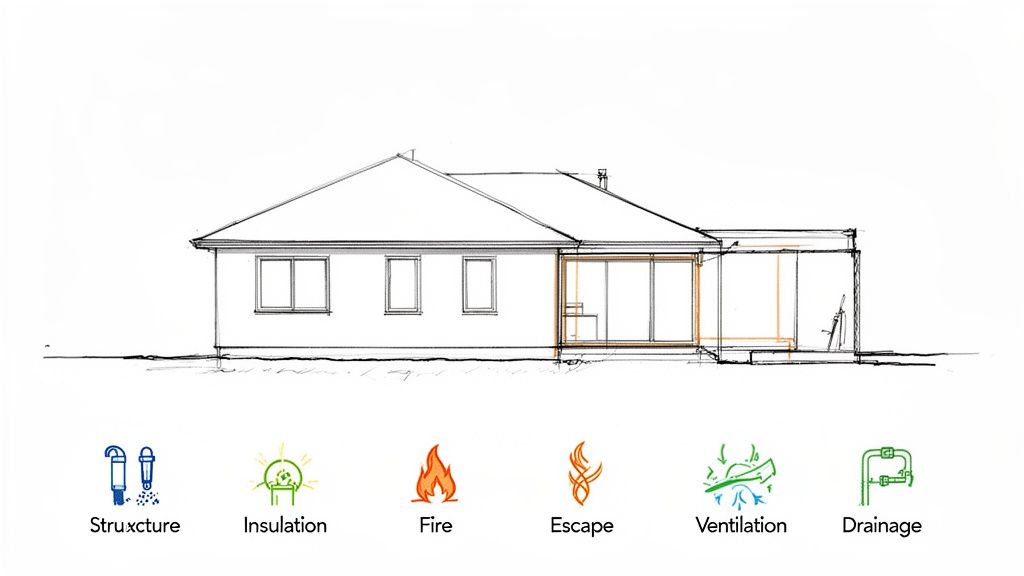
When you're planning an extension, you’ll quickly run into two key hurdles: Planning Permission and Building Regulations. It's a common mix-up, especially for homeowners in Highcliffe and Christchurch, but they are not the same thing.
Think of it this way. Planning Permission is all about whether you’re allowed to build it in the first place. It looks at the bigger picture – things like the visual impact on the street, how it changes your home’s appearance, and if it affects your neighbours' light or privacy. It’s the ‘what and where’ of your project.
In contrast, single-storey extension building regulations are all about how you build it. They're the nitty-gritty, technical rulebook for construction. This ensures your extension is structurally sound, energy-efficient, and a healthy space to live in. So even if your extension in Poole is a 'Permitted Development' and dodges the need for planning permission, it absolutely must comply with building regulations. No exceptions.
The Core Purpose of Building Regulations
At their heart, these regulations are there to protect the health and safety of everyone in and around your home. They set the non-negotiable minimum standards for everything from the depth of the foundations and the strength of the steel beams to the quality of your insulation and ventilation.
Getting this right isn't just about ticking a legal box. It’s fundamental to creating a comfortable, durable extension that won’t cost a fortune to heat and will stand the test of time. For any project across the Southampton and Ringwood areas, sticking to these standards is simply part of the job.
Why You Cannot Ignore Them
Cutting corners on building regulations can lead to serious headaches. Your local council can issue an enforcement notice, forcing you to fix or even tear down any work that doesn't comply – all at your own expense.
Worse still, you won't get a Final Completion Certificate. This little piece of paper is a legal document that proves the work was done correctly. Without it, selling your property in the future becomes a nightmare.
A project without a building regulations completion certificate can be a major red flag for mortgage lenders and solicitors, potentially halting a future house sale and devaluing your investment.
This process ensures that every part of your new extension is built correctly. If you're keen to dig deeper, there are some great resources for navigating building codes and regulations effectively.
At Hallmoore, our expert in-house services are designed to handle all these complexities for you. From the first architectural drawings to the final sign-off from the building inspector, we see to it that your extension meets every single technical requirement. It’s about giving you complete peace of mind and a beautifully finished, fully compliant new space.
Permitted Development vs Full Planning Permission
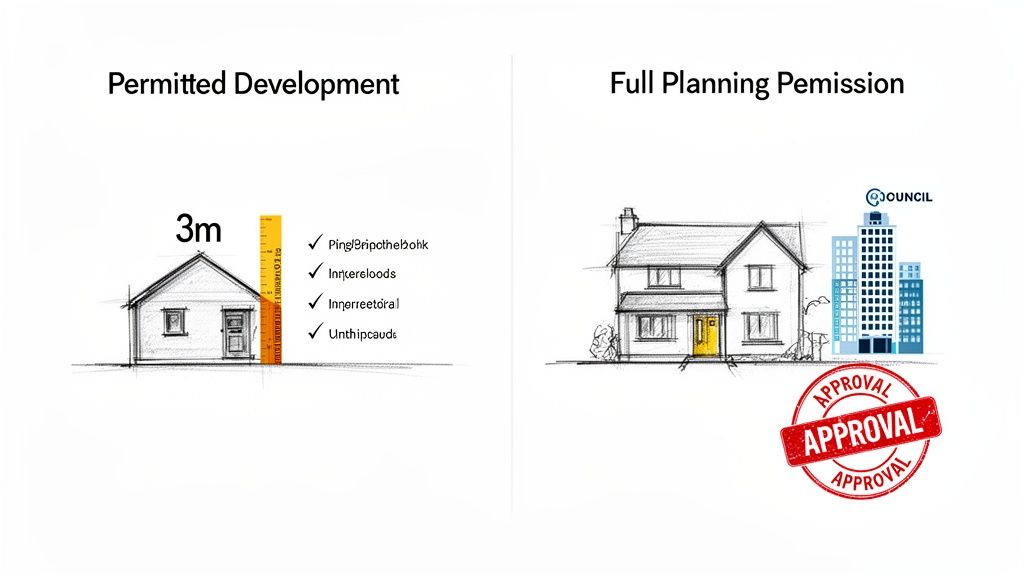
Before a single spade hits the ground for your extension in Poole or Ringwood, you'll come up against a crucial fork in the road. Does your project fall under Permitted Development (PD) rights, or will you need to apply for full planning permission? Getting this right from the start is absolutely key to mapping out your project’s legal pathway.
It helps to think of it like cooking. Permitted Development is like following a pre-approved recipe from a trusted cookbook. As long as you stick to the exact measurements and ingredients—the specific limits on size, height, and materials—you don’t need special permission to cook the dish. You just follow the rules.
Full planning permission, on the other hand, is like creating a brand-new, custom dish from scratch. Because it’s unique and doesn't follow a set recipe, you have to submit your plan to a panel of expert chefs (your local council) for their approval before you can even think about starting.
What Are Permitted Development Rights?
Permitted Development rights are essentially a national grant of planning permission, allowing certain types of work to be carried out without you needing to apply to the local authority. For single-storey extensions, this "pre-approved recipe" comes with some very strict rules.
These rules create clear boundaries on what you can build. For instance, in England, a single-storey rear extension on an attached house (like a terraced or semi-detached property) can typically extend up to 3.0 metres from the original rear wall. If you have a detached house, that limit increases to 4.0 metres.
There are height restrictions, too; a single-storey extension can’t be taller than 4.0 metres. Crucially, your extension can't cover more than 50% of your original garden, and any side extension must be less than half the width of the original house. It's a rigid framework, but it keeps minor home improvements moving without clogging up the planning system. If you want to explore these conditions in more detail, it's well worth your time.
If your design steps over any of these lines, or if you live on designated land like a conservation area, you’ll almost certainly need full planning permission. At Hallmoore, our in-house services can check your plans against these criteria right from day one.
When Full Planning Permission Is Required
You'll need to submit a full planning application if what you have in mind falls outside the strict limits of Permitted Development. This is the more formal, "custom dish" route, where the local authority in areas like Christchurch or Southampton will assess your project on its own individual merits.
They'll be looking at things like:
The design and appearance of the extension.
The impact on your neighbours (things like overshadowing or a loss of privacy).
Whether the materials you plan to use are appropriate for the existing house and the local area.
Any impact on road safety or local infrastructure.
This process is more subjective and takes longer—usually around 8-12 weeks for a decision. It involves submitting detailed drawings and supporting documents for the council to review.
The most important takeaway is this: whether your project is a straightforward Permitted Development or requires a full planning application, you must always comply with single storey extension building regulations. Planning and regulations are separate, and both are non-negotiable legal requirements.
Quick Comparison Table
To give you a clearer picture of which path your project might take, here’s a straightforward breakdown of the key differences between the two routes.
Permitted Development vs Full Planning Permission for Your Extension
Aspect | Permitted Development (PD) | Full Planning Permission |
|---|---|---|
Approval Process | Automatic, provided you meet the strict criteria. | Requires a formal application and council approval. |
Scope & Scale | Limited by specific size, height, and location rules. | Much more flexible, allowing for larger or more unique designs. |
Timeline | No waiting period for a decision. | Typically 8-12 weeks for the council to decide. |
Cost | No application fee, but a Lawful Development Certificate is a smart move. | A statutory application fee is required. |
Certainty | High, as long as your design is clearly within the rules. | Lower, as approval is based on the council's judgement. |
Understanding which route applies to your home extension is fundamental. At Hallmoore, our in-house services make sure our clients are crystal clear on their obligations from the very beginning, managing the entire process to ensure a smooth and compliant build.
What Building Regulations Actually Cover
It’s a common point of confusion, but planning permission and building regulations are two completely different beasts. While planning is all about the 'what and where'—the size, appearance, and impact of your extension on the neighbourhood—building regulations for a single-storey extension are purely about the 'how'.
These are the non-negotiable, technical rulebooks that dictate the quality and safety of the actual construction. They’re laid out in a series of government-approved documents covering everything from the strength of your foundations right down to the efficiency of your new radiators.
Think of it like this: planning permission is like getting the green light to build a new car. Building regulations are the MOT—the detailed inspection that makes sure the brakes, engine, and chassis are all up to scratch and safe for the road. For anyone building in Highcliffe, Bournemouth, or the wider area, getting your head around these technical rules is the secret to a smooth, compliant project.
Let's break down exactly what the inspectors will be looking at.
Part A: Structural Safety
This is the bedrock of your extension—literally. Part A of the Building Regulations is there to ensure your new structure is strong enough to support itself, along with any extra loads from heavy snowfall, strong winds, and of course, you and your furniture. It’s all about creating a solid, durable space that will stand the test of time.
A huge part of this is the foundation design. This is never a one-size-fits-all job. For an extension in a coastal spot like Christchurch, the sandy soil will likely demand a very different approach to foundations compared to the heavy clay you often find further inland around Ringwood.
Key things covered under Part A include:
Foundation Depth and Type: A building control inspector must sign off on the trenches before any concrete gets poured. They're checking that the depth and type are right for the specific ground conditions on your site.
Wall and Roof Integrity: This covers the materials and structural calculations for critical elements like steel beams and roof joists, making sure everything can handle the load without any risk of failure.
Resistance to Movement: The design has to account for potential ground heave or settlement over time to prevent nasty cracks or long-term structural problems.
Part L: Thermal Efficiency
In simple terms, this is all about keeping your extension cosy in the winter and cool in the summer without racking up enormous energy bills. Part L sets seriously strict standards for thermal efficiency, focusing on high-quality insulation and preventing heat from escaping. Getting this right not only makes your home far more comfortable but also shrinks your carbon footprint.
For instance, the regulations set minimum performance targets (known as U-values) for new walls, floors, and roofs. The lower the U-value, the better the insulation. This directly impacts the type and thickness of insulation you’ll need to specify, and our team at Hallmoore ensures every extension we build in Poole is designed to be as energy-efficient as possible.
Part B: Fire Safety
Safety is always the number one priority, and Part B provides the essential rules for protecting you and your family from fire. The goal is to ensure that, in a worst-case scenario, everyone has enough time to get out safely. This is especially important if your extension changes the existing layout of your home.
The regulations look at several key areas:
Means of Escape: Your new extension can't make it harder to escape from the original parts of the house. A new open-plan kitchen-diner, for example, might mean you need to add new escape windows or install interconnected smoke alarms throughout.
Fire Resistance: Some internal walls, doors, and ceilings may need to be built with fire-resistant materials to slow down the spread of flames and smoke between different areas.
External Fire Spread: The materials used on the outside of your extension are also regulated, especially if you're building close to a neighbour's boundary, to stop fire from jumping between properties.
Parts F and H: Ventilation and Drainage
A healthy home has to be able to breathe. Part F (Ventilation) makes sure your new space gets a proper supply of fresh air to stop problems like condensation, damp, and mould from taking hold. This is usually handled with trickle vents in the windows and powerful extractor fans in kitchens and bathrooms.
Meanwhile, Part H (Drainage and Waste Disposal) is all about how wastewater gets out of your extension. It covers everything from where you can place new toilets and sinks to how the new pipework connects safely to the main sewer. All professional plumbing services must be installed correctly to prevent leaks, foul smells, and serious health hazards.
Our in-house services at Hallmoore manage all these technical details as part of our comprehensive service. From liaising with structural engineers in Southampton to ensuring every detail meets the standards set by the Approved Documents, we see to it that your extension is safe, efficient, and fully compliant.
Navigating The Building Control Process And Costs
So, you’ve wrapped your head around what the regulations are actually for. The next step is getting that official stamp of approval. This is where building control comes in—a formal process of applications and on-site inspections designed to make sure your single-storey extension is built safely, correctly, and to the letter of the law.
Think of it as a quality control system that runs alongside your build, making sure every crucial part meets the high technical standards required. It’s a non-negotiable stage of any extension project.
For homeowners in Bournemouth and Poole, this journey starts with a choice between two main ways to apply. Each route has its own pros and cons for your project’s timeline and workflow, so getting to grips with the difference is vital for a smooth start.
Full Plans vs Building Notice: Which Is Right For You?
The first and most common route is the 'Full Plans' application. This is the thorough, belt-and-braces approach we almost always recommend. You submit a complete set of detailed architectural drawings, structural calculations, and technical notes to the building control body before a single spade hits the ground.
They review every last detail to confirm it complies with single storey extension building regulations. Once you get the green light, you can build with total confidence, knowing your plans are sound. This massively reduces the risk of running into expensive problems halfway through the build.
To get through the building control process, your plans need to be spot-on. Taking the time to research the best architectural rendering software can help produce professional-grade designs that tick all the right boxes for the inspectors.
Your other option is a 'Building Notice'. This is a faster, more streamlined route that’s really only suitable for smaller, very straightforward projects. Essentially, you’re just giving the building control body a heads-up that you're starting work, without providing all the detailed plans upfront.
While it gets things moving quickly, it’s a much riskier path. The building inspector approves the work as it happens on-site, and if they spot something that doesn’t comply, it’s on you to rip it out and fix it, all at your own cost.
This flowchart breaks down the essential checkpoints in the approval process, from the foundations right through to safety features.
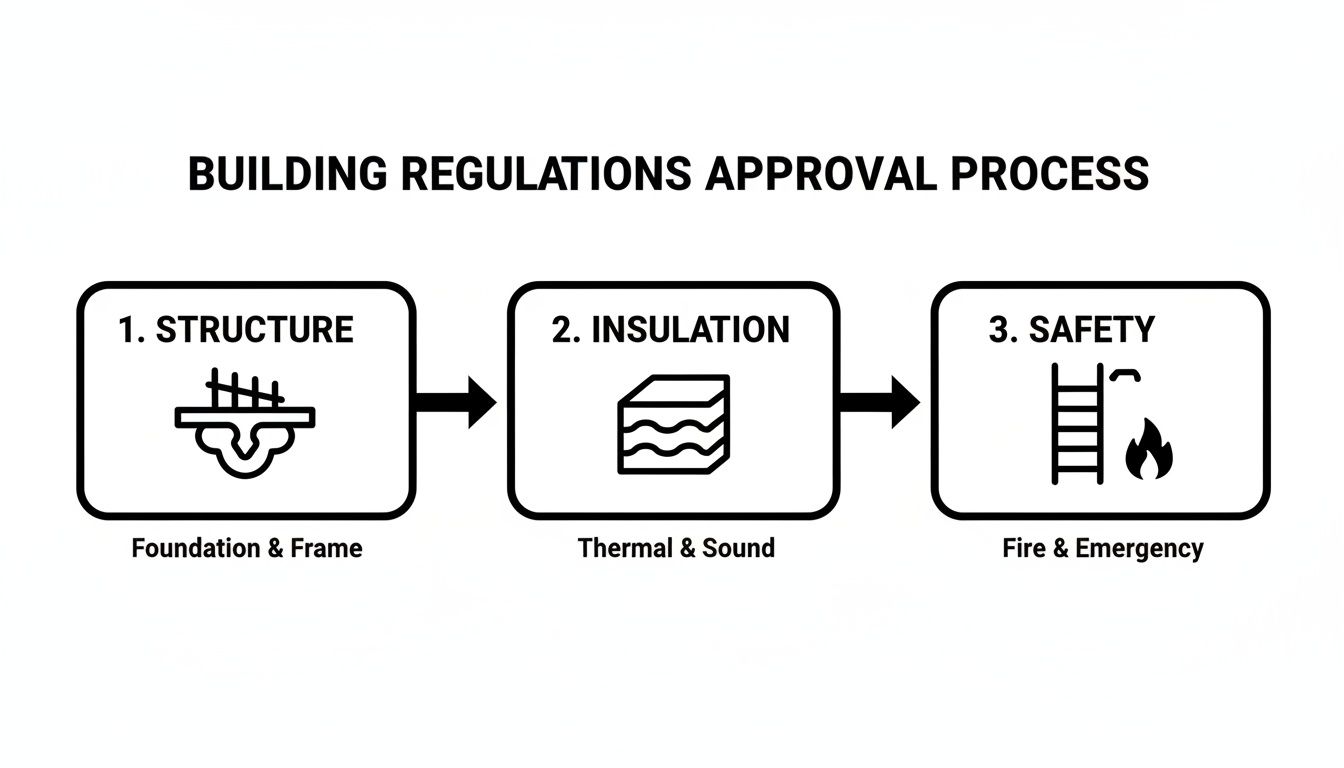
As you can see, compliance isn’t a one-off check. It’s a series of crucial inspections at key moments during the construction.
Key Milestones And Site Inspections
Whichever application route you take, a building control inspector will need to visit your site in Christchurch or Southampton at several critical stages. They need to see the work first-hand to sign it off.
These key inspection milestones typically include:
Foundations: The inspector has to see the trenches once they’re dug out—before any concrete is poured—to check the depth and make sure the ground conditions are suitable.
Drains: All the new drainage pipework needs to be inspected for the correct falls and connections before it gets covered over.
Structural Elements: They’ll check the installation of key components like steel beams, roof timbers, and any other load-bearing structures.
Completion: A final inspection takes place right at the end to confirm every part of the project is compliant and finished correctly.
Once you’ve passed that final inspection, you’ll be issued a Completion Certificate. This is an incredibly important legal document. It’s your official proof that the extension was built in line with the regulations, and you absolutely cannot sell your house in the future without it.
Understanding The Associated Costs
Don’t forget to budget for the building control process itself. All single-storey extensions have to go through it, and there are fees to pay. The costs can vary depending on your local authority, but you can generally expect to pay between £150 and £400 for the initial application.
On top of that, there are charges for the site inspections. All in, the total cost for regulatory oversight can land anywhere between £500 and £1,500. As you map out your finances, it’s a good idea to get a clear picture of the build costs too. You can learn more with our guide to getting a full renovation estimate.
These fees are completely separate from any planning permission costs and are non-negotiable. Whether your project is in Ringwood or Highcliffe, this oversight is what guarantees your extension is legal, safe, and built to last.
Here at Hallmoore, our in-house services can handle this entire process for you. From submitting the right application to scheduling every site visit, we make sure you get full, stress-free compliance.
Common Pitfalls and How Our Team Can Help
Navigating the world of single storey extension building regulations can feel like a minefield. While the rules are there to keep your project safe and sound, a few common missteps can easily lead to costly delays, stressful disputes with your neighbours, and even the council demanding you pull work down.
Knowing these pitfalls is your best defence.
So many homeowners, buzzing with excitement, make the critical error of starting construction before they have formal building control approval. It's a huge gamble. Without an inspector signing off on crucial stages like the foundations, any work you've already done might have to be ripped out at your own expense if it doesn't meet the standard.
Another frequent oversight is the Party Wall Act. If your extension involves building on or near the boundary line you share with a neighbour, you are legally required to serve them a formal notice. Forgetting this can lead to legal wrangles that stop your project in its tracks for months and poison relationships for years. Our in-house services make sure this detail is handled correctly right from the start.
Avoiding Costly Material and Design Mistakes
Choosing the wrong materials is a subtle but seriously expensive mistake. Specifying insulation that doesn't hit the required thermal efficiency targets (Part L), or using structural timbers that aren't correctly graded, often means failing an inspection. This forces you to replace materials you’ve already paid for and installed, hammering both your budget and your timeline.
In the same way, poor design choices can have real regulatory consequences. An open-plan layout that accidentally compromises a fire escape route, for example, will fall foul of Part B (Fire Safety). Fixing it might mean redesigning the space or adding costly extras like fire doors or a sprinkler system—all of which could have been avoided with an expert eye on the plans from day one.
The true value of professional oversight isn't just in managing the process, but in spotting and preventing these common, costly mistakes before they ever happen. A seamless, compliant build is the result of careful, expert planning from the get-go.
For homeowners across Bournemouth and Poole, having an experienced team manage these details is the surest way to sidestep the stress and unforeseen costs that can derail a project.
How Our In-House Services Provide a Solution
This is where the Hallmoore team offers a clear advantage. We act as your single point of contact, managing every single technical aspect of your extension under one roof. Our in-house services are designed to give you a seamless, fully managed experience, getting rid of the headache of trying to coordinate multiple contractors and consultants.
Our process covers everything:
Structural Calculations: Our in-house services handle all the complex engineering sums needed to satisfy Part A of the building regulations, ensuring your extension is structurally rock-solid.
Application Management: Our team prepares and submits your building control application for you, whether that’s a Full Plans submission or a Building Notice, ensuring all the paperwork is spot on.
Inspector Coordination: We liaise directly with building control inspectors in Christchurch and the surrounding areas, scheduling all the necessary site visits and managing communications on your behalf.
Compliance Assurance: From preventing damp issues to ensuring correct ventilation, our in-house services guarantee every element meets the strict technical standards. For more information on protecting your new structure, you can explore our detailed guide on professional damp proofing solutions.
By entrusting your project to us, you aren't just hiring builders; you are partnering with a team dedicated to a smooth, efficient, and fully compliant build. We see to every detail, allowing you to focus on the exciting prospect of your new living space. For a stress-free extension in the Southampton or Ringwood area, our integrated approach is the key to success.
Your Essential Project Checklist for a Compliant Extension in Highcliffe
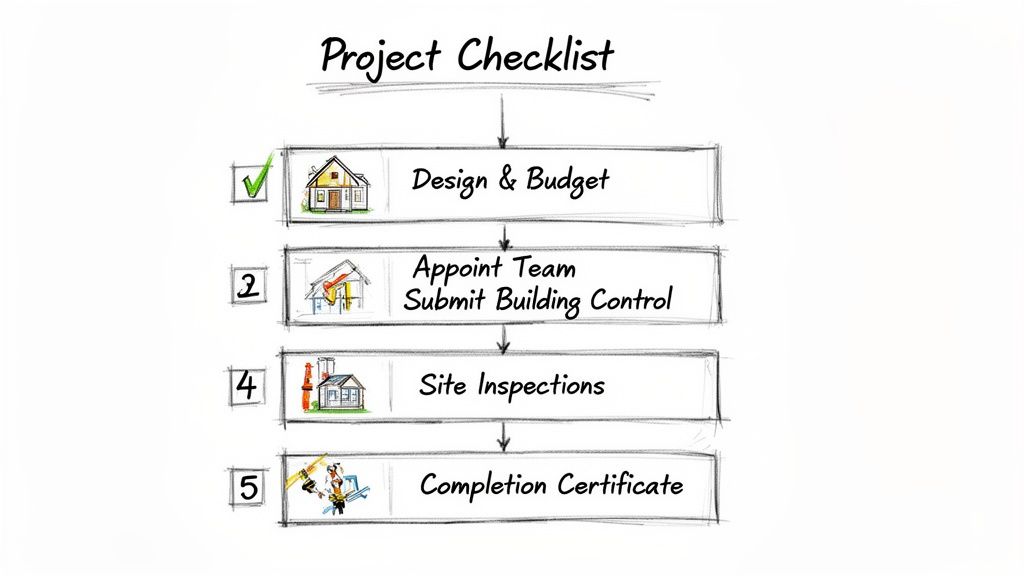
Let's pull all of that information together into an actionable roadmap. Think of this checklist as your step-by-step guide to navigating the single storey extension building regulations maze, giving you the confidence to get your project in Bournemouth or Christchurch off the ground.
Keep this handy, from that first back-of-an-envelope sketch right through to the final sign-off.
Pre-Construction Phase
Initial Design and Budgeting: Start by sketching out your ideas and, crucially, setting a realistic budget. As a ballpark, recent UK guides show build costs for a single-storey extension can fall anywhere between £65,000–£102,000. The per-square-metre rate hovers around £2,350–£2,600, but remember that regional costs vary, so always factor that in. You can learn more about how extension costs are calculated in the UK.
Appoint Your Professional Team: Now it's time to choose your architect, structural engineer, and builder. At Hallmoore, our in-house services can handle every aspect, which massively simplifies the process for homeowners in Poole and the surrounding areas.
Determine Your Approval Route: You need to confirm if your project falls under Permitted Development rights or if it requires a Full Planning Application. This single decision will dictate all your next steps with the local council.
Approvals and Legal Formalities
Submit Building Control Application: You'll need to prepare and submit either a 'Full Plans' application or a 'Building Notice' to your local authority or an Approved Inspector. This is a non-negotiable step that ensures your build is compliant and safe.
Handle Party Wall Notices: If any part of your work affects a shared wall or boundary line, you are legally required to notify your neighbours under the Party Wall Act 1996. This needs to be done well in advance of any work starting on site.
Following these steps chronologically is your best defence against project delays. Getting all the legal and regulatory groundwork sorted before a single shovel hits the ground will save you a world of time, stress, and money down the line.
Construction and Completion
Schedule Site Inspections: It's your builder's responsibility to arrange for a building control inspector to visit the site at key moments. These critical stages include checking foundations before the concrete is poured and inspecting drainage once it's installed.
Secure Your Completion Certificate: Once the dust settles and all the work has passed its final inspection, you’ll be issued a Completion Certificate. This document is the essential legal proof that your new extension in Southampton or Ringwood meets all single storey extension building regulations.
When you're ready to take that first step, get in touch with our experts at Hallmoore. Our in-house services manage the entire process, from initial plans right through to the final touches, like getting you an accurate plastering quotation.
Got Questions About Building Regulations? We've Got Answers.
We get it. The world of building regulations can feel like a maze of technical jargon. To help clear things up, here are some straight answers to the questions we hear most often from homeowners planning a single-storey extension in areas like Highcliffe and Bournemouth.
Do I Need Building Regulations Approval For A Small Conservatory?
More often than not, yes. There’s a common myth that all small conservatories are exempt, but this only applies under very specific, old-school conditions (like being under 30m² and separated from the house by external-quality doors).
Most people today want a proper, year-round living space that flows from their home, not a glorified greenhouse. For that kind of extension, you absolutely need full building regulations approval. This is a good thing—it’s your guarantee that the space is safe, warm, and built to last. Our in-house services can quickly tell you what's needed for your project, whether you're in Southampton or Christchurch.
What Happens If I Ignore The Building Regulations?
Cutting this corner is one of the biggest mistakes you can make. The local council has the power to issue an enforcement notice, forcing you to alter or even demolish the entire extension at your own expense.
Even worse, you will never receive a completion certificate. This piece of paper is non-negotiable when you come to sell your house. No certificate, no sale. Most solicitors will advise their clients to walk away, leaving you with a property that's not only devalued but practically unsellable.
How Long Is A Completion Certificate Valid For?
Forever. A building regulations completion certificate never expires. It's a permanent legal document tied to your property, proving the work was compliant with the standards in place at the time of construction.
Think of it as part of your property’s official history. You’ll want to file it away safely with your deeds, as you'll definitely need it for any future sale of your home in Poole.
A completion certificate is the official seal of approval that your extension is safe and legally sound. Without it, you're not just risking a run-in with the council; you're creating a massive legal and financial headache for yourself down the line.
Should I Use The Council or A Private Inspector?
You've got two options here: the council’s own Local Authority Building Control (LABC) or a government-approved private inspector. Both are fully qualified to check the work and issue that all-important final certificate.
Sometimes, a private inspector can offer a bit more flexibility with scheduling site visits. At Hallmooore, our in-house services mean we work with both routes all the time. We can advise which is the best fit for your project in the Ringwood area and then manage the entire process for you, from start to finish.
Navigating the rules shouldn't be a headache. The expert team at Hallmoore handles every last detail with our in-house services, ensuring your extension isn't just beautiful, but also fully compliant and built to the highest possible standards. Stop worrying about the paperwork and start picturing your dream space. Get in touch with us today!
Comments