.png)
How to Prevent Frozen Pipes in Your Home in Bournemouth, Southampton, and Christchurch
- Dan Hall
- Jan 6
- 13 min read

When the first proper cold snap hits Bournemouth and Christchurch, the last thing any homeowner wants is a burst pipe. But it’s a real risk. A frozen pipe isn't just a hassle; it can cause catastrophic water damage, mess with your home's structure, and land you with an eye-watering repair bill. This isn't just about a few tips—it's a practical, real-world plan to protect your property.
Simple, proactive steps are your best defence against the chaos and cost a burst pipe can cause. Our in-house service's are here to help see to your needs and keep your home safe.
Your Guide To Preventing Frozen Pipes This Winter in Poole
The statistics paint a pretty stark picture. Last winter, insurance claims for burst pipes in the UK shot up by a staggering 75%. A big reason for this was people turning their heating off completely to try and manage soaring energy costs. Research from Zurich Insurance pinpointed a huge spike during the December 2022 'deep freeze', where the average repair cost ballooned by nearly £4,000 in just one year. It's a sobering reminder of the financial hit you can take.
Why You Can't Afford To Wait
Getting ahead of the first frost is absolutely key. It’s about being proactive rather than reactive. Too many homeowners in Highcliffe and Poole only worry about their plumbing when water is already pouring through the ceiling. A bit of preparation now can save you a world of stress and expense later.
So, where should you focus your efforts?
Smart Temperature Management: Keeping a stable, low-level heat on is far more effective—and often cheaper in the long run—than footing the bill for a burst pipe.
Finding the Danger Zones: You need to know which pipes are most at risk. Think about unheated spaces like lofts, garages, or those running along exposed outside walls. This is your starting point.
Getting the Insulation Right: Wrapping up your exposed pipework with the right materials creates a vital thermal barrier. It’s a simple job that makes a massive difference.
Moving beyond just reacting to emergencies is what we're all about. To get a deeper understanding, it’s worth exploring some reliable proactive strategies for preventative maintenance in plumbing service. These are the steps that help you avoid making that panicked emergency call in the first place.
Of course, if you do find yourself in a tricky spot or just want a professional to get you winter-ready, our in-house service's are always on hand with a full range of expert plumbing services to keep your home safe.
Pinpointing and Insulating Your Most Vulnerable Pipes in Highcliffe
Preventing frozen pipes isn’t about guesswork; it’s about being strategic. Before you can protect your plumbing, you first need to identify the high-risk zones in your home, especially if you're in an older property around Ringwood or Southampton that might not have today's standard of insulation.
Let's be clear: not all pipes are created equal when it comes to freezing risk. Your job is to find the ones most exposed to the bitter cold.
Identifying Your Plumbing Hotspots
Time to do a little detective work. Grab a torch and start a thorough inspection of your property, paying close attention to any unheated or poorly insulated areas. These are the places where pipes are most likely to freeze solid when the temperature plummets.
Focus your search on these key areas:
Lofts and Attics: Pipes running through the loft are a classic weak spot. They're often surrounded by nothing but cold air, making a poorly insulated loft a massive risk factor.
Garages and Cellars: Since these spaces are usually unheated, any water pipes passing through them are completely exposed to sub-zero conditions.
External Walls: Be wary of pipes located within or running alongside your outside walls. The north-facing ones are particularly vulnerable as they get almost no warmth from the house.
Outdoor Taps and Garden Hoses: An uninsulated outdoor tap is a common entry point for frost. That frost can easily travel back into the connecting pipework inside your home, causing chaos.
A bit of prevention goes a long way. According to Direct Line Home Insurance, a staggering 2,650 domestic pipes burst across the UK every year, leading to nearly £50 million in damages. The peak season for this disaster is, unsurprisingly, January and February, accounting for a chilling 23% of all claims.
The best approach is a simple one: assess your home for risks, insulate the vulnerable spots, and keep the heat circulating.
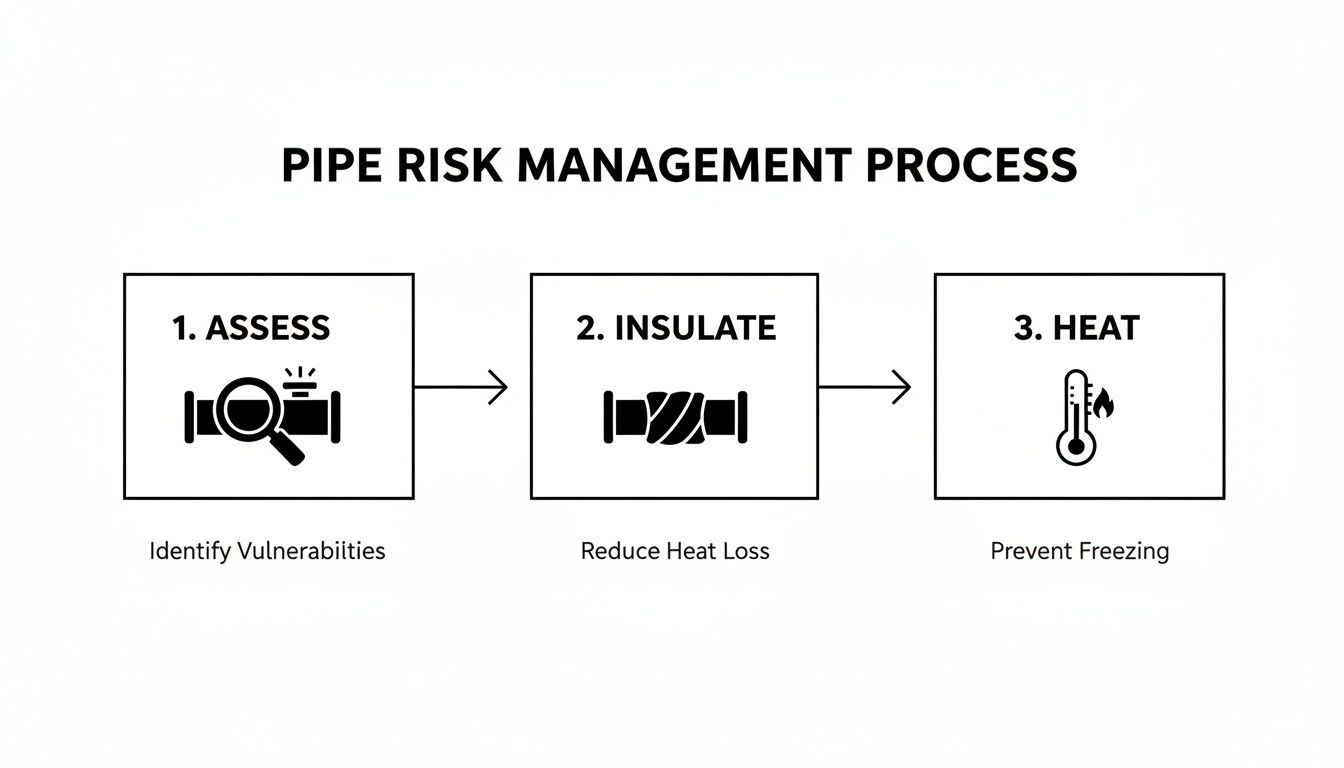
Stick to this methodical "assess, insulate, and heat" strategy, and you'll give your plumbing the best possible defence against the winter cold.
Vulnerable Pipe Hotspot Checklist
Use this checklist to identify and prioritize the pipes that need immediate attention and insulation before the cold sets in.
Location | Common Risk Factor | Recommended Action |
|---|---|---|
Loft/Attic | Exposed to cold air; poor loft insulation. | Lag all pipes with 25mm foam; ask our service's about professional insulation top-up. |
Garage | Unheated space; pipes run along cold walls. | Lag all visible pipes; ensure garage door is well-sealed to block drafts. |
Under Sinks | Located in cold cupboards against external walls. | Keep cupboard doors ajar during extreme cold to allow warm air circulation. |
Outdoor Tap | Directly exposed to freezing temperatures. | Fit an insulated tap cover; disconnect and drain garden hoses. |
Crawlspace/Cellar | Unheated and often damp, increasing cold transfer. | Lag pipes thoroughly and check for any drafts or air leaks to seal. |
This quick audit will give you a clear action plan, helping you focus your efforts where they'll make the most difference.
The Power of Proper Insulation
Once you’ve hunted down your vulnerable pipes, it’s time to get them wrapped up. This process, known as pipe lagging, simply involves covering them in a protective thermal sleeve. It's easily one of the most cost-effective preventative measures you can take.
For the best protection, grab some foam pipe lagging with a wall thickness of at least 25mm. It’s absolutely crucial to cover every single inch of exposed pipe, paying special attention to the bends and joints. Use duct tape or cable ties to secure the lagging tightly—you don't want any gaps where cold air can sneak in.
If you have a lot of pipework in your attic, making sure the entire space is well-insulated is a game-changer. Beyond just lagging pipes, investing in professional loft boarding from our in-house service's can seriously boost thermal efficiency and makes it much easier to get in there for future checks.
And don't forget that outdoor tap! You can pick up specially designed insulated tap covers for next to nothing. They're easy to fit and create an essential barrier against frost. Just make sure you’ve disconnected and drained any garden hoses before you put it on.
By taking these straightforward steps in your Christchurch or Poole home, you dramatically cut the risk of a messy and expensive plumbing emergency. And if you need a hand, our in-house service's are always ready to help.
Using Smart Heating Strategies to Protect Your Plumbing in Southampton
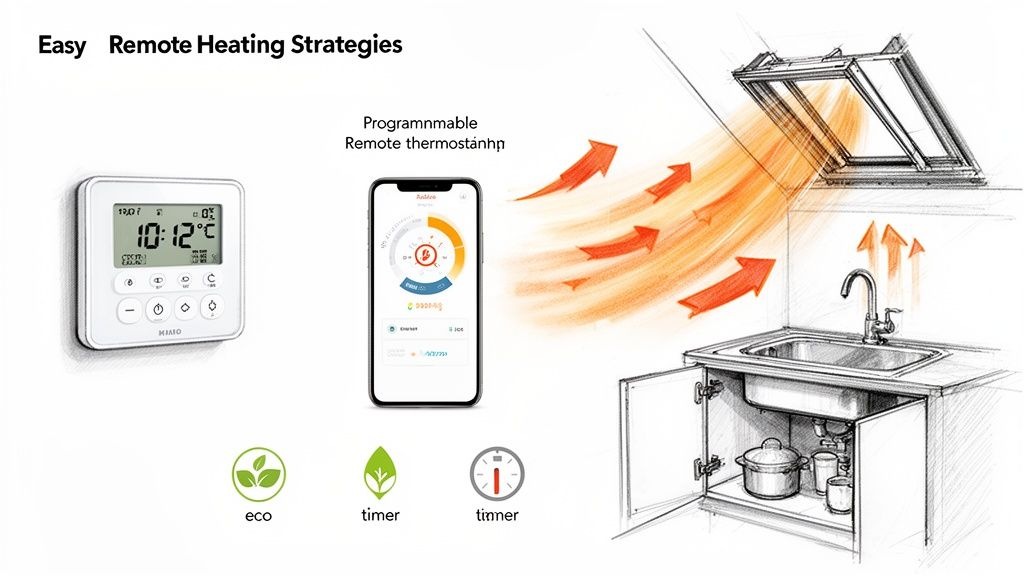
A consistent, low-level heat source is your plumbing’s best friend during the bitter winter months. One of the costliest mistakes we see homeowners in Poole and Christchurch make is turning the heating completely off when they go to work or on holiday. It seems like a smart way to save money, but it creates the perfect storm for frozen and burst pipes.
Instead of a complete shutdown, the smarter play is to maintain a constant background temperature. Keeping your thermostat set to a minimum of 10-12°C ensures the air inside your home never gets cold enough for the water in your pipes to freeze solid. Honestly, this simple habit costs far less than cleaning up the catastrophic mess a burst pipe leaves behind.
Strategic Warmth for At-Risk Areas
Circulating warmth isn't just about keeping your living room cosy; it's about getting that heat into the forgotten corners where pipework hides. Your most vulnerable pipes are often tucked away out of sight, completely missing out on the warmth circulating through your home.
Here’s a simple but incredibly effective tip our Gas Safe registered engineers often share with clients: open the doors to under-sink cabinets in kitchens and bathrooms. Likewise, cracking open the loft hatch allows warmer air to rise from the house and protect any pipes running through the attic. This bit of passive air circulation can genuinely make all the difference during a severe cold snap in Southampton.
Keeping your home's heating system in top condition is essential for this strategy to work. An inefficient or faulty boiler won't provide the reliable, consistent heat needed to protect your pipes when temperatures plummet outside. Our in-house service's can see to this.
Modern Heating for Peace of Mind in Bournemouth
Technology now offers some fantastic tools for managing your home’s temperature without wasting energy. If you have a programmable thermostat, you can set it to cycle on for short periods throughout the day and night. This keeps warm water moving through the system periodically without having the heating on constantly.
Smart thermostats take this a huge step further, letting you monitor and control your heating from anywhere using your phone. If an unexpected cold front hits the Ringwood area while you're away, you can simply bump the temperature up for an hour or two. It gives you complete control and real peace of mind.
Of course, none of this works if the system itself is unreliable. A well-maintained boiler is not only more efficient but also far less likely to fail when you need it most. You can learn more about why regular checks are so important from our expert boiler service team, one of our key in-house service's.
What to Do When a Serious Cold Snap Hits in Ringwood
When the weather forecast for areas like Southampton or Bournemouth turns severe, it's time to be on high alert. This is your go-to action plan. A few immediate, temporary measures can be the difference between a calm winter evening and the absolute chaos of a burst pipe.
What you do right now could genuinely save you thousands in repair costs down the line.
Immediate Steps to Take in Christchurch
First things first, and this is non-negotiable: you must know where your main stopcock is. This is the big red button for your home's water supply. In an emergency, you need to shut it off in seconds to stop a flood in its tracks.
Don’t wait for a crisis to go hunting for it. It’s usually tucked away under the kitchen sink, in a downstairs loo, or where the main water pipe enters your home. Once you've found it, give the handle a gentle turn to make sure it isn’t seized solid. You’ll be glad you did.
The data backs this up. A recent study found that while 6% of Brits have had their homes damaged by frozen, burst pipes, a staggering 24% admit they haven't bothered with basic pipe insulation. Finding and checking your stopcock is a fundamental part of defending your home against the UK's wild winters. You can read more about these winter readiness findings from Aviva.
Relieve the Pressure with a Slow Drip in Poole
It sounds odd, I know, but letting a single tap drip can be a lifesaver for your plumbing during a deep freeze. Pick the tap that’s furthest from where the water comes into your house – think an upstairs bathroom or an ensuite – and let a tiny but constant trickle of cold water run from it.
This simple trick does two incredibly important things:
It keeps the water moving. Even that slight flow is often enough to prevent the water from freezing solid inside the pipe.
It acts as a safety valve. If a section of the pipe does start to freeze, the open tap gives the building pressure an escape route. That pressure is what causes pipes to burst, so this tiny drip can prevent a catastrophe.
Don't forget the basics we’ve already covered. Make sure vulnerable pipes are properly lagged, keep the heating on a low, constant background temperature, and open up the doors on cabinets under sinks. This lets the warmer air from the room circulate around the pipework. Every little bit helps.
If you hit an emergency or just feel out of your depth with any of this, don’t hesitate. Our in-house service's are on call 24/7 across the region for exactly these situations. If you need urgent help in Highcliffe or Ringwood, please contact our expert team immediately. We’ll get there fast, manage the situation safely, and stop any further damage.
How to Spot a Frozen Pipe and What to Do Next in Bournemouth
Even with the best preparation, the biting cold in Christchurch or Poole can sometimes get the upper hand. The result? A frozen pipe. The real trick is catching it early, long before a simple freeze escalates into a catastrophic burst pipe situation.
Knowing the tell-tale signs is your first line of defence. The most obvious clue is turning on a tap and getting nothing but a pathetic trickle, or maybe no water at all. You might also notice strange gurgling or clanking sounds coming from your plumbing as water tries and fails to push past an ice blockage. In some cases, you can even see a layer of frost or condensation on an exposed pipe in a garage or loft.
Safely Thawing a Frozen Pipe in Southampton
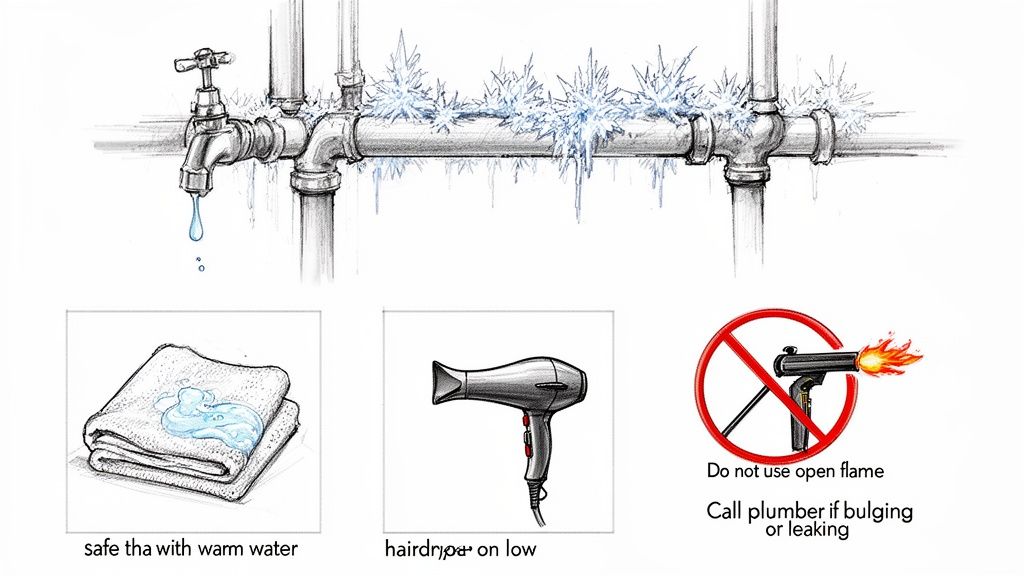
If you’ve caught it early and the pipe hasn't burst, you might be able to thaw it out yourself. First things first: open the tap connected to the frozen pipe. This is a crucial step because it gives the melting ice and any resulting steam an escape route, relieving the immense pressure building up inside.
Next, you need to apply gentle, consistent heat to the frozen section. I can't stress this enough: never, ever use a blowtorch or any open flame. The sudden, intense heat can cause the pipe to crack instantly or, even worse, start a fire. It's just not worth the risk.
Here are a few safe methods our in-house service's stand by:
Hairdryer: Set it to its lowest heat and move it back and forth along the frozen area. Don’t just hold it in one spot.
Warm Towels: Soak some towels in warm water (not boiling!), wring them out, and wrap them snugly around the pipe.
Electric Heating Pad: These can also work a treat, but they should never be left unattended for safety reasons.
Keep applying gentle heat until you see the water flow from the open tap return to normal.
When to Stop and Call Our In-House Service
Look, DIY thawing has its limits. Knowing when to put the tools down and call a professional is vital for your safety and your home’s integrity. If a pipe does burst, the consequences can be devastating. For a deeper understanding of the potential damage, you can check out guides like Water Damage Explained Part 1.
It's time to stop what you're doing and call our 24/7 in-house service immediately if you notice any of these signs. Trying to fix these issues yourself can quickly lead to severe water damage or personal injury.
Pick up the phone right away if you spot any of the following:
You can see a bulge or crack in the pipe. This is a massive red flag that it's under extreme pressure and about to fail.
The pipe has already burst and is actively leaking water.
You can't locate or safely access the frozen pipe.
The frozen section is anywhere near your boiler or another gas appliance.
In these scenarios, don't take any chances. Our in-house service's are ready to go across Highcliffe, Ringwood, and the surrounding areas to handle the emergency safely and effectively.
When to Call Our Professional Plumbers for Help
While sorting out insulation and keeping an eye on the weather is something most homeowners can manage, there are definite moments when you need to put the tools down and call for backup. Knowing when to hand a problem over to an expert is just as crucial as the prevention itself. A DIY attempt on a serious plumbing issue can quickly escalate from a manageable problem into a full-blown catastrophe.
Some situations are simply too risky to tackle alone. If you spot any of the following signs, your next call should be to our in-house team. Our Gas Safe registered engineers are fully equipped to handle these emergencies safely and efficiently across Highcliffe, Bournemouth, and Southampton.
When to Call Our Emergency Service in Christchurch
Certain scenarios demand immediate, professional intervention. This isn't just about fixing a pipe; it's about preventing severe water damage and ensuring your family's safety.
Give us a call straight away if you encounter any of these:
A Bulging or Cracked Pipe: This is the most urgent warning sign of them all. It means the pipe is under immense pressure from the ice blockage and is seconds away from bursting. Don't apply any more heat or try to fix it yourself; call our in-house service's immediately.
Complete Loss of Water: If taps all over the house have run dry, the freeze could be much closer to your main supply line. This is a far more complex problem to locate and resolve safely without professional gear.
The Pipe is Near Gas Appliances: If the frozen pipe is anywhere near your boiler, water heater, or any other gas appliance, this is strictly a job for a Gas Safe registered professional. Mixing a potential water leak with gas systems is incredibly dangerous.
You Can't Find the Frozen Section: Sometimes the ice blockage is hidden away inside a wall or under the floorboards. Trying to find it yourself can mean causing a lot of unnecessary damage to your property. Our in-house service's have thermal imaging and other tools to pinpoint the problem with minimal disruption.
Trusting a professional in these high-stakes situations isn't just about getting the job done right; it's about protecting your property in Poole and Ringwood from thousands of pounds in potential damages. Our experienced in-house team can assess the entire system, not just the immediate issue.
Don’t risk your property’s safety. Our in-house service's offer a comprehensive 24/7 emergency plumbing service to safely thaw pipes, carry out durable repairs, and give you solid advice on how to prevent it from ever happening again.
Your Frozen Pipe Questions Answered
We get a lot of the same questions from homeowners across Bournemouth, Christchurch, and Ringwood when the temperature starts to drop. Here are some straightforward answers to help you protect your pipes and avoid the stress and expense of a winter plumbing disaster.
Is It Really Worth Leaving My Heating On Low All Winter?
Absolutely. While you'll notice a small increase in your energy usage, keeping the heating on a low background temperature of around 10-12°C is a tiny price to pay compared to the thousands of pounds in water damage a burst pipe can cause.
Think of it as a very affordable insurance policy. A simple programmable thermostat makes it easy to manage this, ensuring your pipes are protected without cranking the heat up unnecessarily. Our in-house service's can advise on the best smart thermostat for your home.
Will My Home Insurance Actually Cover a Burst Pipe?
Most standard home insurance policies do cover damage from an 'escape of water', which is the technical term for a burst pipe. However, there's often a catch in the small print. Insurers expect you to have taken reasonable precautions, like not turning your heating off completely when you go away in winter.
It's absolutely crucial to dig out your policy documents and check the specifics. Don't just assume you're covered; know exactly what your obligations are before you need to make a claim.
Can Pipes Inside My Walls Freeze? I Thought They Were Safe.
Yes, they certainly can, and it's a common blind spot for many homeowners. Pipes running through poorly insulated external walls or next to unheated spaces (like a garage attached to your Southampton home) are prime candidates for freezing. This risk skyrockets during a prolonged, bitter cold snap.
Here's a simple but surprisingly effective trick: open the cabinet doors under your kitchen and bathroom sinks. This lets the warmer air from the room circulate around the pipework, giving those hidden pipes some much-needed protection. If you are concerned, our in-house service's can see to an inspection.
When you need a professional you can trust for everything from routine maintenance to a 24/7 emergency, Hallmoore developments has you covered. Our in-house, Gas Safe registered plumbers are ready to help protect your home. For expert service in Highcliffe, Poole, and beyond, visit us at https://www.hallmoore.co.uk.
Comments