.png)
What Is Underpinning in Construction?
- Dan Hall
- Nov 26, 2025
- 14 min read
Underpinning is a word you might hear when people talk about serious structural work on a house. Put simply, it’s the process of strengthening, repairing, or deepening the foundation of an existing building. It’s a permanent solution brought in when a property’s original foundation can no longer safely support the structure sitting on top of it. Our in-house service can see to any foundation issues you might have.
What Is Underpinning? A Practical Guide
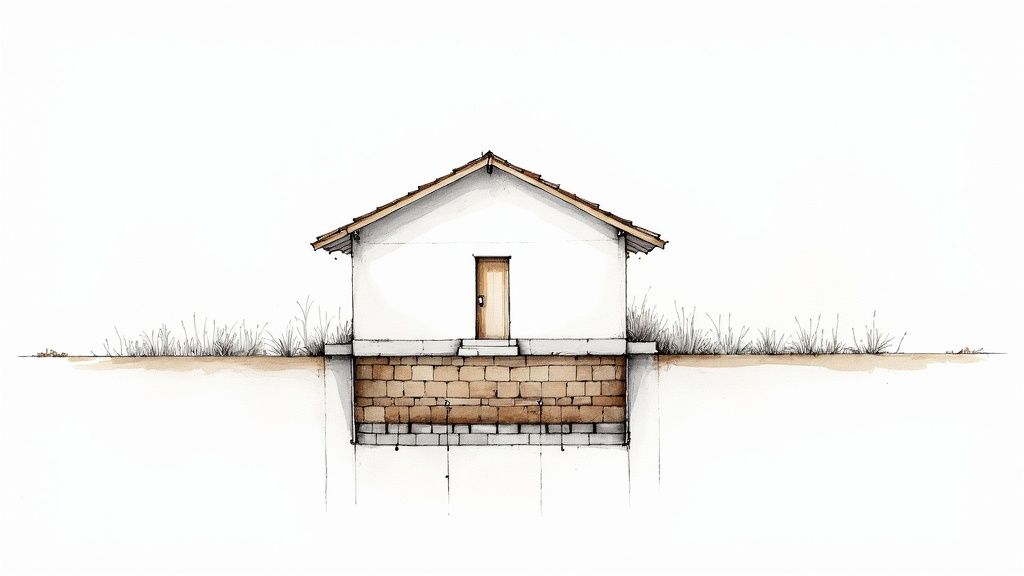
Before we get bogged down in the technical details, let's get a clear picture of what underpinning really is. Think of it as giving your home’s foundation a stronger, more reliable base to stand on. It’s a bit like giving an old, leaning tree a deeper, more robust root system to keep it stable and secure against the elements. Our in-house services are designed to provide this stability for your property.
While the term might sound a bit intimidating, underpinning is a well-established and proven solution for common structural problems affecting properties all across the UK. It becomes essential when the ground beneath your home can’t support its weight anymore, leading to issues that will only get worse if left ignored.
To help you get a quick handle on the basics, here’s a simple breakdown of the core concepts.
Underpinning Fundamentals at a Glance
Concept | Brief Explanation | Why It Matters |
|---|---|---|
Purpose | To reinforce or deepen a building's existing foundation. | It provides a permanent fix for structural instability, preventing further damage. |
Common Triggers | Subsidence, adding a new storey, or original foundation faults. | Identifying the cause is crucial for choosing the right underpinning method. |
Primary Benefit | Restores structural integrity and secures the property's value. | A stable foundation is non-negotiable for a safe and sound home. |
This table should give you a solid starting point for understanding when and why this kind of work is so important.
Why Would a Homeowner Need Underpinning?
There are a few key reasons why a homeowner in places like Highcliffe, Bournemouth, or Southampton might need to look into this kind of foundation work. Our team is often called out to investigate concerns related to these common culprits, and our in-house service can see to the entire process.
Subsidence and Settlement: This is when the ground under the foundation begins to sink or shift. It can be caused by anything from the type of soil (like clay), water damage from leaking drains, or even the roots of large trees nearby.
Increased Structural Load: If you’re planning on adding a significant extension or another storey to your home, you’re adding a lot of extra weight. The original foundation might not have been designed to handle that kind of load.
Original Foundation Flaws: Let’s be honest, sometimes the original construction wasn't up to scratch. Over many decades, the materials used can degrade, or it might just have been poorly built from the start, meaning it needs reinforcing.
The need for foundation repair is more common than you might think. In fact, around £1.4 billion is spent every year in the UK on foundation repair and ground stabilisation, which includes underpinning projects. This huge figure really highlights how vital it is to maintain the structural integrity of both older and newer properties.
When thinking about your home's stability, it’s also worth considering broader residential concrete and masonary repair services, as these can often be linked to foundation health.
Key Signs Your Poole Property Needs Underpinning
Spotting foundation problems early can save you a world of stress and money down the line. While it's true that all houses settle a little over time, some signs point to something more serious going on beneath the surface – a problem that needs a professional eye. For homeowners in Poole and the surrounding areas, knowing what to look for is the first step toward protecting your biggest investment.
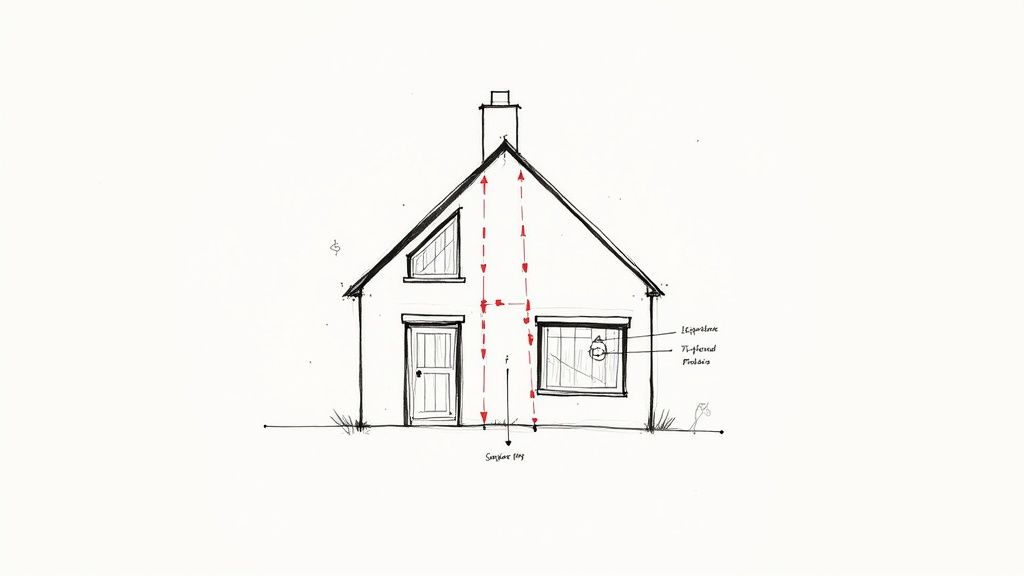
Often, the first clues appear inside your home. Think of these symptoms as your property's way of telling you that its foundations are struggling to keep everything stable. Our in-house service can see to a full investigation for you.
Telltale Cracks in Your Walls
One of the most obvious red flags is the appearance of large cracks in your walls, both inside and out. We’re not talking about those tiny hairline cracks that are usually just cosmetic. The ones to worry about are:
Diagonal Cracks: If you see jagged, step-like cracks spreading out from the corners of windows and doors, that's a classic sign of foundation movement.
Growing Cracks: Any crack that is wider than 5mm or seems to be getting longer or wider over time is a clear signal of an active structural issue.
External Brickwork Cracks: On the outside of your Ringwood home, look for zig-zag cracks running through the mortar lines. This suggests the brickwork is under enormous strain from subsidence.
These cracks form because one part of your foundation is sinking faster than another, literally pulling the structure of your house apart.
A critical mistake homeowners make is to simply fill and paint over these cracks. It hides the evidence, but it does absolutely nothing to fix the underlying cause. The structural damage will just keep getting worse, unseen. Our in-house service can see to the root cause.
Doors and Windows That Stick
Another clear warning sign is when your doors and windows suddenly start to stick or don't close properly anymore. You might notice a door that once swung freely now jams at the top, or a window becomes a real chore to open and close.
This happens because the foundation settlement has twisted the timber or uPVC frames out of shape. In more serious cases, you might even see doors swing open on their own, which means the whole floor is no longer level. It’s more than just a daily annoyance; it’s a direct symptom of a shifting foundation that needs looking at.
Sometimes, persistent dampness can also cause timber to swell and create similar issues. It’s always useful to understand the link between structural integrity and having effective damp proofing solutions for your home.
Uneven Floors and Gaps
If you can feel a definite slope in your floors or see gaps opening up between the wall and the floor or ceiling, that's a major red flag. You might also spot a visible gap forming outside between your house and the patio, pavement, or even an attached extension at your Christchurch property. This is a telltale sign that a part of your home is physically sinking or pulling away.
When you notice any of these signs, it's crucial not to ignore them. Our in-house service provides expert structural assessments across Bournemouth and Southampton to figure out if underpinning is the right solution. Getting in touch early can stop a manageable problem from turning into a major, costly repair.
Exploring Common Underpinning Methods
So, what exactly is underpinning in construction? It's crucial to understand there’s no single, off-the-shelf solution. Our in-house professionals select the right method based on your property’s specific needs, the ground conditions in your area, and what’s causing the foundation issue in the first place. Think of it like a doctor choosing the correct treatment—the diagnosis dictates the remedy. Our in-house service can see to this entire diagnostic process.
We’ll break down the core techniques our experts use, turning these technical processes into straightforward concepts. Getting to grips with these methods will help you feel more confident about the work being proposed for your home, whether you're in Bournemouth, Poole, or Ringwood.
Mass Concrete Underpinning
The most traditional and direct approach is mass concrete underpinning, sometimes called the pit method. Imagine our team carefully digging out small, manageable sections of earth from beneath your existing foundation in a precise sequence. Once a section is clear, it's filled with concrete to forge a solid new footing before we move methodically to the next.
It's essentially like building brand-new footings, block by block, extending your foundation deeper until it reaches more stable ground. This keyword friendly approach is highly effective for shallow foundations where solid soil isn't too far down. It's a reliable, time-tested technique that our teams in Highcliffe often use for older properties with less complex structural issues.
Beam and Base Underpinning
A more advanced technique is beam and base underpinning. This method involves creating a supportive concrete "bridge" beneath the original foundation. First, a reinforced concrete beam is constructed below the existing footing to span the problem area, spreading the building's weight more evenly.
This new beam is then supported by strategically placed concrete bases, which act like incredibly strong pillars. This approach is excellent for bridging over isolated weak spots in the ground or when dealing with localised subsidence. It provides a seriously robust and durable solution for properties in Southampton that might be affected by inconsistent soil types.
Mini-Piled Underpinning
For situations where the ground is particularly weak or unstable for a significant depth, mini-piled underpinning is the modern go-to solution. This technique is a bit like installing deep steel stilts to reach solid ground far below the surface. Our teams drill or drive slender steel piles deep into the earth until they hit a stable layer of soil or rock.
These piles are then connected to your home's foundation, effectively transferring the entire weight of your Christchurch property onto this much stronger, deeper ground. It’s the ideal choice for challenging sites, properties with restricted access, or when keeping disruption to an absolute minimum is a top priority for the homeowner.
These modern underpinning techniques have come a long way in recent decades. Innovations like mini-piling and beam and base systems allow for more efficient restoration with far less disruption. In many cases, these methods can save up to 20% compared to the costs of older, more disruptive traditional approaches. The UK's Construction Industry Training Board also notes a growing demand for these specialised skills, with a 4-5% yearly increase in training for underpinning professionals. You can find more details about UK construction trends in reports from the Office for National Statistics.
Choosing the right underpinning method isn't just about what works best for the ground—it's also about compliance. It's essential to ensure any structural work aligns with local building codes, especially if you're undertaking a project like an extension. You can learn more by reading our guide on UK building regulations for extensions explained. Our in-house service team can see to every detail, ensuring your project is safe, effective, and fully compliant.
Comparing Underpinning Methods Pros and Cons
Choosing the right technique can feel daunting, so we've put together a simple table to compare the three main methods at a glance. This should help you understand which approach might be best suited for different situations, considering factors like cost, disruption, and soil type.
Method | Best For | Advantages | Disadvantages |
|---|---|---|---|
Mass Concrete | Shallow foundations; stable soil is not too deep | Proven, reliable, and cost-effective for suitable sites. Uses simple materials and techniques. | Labour-intensive and can cause significant disruption. Not suitable for deep unstable ground. |
Beam and Base | Spanning weak spots; bridging over drains or services | Very strong and durable. Spreads the load over a wider area, reducing localised pressure. | Can be more complex and costly than mass concrete. Requires more specialised engineering. |
Mini-Piled | Deep unstable ground; restricted access sites | Minimal disruption and vibration. Can reach very deep stable ground. Fast installation. | Generally the most expensive option. Requires specialised equipment and geotechnical analysis. |
Ultimately, the best method will always be determined by a professional assessment of your specific property. A thorough site investigation is the only way to guarantee a safe, effective, and long-lasting solution, which our in-house service can see to.
The Underpinning Process From Start to Finish
Knowing what underpinning is helps, but understanding what the process actually looks like can take away a lot of the stress and uncertainty. To give you a clear roadmap, we’ve broken down a typical project from the first phone call right through to the final sign-off. We want you to feel confident and fully in the loop.
From start to finish, the entire job is managed with meticulous care, making sure homeowners in places like Bournemouth and Southampton are supported and updated every step of the way. Our in-house service can see to this for you.
Initial Structural Survey and Assessment
It all starts with a thorough structural survey. A qualified structural engineer will visit your property, whether it's in Christchurch or Poole, to get a proper look at the extent of the damage. They’re there to pinpoint the real cause of the problem—be it shifting soil, water damage, or simply an old foundation struggling under the load—and confirm if underpinning is the right fix.
This first step is absolutely crucial; it’s the foundation for the whole project. Think of it like a doctor’s diagnosis before prescribing treatment. Getting this right is everything.
Engineering Design and Planning
Once the problem is diagnosed, the next stage is to create a detailed engineering plan. The structural engineer will design the best underpinning solution for your specific home, choosing from methods like mass concrete, beam and base, or mini-piling.
This diagram gives you a simple visual of how these core methods work.
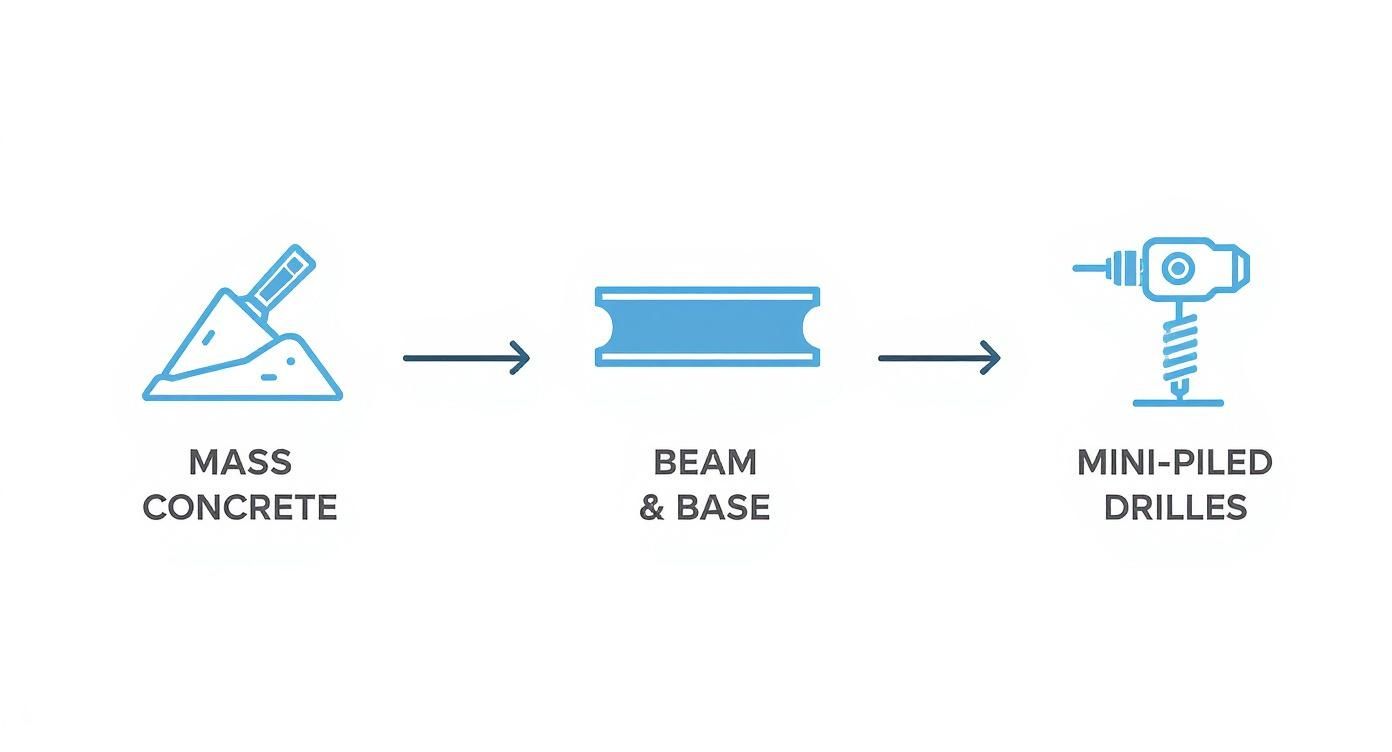
As you can see, each technique offers a different kind of support, from direct reinforcement right at the base to driving deep piles for serious stabilisation.
The final plan will include precise calculations, technical drawings, and a clear scope of the work involved. This is also when we handle any legal requirements. For example, the Party Wall Act 1996 formalised the rules for underpinning when the work might affect a neighbour's property. Its introduction reflects how vital this work has become in modern construction.
Our in-house team handles all the necessary planning permissions and building control approvals, making sure everything is fully compliant before a single shovel hits the ground. If you’re trying to get a handle on costs, you can always request a full renovation estimate to help with your budget.
Site Preparation and Excavation
With the green light on the plans, our skilled builders get your Highcliffe or Ringwood property ready for action. This means clearing the work area, putting up safety measures, and marking out exactly where to dig based on the engineer’s design.
Lasting underpinning relies on proper footings excavation—it’s the critical first move for any sound structural work. We carry out the digging carefully in controlled stages to keep your home stable throughout the entire process.
Communication is absolutely key during this phase. Our project managers make sure you’re kept fully informed about progress, timelines, and what’s happening on-site. We find that transparency builds trust and makes the whole project a much smoother experience for everyone.
Installation and Final Inspection
The final stage is putting the new foundation supports in place. Whether it’s pouring concrete for a mass concrete base or driving piles deep into the ground, our team works with precision and care. Once the new supports are installed and the concrete has cured, the building's weight is carefully transferred to its new, stronger foundation.
After the installation wraps up, a final inspection is carried out by both the structural engineer and the local authority's building control officer. They’ll check that the work meets all the required standards and then issue a certificate of compliance. That certificate is your guarantee of a job done right and gives you complete peace of mind. Our in-house service can see to all final checks.
How to Choose Underpinning Experts in Highcliffe
Choosing the right contractor for an underpinning project is probably the single most important decision you'll make. This isn't your standard building job; it's a highly specialised field where experience and precision are completely non-negotiable. Get this choice wrong, and you could face even worse structural damage and spiralling costs, turning a vital repair into an absolute nightmare.
When you start your search for experts in Highcliffe, Bournemouth, or Poole, you need a solid checklist to tell the true professionals from the rest. A trustworthy contractor won't just have the technical skills – they’ll give you the transparency and reassurance you need to feel confident throughout the entire process. Our in-house service can see to this for you.
Vetting Your Potential Contractor
Before you even think about committing to a company, it’s time to do your homework. A reputable firm will be more than happy to show you proof of their expertise and past work.
Here’s what you should always ask for:
Proven Experience: Ask to see a portfolio of similar underpinning jobs they’ve finished in your area, like in Christchurch or Southampton. This is crucial because it shows they know the local ground conditions and building types.
Correct Insurance: They absolutely must have Public Liability and Contractor's All Risks insurance that specifically covers underpinning. Standard builder's insurance often won't cut it for a high-risk job like this.
Client References: Don't just take their word for it. Speak to their previous clients to get a real sense of their experience. Ask about the team's professionalism, how they communicated, and the quality of the final result.
A detailed, transparent quote is the hallmark of a professional. Be very wary of any quote that comes in significantly lower than the others. This can be a huge red flag for cutting corners on materials, safety, or expertise. When your home's stability is on the line, the cheapest option is rarely the best one.
Why Local Expertise Matters
When it comes to understanding what underpinning is in construction, having a team with deep local knowledge is a massive advantage. At Hallmoore, our in-house service is built on years of hands-on experience across Highcliffe and the wider Dorset and Hampshire region. We manage every single detail, from the initial survey right through to the final sign-off, which means a seamless and reliable process for our clients.
Our commitment is to provide not just exceptional workmanship but complete peace of mind. We pride ourselves on clear communication, transparent practices, and a dedication to quality that protects your most valuable asset. For anyone planning projects nearby, our guide on finding builders in Christchurch offers more practical advice for your journey.
Your Underpinning Questions, Answered
Even after getting to grips with the basics, most homeowners we meet still have plenty of practical questions about the whole process. We’ve put together the most common queries our teams in Highcliffe, Bournemouth, and Southampton hear, with clear, straightforward answers to help you feel confident and informed.
How Long Does an Underpinning Project Typically Take?
There’s no one-size-fits-all answer here, as the timeline really depends on your property's size, the method we use, and just how serious the foundation issues are. A small, relatively simple job in Poole using the mass concrete method might take 2-4 weeks.
On the other hand, more complex projects, like one needing mini-piling for a larger building over in Ringwood, could stretch to 6-8 weeks or even longer. Things like tricky soil conditions, bad weather, or limited site access can also affect the schedule. When you work with us, our in-house service will give you a detailed project timeline right from the start as part of our initial assessment, so you know exactly what to expect.
Will I Have to Move Out of My House During Underpinning?
In most cases, no—you can stay right where you are while the work is being done. Modern techniques, especially mini-piling, are designed to keep disruption to your daily life to an absolute minimum.
That said, you should expect some noise and vibration, particularly when we’re excavating and during the main construction phase. For very large-scale projects, or if a whole new basement is being created, it might be more comfortable to find temporary accommodation. Your safety and comfort are our top priorities, and our in-house service team will always advise you on the best approach for your specific project in Christchurch.
Underpinning is a significant but worthwhile investment. From a safety perspective, advancements in underpinning have made a real impact. Statistics show that foundation failure-related incidents have decreased by 30% since the 1990s due to better practices and materials. While these projects often add 10-25% to a renovation budget, this reflects their technical importance in securing your property. You can explore more data on the UK construction market to understand these trends better.
Does Underpinning Add Value to a Property?
While underpinning is mainly a fix for a serious structural problem, it absolutely protects and can even increase your property’s value. Think about it from a buyer's perspective: a home with a history of subsidence that has been professionally underpinned is structurally sound. That makes it far more attractive to buyers and mortgage lenders than a house with lingering foundation problems.
It’s documented proof that the property has been properly looked after and stabilised for the long haul. Having a full report and a guarantee from a reputable company like ours is a huge asset when it comes time to sell, giving the next owner complete peace of mind. Our in-house service can see to providing all necessary documentation.
If you’ve spotted any of the warning signs of foundation trouble or just have more questions, don’t wait. The expert team at Hallmoore developments is here to offer professional assessments and reliable, long-lasting solutions. Our in-house service will look after your needs with genuine care and expertise. Contact us today to secure the foundation of your home for years to come.