.png)
Your Expert House Extension Specialist in Bournemouth & Highcliffe
- Dan Hall
- Nov 18, 2025
- 18 min read

Embarking on a house extension is one of the biggest investments you'll make in your home, and let's be honest, the most critical decision you'll face is choosing the right house extension specialist. This single choice dictates everything—the budget, the build quality, and whether the whole process is a smooth ride or a constant headache. Finding a reliable partner you can genuinely trust is the absolute foundation of a successful project, which is why our in-house services are designed to see to your every need.
Finding Your Ideal House Extension Specialist in Bournemouth

Transforming your home should be an exciting journey, but the reality for many homeowners is a mountain of stress. The thought of finding, vetting, and managing separate tradespeople—from architects and structural engineers to plumbers and electricians—can be completely overwhelming. Coordinating every single stage often turns into a full-time job, riddled with potential delays and unexpected costs.
This is where a true house extension specialist really proves their worth. Instead of you juggling a dozen different contractors, a full-service company like Hallmoore Developments acts as your single, accountable team managing every last detail. Our in-house services handle everything, ensuring a seamless experience from the first design sketch to the final coat of paint. It’s an approach designed to eliminate the frustrations homeowners typically face.
The Full-Service Advantage for Your Project
Opting for our all-in-one service offers clear benefits that protect both your investment and your peace of mind. Our in-house team is built to handle the entire scope of work, which means no more chasing different companies or dealing with communication breakdowns.
Here's what you can expect when you use our in-house services:
Unified Vision and Execution: Our designers, builders, and trades work together from day one. This ensures the architectural vision you fell in love with is executed flawlessly.
Simplified Communication: You get one dedicated point of contact. This cuts out all the confusion and guarantees you're always in the loop on your project's progress, whether you're in Highcliffe or Ringwood.
Budgetary Control: With all services under one roof, we provide a transparent, fully-detailed quote. This is key to preventing surprise costs and keeping the project firmly on budget.
Guaranteed Quality: Our team of skilled professionals, from Gas Safe registered engineers to time-served plasterers, upholds the highest standards of craftsmanship on every single job.
A genuine house extension specialist doesn't just build; they manage, coordinate, and take full responsibility for delivering your vision. Our in-house services offer this integrated approach, which is the key to a stress-free and successful home transformation.
Navigating Local Nuances in Poole and Christchurch
Every area has its own character and, more importantly, its own building regulations. From the unique demands of coastal properties in Poole to the protected conservation areas in Christchurch, local knowledge is non-negotiable. A local specialist who understands the ins and outs of Bournemouth and Southampton councils can navigate planning permission and building regulations expertly, saving you a world of time and hassle. Our deep experience in the region ensures your extension not only meets but exceeds all local standards.
For homeowners here, getting to grips with the local building landscape is crucial. To help, we've put together a practical guide on finding builders in Christchurch, which offers more specific local advice. When you choose Hallmoore, you’re partnering with a team that has a proven track record of delivering incredible extensions across Hampshire and Dorset. Our in-house services are here to guide you with confidence and expertise.
Understanding the Real Costs of a Home Extension
One of the first, and most important, conversations we have with clients is about the budget. Getting a realistic grip on the numbers from day one is the key to a successful project, turning what can feel like a moving target into a clear, manageable plan. The final figure is shaped by everything from the size of your dream space to the specific taps you choose, so let's break it down.
The biggest factor, as you'd expect, is the size of the extension. We always calculate costs on a per square metre basis, so a bigger footprint naturally means a larger investment. But it’s not always that simple. A two-storey extension, for example, often works out cheaper per square metre than a single-storey one. Why? Because you’re building one set of foundations and one roof to serve two floors, creating a clever economy of scale.
Breaking Down the Main Cost Drivers
Beyond the basic size, a few key decisions will really steer your budget. A good house extension specialist won’t just build your vision; they’ll guide you through these choices, explaining the financial impact of each one so there are no surprises.
Material Choices: This is where you can really make your mark, but it has a huge effect on the final price. High-end bifold doors, a bespoke kitchen, or premium engineered oak flooring will cost significantly more than standard, off-the-shelf options.
Structural Complexity: Is your design an ambitious open-plan space that needs complex steelwork to hold everything up? Or are the ground conditions in your area, like in parts of Ringwood or Christchurch, a bit tricky? These elements demand more labour and specialised materials, which will be reflected in the quote.
Local Labour Rates: The cost of skilled tradespeople varies from region to region. As a local builder, we have long-standing relationships with the best trades across Bournemouth and Poole, which helps us secure fair pricing without ever compromising on quality.
Budgeting for an extension isn't just about the main construction quote. It's about seeing the complete financial picture from day one—including all the professional fees and finishes—to ensure your project is a financial success from start to finish.
Uncovering the Hidden Expenses
It’s easy to focus on the builder's quote, but that's only part of the story. A good chunk of your budget—often around 10%—needs to be set aside for professional and administrative fees. These aren't optional extras; they're essential costs to make sure your extension is legal, safe, and built to last.
To give you a clearer idea, we’ve put together a table of the typical professional fees you'll need to account for.
Estimated Professional Fees for a Typical UK House Extension
Fee Type | Estimated Cost Range (UK Average) |
|---|---|
Architect & Design Fees | £4,500 – £6,500 |
Structural Engineer | £1,500 – £2,500 |
Planning Permission Application | ~£600 |
Building Regulations Approval | ~£1,200 |
Party Wall Agreements (per neighbour) | £1,500 – £3,000 |
Forgetting to factor these in can put a serious dent in your finances later on. That's why our in-house services are designed to prevent this. We provide a single, all-inclusive quote that covers everything, managing all the applications and consultations for you. It gives you total cost clarity right from the start.
You can dive deeper into these figures in our practical guide to UK house extension costs.
Budgeting with Confidence in Bournemouth and Southampton
Costs definitely vary across the UK. The latest 2025 figures show that the average cost for a house extension falls between £1,800 to £3,000 per square metre. Here in the South East, we tend to be at the higher end of that scale due to greater demand and labour costs. A crucial first step for many is learning how to determine your home's equity, as this is often used to fund the project.
In real terms, this means a typical single-storey extension can cost anywhere from £40,000 to over £56,000, and that’s before professional fees and high-spec finishes.
This is where working with a full-service extension specialist really pays off. At Hallmoore Developments, our in-house team of designers, project managers, and tradespeople work as one cohesive unit. Our established network of suppliers across Hampshire and Dorset means we can source top-quality materials at competitive prices, and we pass those savings directly on to you. With our in-house services, we provide a meticulously itemised quote so you know exactly where every pound is going. This transparent, organised approach stops the budget from spiralling and turns what could be a stressful financial puzzle into a clear, confident plan.
Your Vetting Checklist for Any Building Specialist in Christchurch
You've got a shortlist of potential builders. Great start. But the real work begins now, turning a promising website into a signed contract. This isn't just about ticking boxes; it’s about protecting your home, your finances, and making absolutely sure the final result matches the vision in your head.
A genuine house extension specialist won't just tolerate this level of scrutiny—they'll welcome it. They should be ready and willing to provide all the documents you need to feel confident. Let's break down the non-negotiable checks that separate the true professionals from the rest.
Verifying Essential Credentials and Qualifications
Before you even get into chatting about designs or costs, you need to confirm they have the right qualifications. Different parts of a house extension require specific, legally mandated certifications. This is all about safety and compliance.
Here are the absolute must-haves:
Gas Safe Registration: This is a legal requirement for anyone touching gas appliances—boilers, hobs, you name it. Don't just take their word for it. You can and should verify their registration number on the official Gas Safe Register website. At Hallmoore Developments, all our heating engineers are Gas Safe registered, so you know this critical work is done by the book.
NICEIC or NAPIT Certification: For anything electrical, your contractor must be certified by a recognised body like NICEIC or NAPIT. This is your proof they’re competent to work to UK safety standards (BS 7671) and can self-certify their work, which is vital for getting your project signed off by building regulations.
Trade Association Memberships: Keep an eye out for memberships with respected bodies like the Federation of Master Builders (FMB). While it’s not a legal must-have, it shows a builder is serious about maintaining high standards and adhering to a code of conduct.
A quick but crucial tip: Never just glance at a certificate. Ask for the registration numbers and check them yourself with the official governing bodies online. Any reputable specialist will have this information ready for you without any fuss.
The Non-Negotiable Topic of Insurance
Insurance is your financial safety net, plain and simple. If a builder says they have it, that's step one. Step two is asking for proof. Anyone working on your home must have the right insurance to cover accidents, damages, or injuries.
The main one you're looking for is Public Liability Insurance. This covers the cost if their work causes injury to someone (like a neighbour) or damage to property (like a shared wall). A minimum of £2 million in cover is standard, but for bigger projects, you'll want to see £5 million. Ask to see their current policy certificate and don't forget to check the expiry date.
The chart below gives you an idea of the investment you’re protecting, showing typical extension costs per square metre.
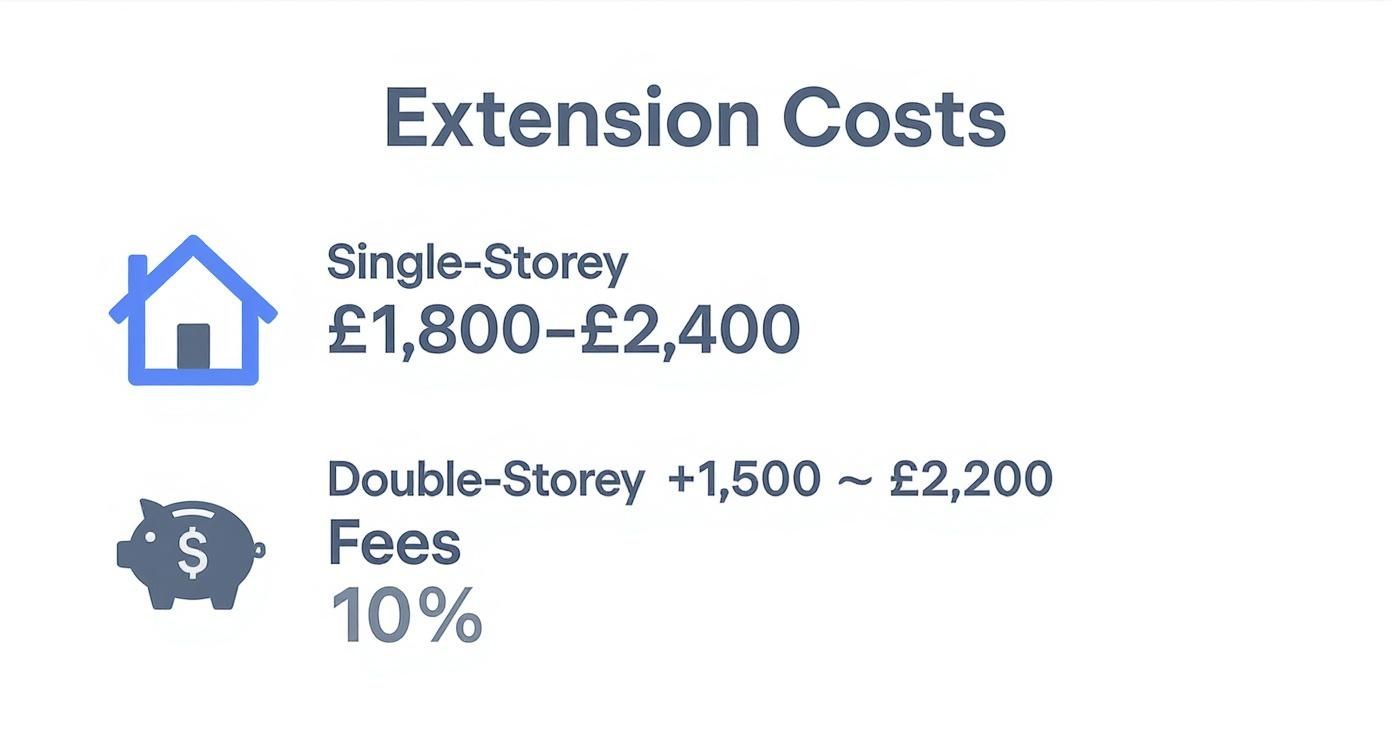
As you can see, even though a double-storey extension can offer better value per square metre, any extension is a huge financial commitment. It absolutely must be properly insured.
How to Check References Like a Pro
Speaking to past clients is probably the most valuable thing you can do. Don’t just accept a list of names. Ask for recent projects that are similar to yours in size and scope. And when you call them, dig deeper than just, "Were you happy?"
Try these targeted questions to get the real story:
Did the project finish on time and on budget? If it didn't, find out what caused the issues and, more importantly, how the builder handled the situation.
How was the communication during the build? Were they kept in the loop about progress and any problems that cropped up?
How tidy was the team on site? Did they clean up after themselves and try to minimise disruption to the family's life?
Have any snagging issues appeared since the work was finished? If so, how quick was the builder to come back and put things right?
Even better, ask if you can pop round to see a completed project in person. Nothing beats seeing the quality of the finishings with your own eyes—it’s something a photo can never truly capture. For a deeper dive, our guide on finding trusted builders in Hampshire has more local tips.
Red Flags to Watch Out For in Poole
While you’re doing your homework, certain things should set off alarm bells immediately. An experienced house extension specialist operates with professionalism and transparency right from the get-go.
Be very wary of any builder who:
Asks for a massive cash deposit upfront. A small, reasonable deposit to book you in is standard practice. A demand for a huge chunk of the total cost before work has even started is a major red flag.
Is vague about providing a written, itemised quote. A "back of an envelope" or verbal-only quote leaves you completely exposed financially.
Can't—or won't—provide verifiable references or proof of insurance. This is an immediate deal-breaker. No excuses.
Pressures you to sign on the dotted line quickly. A good builder is usually a busy builder. They'll understand you need time to weigh up your options.
As a full-service company working across Bournemouth, Southampton, and Ringwood, we put every single trade professional we partner with through this exact vetting process. It’s how we guarantee every part of your project meets our uncompromising standards for quality and safety. Our in-house services are designed to see to it that you avoid these pitfalls.
Navigating Poole Planning Permission and Building Regulations
The moment you hear "planning permission," it’s easy to feel a sense of dread. The process can seem like a maze of complex rules and endless paperwork, but getting to grips with the basics is much simpler than you might think. For a professional house extension specialist, this isn't a hurdle; it's a fundamental part of laying the project's foundation correctly.
It all starts with understanding the difference between two key approvals: Planning Permission and Building Regulations. They’re often confused, but they serve entirely different purposes.
Think of it this way: Planning Permission is about whether your extension is acceptable in principle. It looks at its size, appearance, and impact on your neighbours and the local area.
Building Regulations, on the other hand, are all about how your extension is constructed. They’re a set of technical standards covering everything from structural integrity and fire safety to drainage and energy efficiency. Even if your project doesn't need planning permission, it will almost certainly need to comply with building regulations.
Permitted Development vs. a Full Planning Application
The good news is that many smaller extensions can be built under what’s known as Permitted Development Rights. These are government-set rules that allow for certain types of home improvements without you needing to go through the full planning application process. For example, a modest single-storey rear extension that doesn’t jut out too far from the original house often falls into this category.
But these rights come with strict limitations. The rules are different for detached houses versus semi-detached or terraced homes. They can also be restricted or completely removed in specific locations.
A full planning application is typically needed for:
Extensions that are larger than the permitted development limits.
Projects on designated land, such as Conservation Areas, which are common in historic parts of Poole and Christchurch.
Any new structure that would sit forward of the main front wall facing a road.
Navigating these specific local rules is where an experienced house extension specialist becomes invaluable. Our in-house team at Hallmoore Developments has spent years working with councils across Bournemouth, Southampton, and Ringwood. We know the local policies inside and out, which means we get the right application submitted from the very start.
Why Building Regulations Are Non-Negotiable
While planning permission is about the "what" and "where," building regulations are about the "how." They ensure your new space is safe, healthy, and sustainable for everyone who uses it. A building control inspector will visit the site at key stages of construction to check that all the work meets these vital standards.
The building regulations process isn't just red tape; it's a critical safety net. It guarantees that foundations are correctly laid, insulation meets modern energy efficiency standards, and all structural work is sound, protecting your family and your investment.
This process involves submitting detailed architectural drawings and structural calculations for approval before work begins. It’s a highly technical stage that absolutely requires professional input. Our in-house services handle all of this for you, from producing the technical plans to liaising directly with building control officers, removing a significant burden from your shoulders.
For a deeper dive into this topic, you can read our comprehensive explanation of UK home extension planning permission.
Once construction is complete, a final, crucial step is getting a certificate of compliance. This document formally confirms your extension adheres to all local building codes and standards, and it's essential for any future sale of your property. Our commitment is to ensure your project is fully compliant from start to finish, providing you with all the necessary documentation and complete peace of mind.
The House Extension Journey From Start to Finish
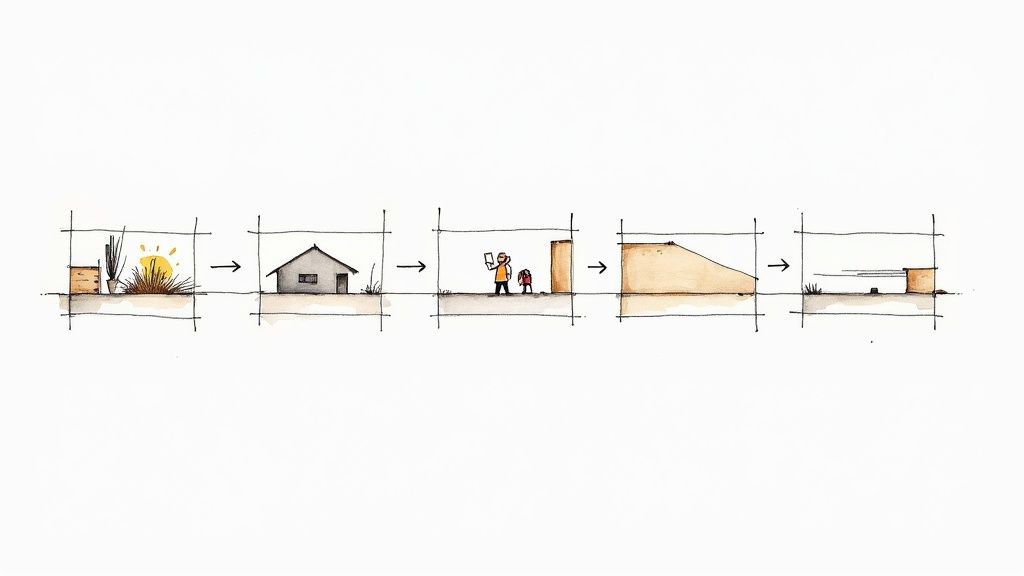
Once the plans get the green light and the budget is locked in, the real excitement begins. Seeing your vision start to take shape is a fantastic feeling, but it’s a process that relies on a well-managed, logical timeline. Knowing the sequence of events helps you understand what’s happening on-site, turning any potential stress into confident anticipation.
A professional house extension specialist is the conductor of this entire orchestra, making sure each stage flows smoothly into the next. It’s a carefully coordinated dance that turns a patch of your garden into a beautiful, functional new living area. This journey is far more than just laying bricks; it’s a complex project that needs an expert eye at every turn.
Laying the Groundwork
The first sign of physical progress is breaking ground. This initial phase is all about preparation and building the foundations—literally setting the stage for everything that follows.
Site Preparation: Our team clears the designated area, which might mean taking up an old patio, moving plants, or removing turf. We’ll also establish safe site access and put measures in place to protect the rest of your home and garden.
Excavating Foundations: We dig the trenches precisely according to the structural engineer’s plans. The required depth and width will depend on things like your local soil conditions and the overall weight of the new structure.
Pouring the Concrete: As soon as building control has inspected and approved the trenches, we pour the concrete foundations. This solid base is absolutely critical for the long-term stability of your extension, so it needs time to cure properly before we put any weight on it.
This early stage is where a skilled project manager really proves their worth. Unexpected issues, like discovering old pipework or hitting unstable soil on a Christchurch property, can throw a spanner in the works. A proactive manager from a seasoned house extension specialist like Hallmoore Developments will already have contingency plans in place, keeping you informed and adjusting the schedule to keep everything moving forward.
Building the Structure and Making It Watertight
With the foundations solid, the visible skeleton of your extension starts to rise. This is often the quickest and most dramatic part of the build, where you can see real, tangible progress every single day.
The next steps focus on building the main shell. We start by constructing the new walls—either traditional blockwork or a modern timber frame—and installing the floor joists. Shortly after, the roof structure goes up and is covered, and the external doors and windows are fitted. Hitting this "watertight" stage is a massive milestone. It means the interior is shielded from the elements, and work can continue inside, whatever the weather is doing in Bournemouth or Southampton.
Having a single, dedicated project manager is the secret to a smooth construction phase. They’re the ones coordinating every trade—the bricklayers, joiners, roofers—making sure everyone is on-site when they need to be, materials arrive on time, and the quality of work never dips. This is the difference between an organised build and a chaotic one.
The First and Second Fix Stages
Once the shell is secure, the action moves inside. This is where the empty space really starts to feel like a part of your home. The work here is split into two key stages: the "first fix" and "second fix."
The first fix is all about installing the essential services that will eventually be hidden behind the walls and under the floors. This covers:
Plumbing pipework for radiators, kitchens, and bathrooms.
Electrical cabling for all your sockets, switches, and lighting.
Stud walls to divide up the new internal space.
Insulation and plasterboarding to finish the walls and ceilings.
After the plastering is done and has had time to dry out completely, the second fix can get underway. This is all about the finishing touches you’ll see and use every day. Electricians come back to fit light fixtures and socket faceplates, plumbers connect the radiators and install bathroom suites, and carpenters hang internal doors and fit skirting boards.
This whole process, from that first day of digging to the final handover, is a significant investment. Recent data on UK home renovation shows that wrap-around extensions can cost anywhere from £40,000 to £100,000 and usually take 10 to 14 weeks to complete. These figures really show how committed homeowners are to improving their living spaces. You can find more insights on UK home renovation spending and statistics on Hillarys.co.uk.
At Hallmoore Developments, our in-house team manages this intricate timeline with precision. We map out a clear work schedule from day one and keep you in the loop with constant updates, so you always know what’s happening. To see how this fits into the bigger picture, have a look at our guide on how to plan a house extension in Hampshire. Our in-house services are here to turn what could be a stressful process into an organised and exciting experience.
Why a Full-Service Specialist is the Smartest Way to Extend Your Home
Deciding to extend your home is the easy part. The real challenge? Juggling architects, structural engineers, builders, plumbers, and electricians without the project descending into chaos. This is where choosing a house extension specialist like Hallmoore Developments changes the game.
Instead of you playing project manager, our integrated design-and-build approach means you have one dedicated team and a single point of contact. From the first sketch to the final coat of paint, our in-house services will see to everything.
This isn't just about convenience. It’s about seamless communication. Your architect is in constant dialogue with the structural engineer, and our builders know the design inside-out from day one. This eliminates the communication breakdowns and costly scheduling conflicts that so often derail projects, keeping everything on time and, crucially, on budget.
Guaranteed Budget Control and Zero Finger-Pointing
When you hire individual trades, you're managing individual invoices. That’s a recipe for costs to quickly spiral. The market for skilled specialists is tight; electricians can charge anywhere from £50 to £120 per hour, while plumbers and joiners often command £35 to £45 per hour. You can see a full breakdown of house extension costs from MyJobQuote.co.uk.
The real risk? A delay with one trade creates a costly domino effect, pushing back everyone else while the bills keep mounting.
Our full-service model gets rid of that financial headache. We provide a single, transparent, and fully itemised quote that covers the entire project. Because we manage our in-house teams and trusted partners, we take full accountability for the budget and the timeline. No hidden fees, no surprise invoices—just a clear, professionally managed process.
Choosing a full-service specialist isn't just about making your life easier; it's about shifting the risk and responsibility from your shoulders to ours. We are wholly accountable for every detail, ensuring quality, cost-control, and your complete peace of mind.
As the go-to house extension specialist for homeowners in Ringwood, Bournemouth, and Southampton, we’ve built our reputation on delivering a smarter, safer, and more efficient path to your dream extension. We invite you to contact our team for a no-obligation chat to see how our in-house services can transform your home with the professionalism and care it deserves.
Got Questions About Your Southampton House Extension? We've Got Answers.
Thinking about extending your home is exciting, but it naturally comes with a lot of questions. As a team that’s been building extensions for homeowners across Southampton and the wider Hampshire area for years, we’ve heard them all. We believe in being upfront and clear, so here are the straightforward answers to the queries we hear most often.
How Long Will My Extension Actually Take?
This is always the big one! The honest answer is: it depends. The timeline for an extension can shift quite a bit based on how big and complex your plans are.
A fairly standard single-storey rear extension, once we break ground, usually takes somewhere between 10 to 14 weeks to get to a finished state.
However, if you're looking at a more ambitious two-storey project or something involving major structural gymnastics, you could be looking at six months or more. It’s also crucial to remember the pre-construction phase. The work of designing, getting planning permission sorted, and securing building regulations approval can add several months before the first spade even hits the ground.
Will I Have to Move Out During the Work?
For the vast majority of extensions, you absolutely won't need to. A good house extension specialist knows how to manage a project to cause as little disruption as possible to your family life. Our in-house services will see to it that disruption is minimised.
Most of the early work—foundations, blockwork, roofing—happens outside. The big moment of breaking through into your existing home is often one of the very last major steps. Of course, you'll have to put up with some noise and dust, particularly during that breakthrough and when the plastering is being done.
The only time moving out might be worth considering is if the project involves a complete overhaul of your only kitchen or bathroom, leaving you without the basics for an extended time. Even then, it's a short-term move for comfort, not a necessity.
What's the Difference Between an Architect and a Structural Engineer?
It's a great question, as both roles are vital but distinct. Think of it this way:
An architect is your creative visionary. They focus on the design, the flow of the new space, and the overall look and feel. They’re the ones who translate your ideas into a set of working drawings that will satisfy planning permission rules.
A structural engineer is all about the science and safety of the build. They do the heavy lifting (pun intended!) by calculating loads, specifying the correct steel beams, designing the foundations, and making sure every part of the structure is safe, stable, and fully compliant with building regulations. You really do need both to create a space that’s both beautiful and built to last.
How Much Value Could an Extension Add to My Home?
While every property in places like Christchurch, Poole, or Ringwood has its own unique market value, a well-planned and executed extension is almost always a smart investment.
Recent industry figures show that even a straightforward single-storey extension can add between 5-8% to your property’s value. A larger double-storey extension could boost it by as much as 12%. Interestingly, loft and garage conversions often give the best bang for your buck, potentially adding up to 20% to your home's value.
Ready to turn your vision into a reality with a team that values transparency and quality? As the premier house extension specialist in Bournemouth and the surrounding areas, Hallmoore developments manages every detail to deliver your dream space, on time and on budget. Explore our services and start your journey today at https://www.hallmoore.co.uk.
Comments