.png)
A Homeowner's Guide to Loft Conversions in Southampton
- Dan Hall
- Jan 19
- 16 min read

Ever feel like the walls are closing in? For homeowners across Southampton, Bournemouth, and Highcliffe, the thought of gaining more space usually brings on the stress of browsing property sites and planning a move. But the smartest solution is often right above your head.
A loft conversion is the perfect way to unlock your home's hidden potential, turning that dusty, forgotten attic into a stunning new bedroom, a quiet home office, or a vibrant playroom for the kids.
Transform Your Attic into Valuable Living Space in Highcliffe, Bournemouth, and Southampton
Whether you're in a terraced house in Ringwood or a detached property in Poole, a professionally managed loft conversion can completely change how you live in your home. It’s not just about tacking on another room; it's about reimagining your property’s potential to fit your family’s needs perfectly.
This is how you get that much-needed extra square footage without the upheaval of moving, all while significantly boosting your property's market value.
Unlocking Your Home's Hidden Potential
The most obvious win is, of course, the extra living space. This new area isn't a generic box—it can be tailored precisely to what your family needs right now, creating a bespoke room that a new house simply might not offer.
Just think about the possibilities:
A Master Bedroom Suite: Imagine a peaceful retreat away from the hustle and bustle of the house, complete with its own en-suite and walk-in wardrobe.
A Dedicated Home Office: A quiet, professional workspace flooded with natural light. It’s exactly what you need to be productive.
A Children's Playroom: Give the kids their own dedicated zone, keeping the toys (and the noise!) contained in one bright, airy space.
A Guest Room or Hobby Area: A truly versatile space that can adapt as your family’s needs change over the years.
This project is far more than just construction; it's a strategic investment. While the main goal is a beautiful new room, many homeowners also use the opportunity to improve their home's overall insulation and structure. Sometimes, a full conversion isn't the first step. You can learn more about how professional loft boarding can create a safe, usable storage space to get you started.
A well-executed loft conversion is one of the most effective ways to add value to your property. Reports often show that adding a bedroom and bathroom can increase a home's value by as much as 20%.
Our complete in-house services mean every single part of your project is handled by our own trusted team. From skilled plasterers and Gas Safe registered plumbers to meticulous painters and decorators, we manage every detail. This integrated approach is our guarantee of quality control and a seamless, stress-free process, from the first design sketch to the final, beautiful room.
Choosing the Right Loft Conversion for Your Home in Southampton, Christchurch, and Poole
So, you’re thinking about converting your loft? It’s a brilliant way to add space and value, but it's important to know that not all lofts are the same, and neither are the conversions that transform them. For homeowners looking at loft conversions in Southampton, understanding the different types available is the very first step. It's a decision that will shape everything that follows, from the amount of usable space you gain to the final cost and project timeline.
Each style has its own unique perks. The best fit for your home in Bournemouth or Christchurch will come down to a few key things: your roof's current structure, how much headroom you need, and the look you’re going for.
Think of a Dormer conversion, for example, as adding a ready-made 'box' right onto your roof. It’s a popular choice because it instantly creates the maximum possible headroom and floor space. On the other hand, a simpler, less intrusive option might be all you need. It’s all about finding that sweet spot between ambition and practicality. Our in-house services always start with a thorough assessment to see exactly what your property can handle, making sure our recommendation maximises both space and value.
This decision tree gives you a quick visual of the key questions to ask yourself as you start this journey, from checking the initial potential to kicking off the build itself.
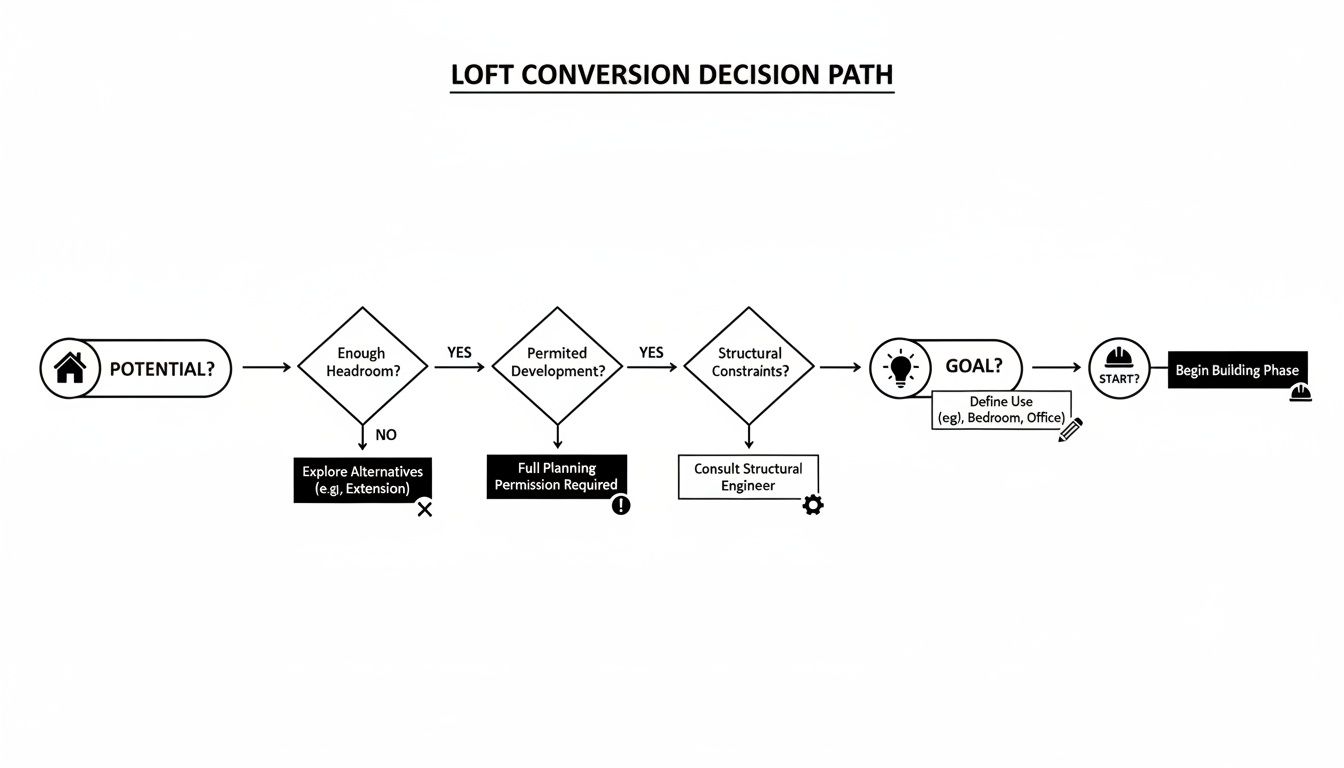
As the flowchart shows, a great project always starts with a clear goal. Are you adding a much-needed bedroom, a quiet home office, or a playroom for the kids in your Ringwood home? Knowing this from the outset makes all the difference.
Popular Loft Conversion Types Explained
To help you get your head around the options, let's break down the most common types. Each one has distinct advantages depending on your property and what you want to achieve with the new space.
Dormer Loft Conversions: This is probably the one you’ve seen the most, and for good reason. A dormer is a structural extension that juts out vertically from the slope of your roof, creating a box shape. This clever addition brings in heaps of extra headroom and floor space, making the room feel less like an attic and more like a conventional part of the house. We dive deeper into this in our guide on dormer windows for Dorset and Hampshire homes.
Rooflight or Velux Conversions: This is the simplest and most budget-friendly way to go. It just involves adding skylight windows into the existing roofline without changing its shape at all. It’s the perfect solution if your loft already has decent headroom, as it requires minimal structural work and can be completed much faster.
Hip-to-Gable Conversions: This one’s specifically for semi-detached or detached homes with a ‘hipped’ roof – that’s one that slopes down on all four sides. We replace the sloping 'hip' side with a vertical wall (a gable end), which creates a surprising amount of internal volume. Often, we’ll combine this with a rear dormer to really open up the space.
Your property's architectural style plays a huge role in determining the most suitable conversion. Our team has extensive experience working with the varied housing stock across the region, from Victorian terraces in Southampton to modern detached homes in Highcliffe.
To make things even clearer, here's a quick side-by-side look at the main options you'll be considering.
Loft Conversion Types Comparison for Southampton Properties
This table breaks down the most common loft conversion types, helping you see at a glance which might be the best match for your home and goals.
Conversion Type | Best For | Headroom Creation | Planning Permission Likelihood | Structural Changes |
|---|---|---|---|---|
Rooflight / Velux | Lofts with existing good headroom; budget-conscious projects. | Minimal – relies on existing roof height. | Low – Often falls under Permitted Development. | Minimal (window installation only). |
Dormer | Most property types, especially terraces; maximising usable floor space. | Excellent – creates a box-like room with vertical walls. | Varies – Can be Permitted Development, but size/design matter. | Moderate (roof extension). |
Hip-to-Gable | Semi-detached & detached homes with hipped roofs. | Good – Replaces a sloping side with a vertical wall. | Often requires Planning Permission due to roof alteration. | Significant (rebuilding one side of the roof). |
Mansard | Creating maximum volume, often on period properties. | Maximum – effectively adds a new storey to the house. | High – Almost always requires Planning Permission. | Major (complete roof restructuring). |
Choosing the right type is the foundation of a successful project. While a Rooflight conversion is straightforward, something like a Mansard is a major structural overhaul. We can help you navigate these choices based on your specific property.
Specialised Conversions for Maximum Space
For homeowners wanting to create the largest possible living area, there are more complex routes we can take. These nearly always involve more significant structural work and are much more likely to need formal planning permission from the council.
A Mansard conversion is a big project. It completely alters the roof structure, usually at the back of the house. The roof is replaced with a flat-topped structure with an almost-vertical outer wall, creating what feels like an entire extra storey. Southampton's diverse property portfolio, from terraced houses in areas like Bitterne to larger detached homes in Chilworth, has made it a real hub for these varied approaches. While Mansard conversions create the most space and are highly sought-after, they will require planning permission.
As you plan, don't forget the details that make a new room comfortable, like insulation. Getting this right is crucial for energy efficiency. Looking into options like spray foam vs. blown-in insulation can help you make a smart choice for long-term comfort and lower energy bills. It’s one of those technical details our in-house team can guide you on to ensure you get the best performance for your project.
Understanding Loft Conversion Costs in Southampton
Let's get straight to it and talk numbers. It’s usually the first question on anyone's mind when they think about a loft conversion: "How much is this actually going to cost me?" For homes across Southampton, Poole, and the wider region, the final figure is always a mix of your vision, your property’s specific quirks, and the features you decide you can't live without. Getting a handle on these key factors is the first step to budgeting with confidence.
At Hallmoore, we're big believers in total transparency. You should know exactly where every penny is going right from the start. This is where our in-house services model really shines; because we have our own trusted team of plasterers, plumbers, and electricians, we can manage timelines and costs far more effectively than firms juggling subcontractors. It allows us to give you a detailed, itemised quote with no nasty surprises down the line.
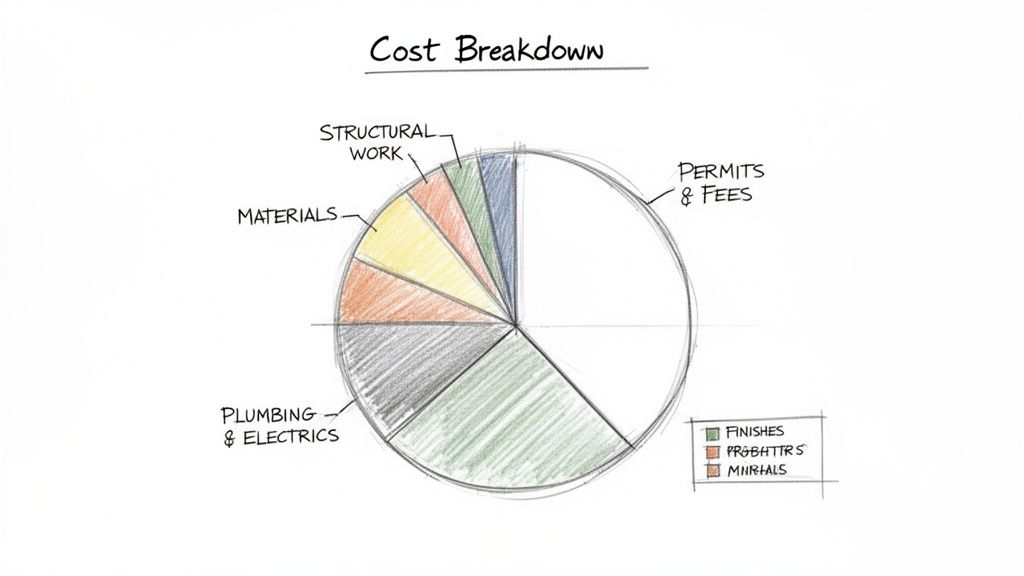
Our whole approach is built on trust, and that starts with giving you the financial clarity you need to make the right decisions for your home.
Key Factors Shaping the Final Price
The final price on your quote isn't just a single number pulled from thin air; it’s the sum of several crucial parts. The type of conversion you opt for is easily the biggest cost driver, with the overall size of your loft coming in a close second. It makes sense—a larger, more complex project in Bournemouth will naturally require a bigger investment than a straightforward conversion in Ringwood.
Your choice of materials and finishes also plays a huge role. From the style of windows and type of insulation to the flooring and bathroom fittings, every decision has a price tag. Custom features, like a gorgeous en-suite or clever built-in storage, will add to the total, but they can also massively improve how you use and enjoy your new space.
These are the main things that move the needle on cost:
Conversion Type: A simple Velux conversion is much lighter on the wallet than a major structural overhaul like a Mansard or Hip-to-Gable.
Size of the Loft: The total square meterage directly affects the amount of materials, labour, and time needed to get the job done.
Specification and Finishes: Your taste in windows, insulation, flooring, tiles, and bathroom suites will all influence the final bill.
Complexity of Work: Things like creating staircase access, running new plumbing, and adding structural reinforcements all add to the project's scope.
Realistic Cost Ranges for Local Projects
To help you build a realistic budget, it’s useful to see what others are paying for loft conversions in Southampton. The final cost can vary quite a bit depending on how ambitious the project is. For a standard 30m² loft space, local data shows a clear pattern based on the conversion type.
Velux conversions are the most budget-friendly, averaging around £27,500. Dormers, a very popular choice for maximising space, typically come in at about £50,000. More extensive Hip-to-Gable projects often command prices closer to £60,000, while the most transformative option, a full Mansard conversion, can be £65,000 or more.
Remember, these figures are just a guide. The only way to get a precise cost for your unique project is with a detailed, on-site survey and quote—which our in-house team provides for free.
Thinking about the finances for a larger project? Understanding how all the different pieces contribute to the final bill is crucial. For a wider view on renovation expenses, take a look at our guide to the cost of renovating a house in the UK.
How Our In-House Services Deliver Value
Choosing a company with integrated, in-house services isn't just about making things easier—it's about financial control and quality you can see. Because we employ our own tradespeople, we can schedule work efficiently, dodge the markups that subcontractors add, and personally ensure every stage of the build meets our exacting standards.
This structure allows us to give you a fixed-price quote you can actually bank on. It covers everything, from the first architectural drawings to the final coat of paint, giving you complete peace of mind and financial clarity from start to finish. Our commitment is simple: deliver exceptional value and an investment that enhances your home for years to come.
The Paperwork Part: Planning & Building Regs Made Simple
Let's be honest, the thought of council applications, paperwork, and legal red tape is enough to make anyone's head spin. For many homeowners thinking about a loft conversion in Southampton, this often feels like the biggest hurdle.
But here’s the good news: it's almost always more straightforward than you imagine, especially when you have an experienced team handling it for you. The trick is to understand the two different sets of rules that will guide your project: Planning Permission and Building Regulations. They sound alike, but they do completely different jobs.
Think of it this way: one is about how your conversion looks from the street and its impact on your neighbours. The other is all about making sure the new space is safe, solid, and built to last. Getting your head around that distinction is the first step to a stress-free project, and our in-house services are set up to manage every single bit of it for you.
The Big Win: Permitted Development
For a huge number of homeowners in areas like Christchurch, Poole, and right across the region, you won't even need to apply for full Planning Permission. Why? Because many loft conversions fall under something called Permitted Development Rights.
You can think of these rights as a set of pre-approved rules for home improvements. As long as your plans tick all the right boxes and meet specific criteria, you can go ahead without a formal, lengthy application. It’s a massive advantage that saves you time, money, and a whole lot of hassle.
The main rules for Permitted Development cover things like:
Volume Limits: The new roof space you create can't be bigger than 40 cubic metres for a terraced house, or 50 cubic metres for a detached or semi-detached home.
Appearance: You can't extend beyond the existing roof plane at the front of your house (the part facing the street).
Materials: Whatever you use on the outside must look similar to the rest of your house.
Our in-house design team are experts at crafting brilliant loft designs that fit neatly within these guidelines, which really helps to speed up the whole pre-construction phase of your project, whether you're in Ringwood or Bournemouth.
Planning Permission vs. Building Regulations
Now, this is a crucial point that catches people out: even if your project is covered by Permitted Development, it always needs to be approved under Building Regulations. They are not the same thing, and you can't swap one for the other.
Planning Permission is all about the visual impact of your home—what it looks like, and how it affects your neighbours and the local area. Building Regulations, on the other hand, are the non-negotiable technical standards for design and construction. They ensure your new loft is safe, energy-efficient, and structurally sound.
Building Regulations cover everything from the fire safety measures (like escape routes and smoke alarms) and the structural integrity (the calculations for steel beams) to insulation levels and proper ventilation. A building control officer from the local council will pop by to inspect the work at key stages. Once everything is checked and approved, they'll issue a completion certificate. Without that certificate, your conversion isn't legally recognised, which can cause a world of problems if you ever decide to sell your house.
How We Handle All the Compliance For You
This is where having a single, dedicated team makes all the difference. Instead of you trying to juggle architects, structural engineers, and council inspectors, our in-house services simply take care of it all. We manage the entire process from start to finish.
Here’s what that looks like in practice:
Assessing Your Project: First, we’ll figure out if your loft conversion falls under Permitted Development or if it needs a full planning application.
Producing All the Drawings: Our team creates all the detailed architectural and structural drawings required for any application.
Submitting the Paperwork: We handle and submit everything to the local council for you. No forms for you to fill in.
Liaising with Inspectors: We schedule and manage all the on-site inspections with the building control officer, making sure every stage gets signed off without a hitch.
By taking this entire burden off your shoulders, we ensure your loft conversion in Southampton is fully compliant, completely safe, and built to the highest standard. If you want to dive deeper into the nuts and bolts, feel free to check out our homeowner's guide to Building Regulations in Southampton. Our goal is to make the journey to your beautiful new room as smooth and simple as it can possibly be.
The Loft Conversion Journey: From First Chat to Final Handover
So, what does a loft conversion in Southampton actually look like from start to finish? A great build isn't about magic; it's about a clear, predictable journey. We've refined our process to turn a potentially complex project into a series of straightforward, manageable stages, so you always know exactly what's happening and when.
This step-by-step map is designed to eliminate surprises and show you precisely what to expect when you work with us. The biggest advantage? Our entire team is in-house. From Gas Safe registered plumbers and skilled electricians to the plasterers and decorators who add the final polish, they're all part of the Hallmoore family. This means no delays waiting for third-party contractors, much tighter quality control, and crystal-clear communication for a smoother experience, whether you're in Highcliffe, Christchurch, or right here in Southampton.
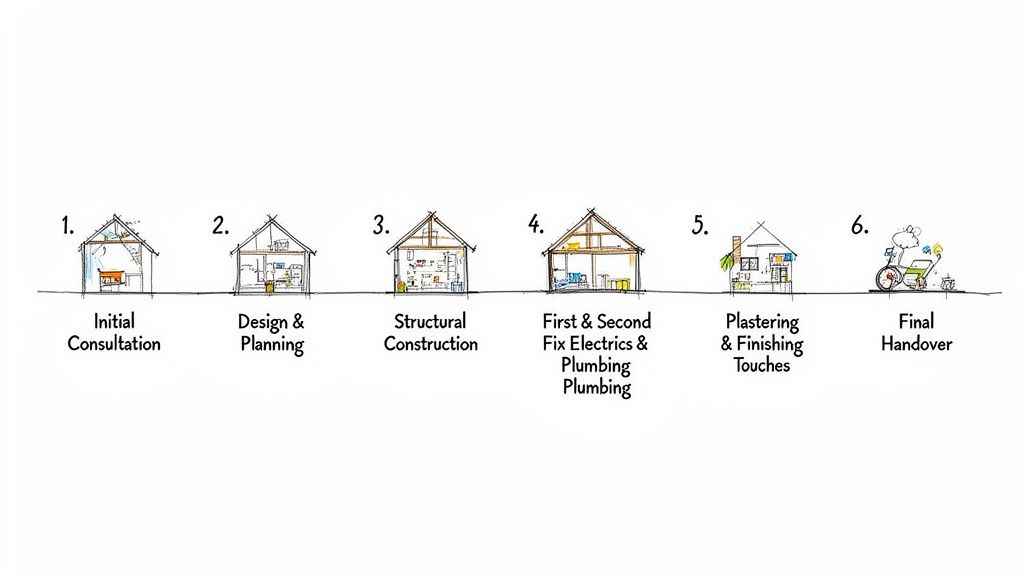
To make sure your project gets off to the best possible start, it helps to understand how to plan a home renovation from the ground up. A solid plan is the foundation of any great project.
Stage 1: Initial Consultation and Quote
It all begins with a chat. One of our specialists will pop round to your home in Southampton, Bournemouth, or Poole to carry out a free, no-obligation survey. We'll get the tape measure out, check the head height, assess the roof structure, and, most importantly, listen to your ideas for the new space.
After that visit, we’ll put together a detailed, itemised quote. This won't just be a single figure; it's a transparent breakdown of all the costs involved, so you can see exactly where every penny of your investment is going.
Stage 2: Design and Planning
Once you give us the green light, our design team springs into action. We’ll produce detailed architectural drawings and structural calculations, making sure your new loft isn't just beautiful but is also perfectly engineered and completely safe.
This is also when we tackle all the paperwork. We'll figure out if your project falls under Permitted Development or needs a full planning application, and then we'll manage the entire submission process with the local council on your behalf.
Our all-in-one services are built to take the stress off your shoulders. By managing everything from design to decoration under one roof, we give you a single point of contact and total accountability. It just makes the whole process so much simpler for you.
Stage 3: The Structural Work
With the plans approved, the tools come out and the real work begins. The first phase is all about creating the core structure. Our team will install any necessary steel beams to support the new floor, build the dormer or other structural elements, and get the whole frame secure and watertight.
We aim to keep disruption to a minimum during this stage, containing most of the heavy work within the loft and on the roof.
Stage 4: First and Second Fix Services
Next up, it’s time to bring the space to life. The "first fix" is when our in-house Gas Safe plumbers and electricians get busy, running all the pipework and cabling for your heating, lights, sockets, and any en-suite facilities you're planning.
Once the walls are plasterboarded, they'll come back for the "second fix." This is the satisfying bit where everything gets connected – radiators are fitted, light fixtures and switches go in, and bathroom sanitaryware is installed, making the room truly functional. Having our own dedicated team here is a game-changer, preventing the classic delays you get when trying to coordinate different external trades. It’s a key part of what we cover in our guide on finding trusted builders in Southampton.
Stage 5: Plastering and Finishing Touches
With the main construction and services sorted, the room really starts to take its final shape. Our expert plasterers will create those perfectly smooth walls and ceilings, ready for a lick of paint. This is usually when the new staircase is fitted, properly connecting your loft to the rest of the house.
After that, it's all about the fine details. We'll fit the skirting boards, architraves, and doors before our painters and decorators work their magic, transforming the space from a building site into a beautiful new room.
Stage 6: Your Final Project Handover
The last step is the best one: the handover. We’ll walk you through your completed loft conversion, making sure every last detail meets your expectations and our own high standards. You'll receive all the essential paperwork, including the building control completion certificate – a vital document for legal compliance.
And the best part? Estate agents consistently report that homes with quality loft conversions can see a significant uplift in market value, often experiencing a 15–25% leap. It's an investment that pays you back in both space and value.
Your Loft Conversion Questions Answered
Embarking on a loft conversion is a big step, so it’s natural to have questions. To give you a bit more clarity, we’ve put together some straightforward answers to the things homeowners in Southampton most often ask us. We'll cover everything from how long it all takes to what happens day-to-day.
How Long Will My Loft Conversion Take in Southampton?
Every project has its own unique quirks, but a typical loft conversion here in Southampton generally takes between 8 to 12 weeks from the first day of construction to the final coat of paint. A simple Velux conversion might be on the quicker end, while a more complex Hip-to-Gable will naturally take a bit longer.
Before we even pick up a tool, we’ll provide you with a detailed project timeline. That way, you know exactly what’s happening and when—it’s a core part of how we ensure everything runs smoothly.
Will I Need to Move Out During the Work?
Definitely not, in almost every case. You can comfortably stay in your home throughout the entire build. The vast majority of the heavy lifting and structural work for loft conversions in Southampton is self-contained within the loft and roof space, keeping your main living areas free from disruption.
The only time you'll really notice us is for a short period when we install the new staircase. Our in-house team is obsessed with keeping your home clean and tidy, and we go out of our way to minimise any impact on your family’s routine.
Using our all-in-one services means you have a single, dedicated point of contact for the entire project. This streamlines communication, ensures higher quality control, and often leads to a faster, more cost-effective completion.
How Do I Know If My Loft Is Suitable for Conversion?
The single most important factor is head height. As a rule of thumb, you need at least 2.2 metres of clear vertical space. We measure this from the bottom of the main roof ridge timber right down to the top of your ceiling joists.
This measurement is the key to creating a space that feels comfortable and meets all the legal requirements.
When we pop over for a free consultation at your Highcliffe, Bournemouth, or Christchurch home, we’ll do a full survey to see what’s possible. We’ll check the structure, get the tape measure out, and chat through the best options for your specific roof.
What Are the Benefits of Our In-House Services?
Choosing a company that handles everything in-house, like us, makes a huge difference. Instead of you having to juggle plumbers, electricians, plasterers, and decorators, we manage the entire crew under one roof.
This integrated approach has some real advantages:
One Point of Contact: You'll have a single project manager who knows your project inside-out. No chasing different trades.
Superior Quality Control: It’s our own trusted team, working to our exacting standards at every single stage.
Efficient Timelines: We control the schedule, so there are no frustrating delays waiting for external contractors to show up.
Cost-Effectiveness: A streamlined process means no unnecessary mark-ups or hidden costs.
Ultimately, it means a seamless, stress-free journey from the first sketch to your beautiful finished room, whether you’re in Poole or Ringwood.
Ready to unlock the hidden potential in your home with a stunning loft conversion? The expert team at Hallmoore developments manages every detail in-house, ensuring a seamless, high-quality project from concept to completion. Contact us today for your free, no-obligation consultation. https://www.hallmoore.co.uk
Comments