.png)
How Much Does a House Extension Cost? A Price Guide for Hampshire & Dorset
- Dan Hall
- Jan 21
- 17 min read

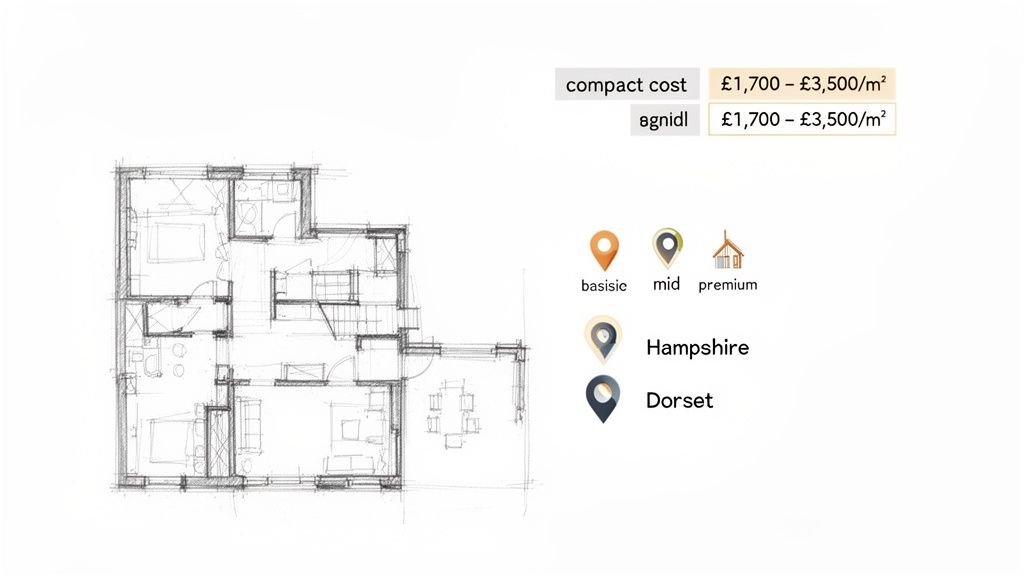
So, you're asking, "how much does a house extension cost?" It’s the big question, isn't it? The short answer is that most projects here in the UK will land somewhere between £1,700 and £3,500 per square metre. But that’s just a starting point – the final figure really depends on the size, your location, and the quality of finishes you go for. Our in-house team at Hallmoore Developments can provide a precise quote to see to your needs.
Your Quick Guide to House Extension Costs in Bournemouth
Starting a home extension is one of the most exciting projects you can take on. Whether you’re in a lively part of Southampton or a quiet cul-de-sac in Highcliffe, adding that extra space can completely transform how you live in your home. Before the excitement takes over, though, there's always that one question on everyone’s mind: the budget.
Getting a grip on the potential costs right from the beginning is absolutely crucial for planning a smooth, successful project. The cost per square metre gives you a solid ballpark figure, but it’s just one piece of a much bigger puzzle. Your final bill will be shaped by a whole host of factors unique to your property and vision.
Key Factors That Influence the Price
A few core elements will always steer the final investment. It’s smart to think about these from day one to build a realistic budget and avoid any nasty surprises down the road.
Location and Labour Costs: Prices can swing quite a bit across the UK. Building in places like Poole or Ringwood might come with different labour rates compared to other regions, purely down to local demand and how easy it is to get materials and trades to the site.
Quality of Finish: This is a big one. The materials and fittings you choose will have a massive impact on the total cost. Basic uPVC windows, for instance, are far more budget-friendly than sleek, high-end aluminium bi-fold doors. The same logic applies to everything from your flooring and kitchen units to the bathroom taps.
Complexity of the Design: A straightforward, rectangular extension will always be kinder on the wallet than a complex, multi-angled design. The more specialist structural work or intricate roofing you need, the more the cost will climb.
At Hallmoore Developments, we believe in total transparency from start to finish. We manage every single trade in-house—from our plumbers and plasterers to our decorators—which allows us to provide clear, itemised quotes. Our in-house services are here to see to your project across Bournemouth, Christchurch, and beyond, ensuring top-notch quality control.
A Look at Average House Extension Costs
To help you set some realistic financial goals, let's look at the national averages. A typical house extension in the UK costs around £40,000, which is why it’s such a popular way for homeowners in Hampshire and Dorset to gain more living space without the hassle of moving.
Of course, this figure can easily go up depending on the scale and specification of your project. For a standard 20m² single-storey extension, you might budget £34,000 to £38,000 for the build alone. Once you add VAT, planning fees, and professional fees into the mix, the total can quickly approach £50,000 or more.
To get an idea of how individual components contribute to the total, a window installation cost calculator can be a handy tool for estimating the price of windows and doors. This is where having an in-house team really shines, as our services can see to costing every element with precision right from the start.
Average House Extension Costs at a Glance
To give you a clearer picture, we've put together a table summarising the typical costs for different types of extensions. Think of this as a quick reference to help you get started with your budget.
Extension Type | Average Cost per Square Metre (m²) | Estimated Total for 20m² Extension |
|---|---|---|
Single-Storey Extension | £1,700 - £2,200 | £34,000 - £44,000 |
Two-Storey Extension | £2,000 - £2,800 | £80,000 - £112,000 |
Kitchen Extension | £2,500 - £3,500+ | £50,000 - £70,000+ |
Wraparound Extension | £2,200 - £3,000 | Varies significantly by size |
Keep in mind these are average figures. The final cost will always depend on the specifics of your project, from the groundworks right through to the final lick of paint.
How Much Will a Single-Storey Extension Cost in Christchurch?
When homeowners in Christchurch, Poole, or Ringwood want to expand their living space, a single-storey extension is almost always the first thought. It’s a brilliant and practical way to get that dream kitchen, a bigger living area, or a much-needed home office.
But figuring out the cost can feel a bit like buying a car. The final price tag depends entirely on the model and the extras you add.
A basic, functional build is your reliable family saloon—it gets the job done well. On the other hand, a high-spec project with aluminium bi-fold doors, a bespoke kitchen, and underfloor heating is more like the luxury SUV. This is why costs can range so widely, typically falling somewhere between a practical £1,700 per square metre (£/m²) and a more premium £3,500/m².
It's Not Just About Size: Different Extension Types Have Different Price Tags
Not all single-storey extensions are created equal. The complexity of the design, how easy it is to access the site, and the amount of structural work needed will all push the final cost up or down. Let's break down the main types so you can see where your project might land.
Rear Extension: This is the classic choice, extending straight out from the back of your house. It’s perfect for creating that stunning open-plan kitchen-diner and usually involves the least complex structural changes.
Side-Return Extension: This clever option fills in that often-wasted alleyway at the side of a terraced or semi-detached home. While it adds valuable width, it can be trickier due to party wall agreements and potentially needing to reroute drains, which bumps up the cost per square metre.
Wraparound Extension: The ultimate space-gainer, combining a rear and side-return extension. As you’d expect, it's also the most complex and costly, as it needs extensive structural work to create the new L-shaped space.
So, while a simple rear extension in Bournemouth might sit at the lower end of the cost scale, a complicated wraparound project in a Southampton conservation area could easily hit the upper limit, thanks to planning rules and tricky structural requirements.
The secret to keeping these costs under control is having one team manage everything. At Hallmoore Developments, our in-house services can see to every single stage—from plastering and decorating right through to the final landscaping. This approach gets rid of the coordination nightmares and surprise costs that can derail a project. We give you a single, clear price from day one.
What the Numbers Say
Recent industry data shows just how popular these projects are. Single-storey extensions are a firm favourite for UK homeowners, with a typical 20m² kitchen or lounge add-on costing between £50,000 and £70,000. That figure usually covers basic finishes but doesn’t include VAT or high-end extras like a designer kitchen.
Here in sought-after southern areas like Hampshire and Dorset, prices often lean higher, hovering around £2,500 to £3,500 per square metre because demand is so strong.
It’s also crucial to remember that tricky logistics will add to the bill. Wraparound and side-return extensions can be 20-30% more expensive per square metre than a simple rear extension because of the extra work needed for things like drainage and foundations. Getting these fundamentals right is non-negotiable.
To get a handle on all the rules and requirements, learn more about single-storey extension building regulations in our homeowner's guide. Understanding these variables is the first step towards setting a realistic budget and achieving a brilliant build.
The Smart Money is on a Double-Storey Extension
Going up a level with a double-storey extension might feel like a huge financial leap, but it’s often one of the shrewdest investments you can make in your home. While the total project cost is obviously higher than a single-storey addition, the number you really need to watch is the cost per square metre.
That’s where the true value becomes crystal clear.
Think of it like buying in bulk. The initial outlay is bigger, but the price per unit—in this case, per square metre of brand-new living space—is dramatically lower. It’s this simple efficiency that leads so many homeowners in places like Southampton and Ringwood to realise it's a far more cost-effective way to get the space a growing family needs.
You’re essentially doubling your liveable floor space without coming anywhere close to doubling the cost of the most expensive parts of the build.
The Secret to Better Value? Shared Foundations and Roofing
So, why is a double-storey extension so much cheaper per square metre? The answer is beautifully simple: you’re sharing the big-ticket structural elements. For any extension, the two most expensive and labour-intensive stages are always the foundations and the roof.
When you build a two-storey project, you only have to dig and pour the foundations once. You also only need one roof structure to cover both new floors. It’s this shared cost that really changes the game.
Foundations: The groundwork—digging, concrete, damp-proofing—is a massive chunk of the budget. Spreading that single cost over two floors instead of one instantly slashes the per-square-metre price.
Roofing: In the same way, all the complex work of building the roof structure, insulating it, and tiling it only happens once. That single roof serves two whole levels of living space, delivering incredible value for money.
By building up instead of just out, you maximise every pound spent on these fixed, high-cost parts of the construction.
This principle of shared costs is fundamental to understanding how much does a house extension cost when planning a larger project. It’s not just about the total spend; it’s about what you get for that money. A double-storey extension can deliver twice the lifestyle upgrade without twice the financial hit.
A Look at Typical Project Costs
While the cost per square metre is lower, what does the overall budget for a double-storey extension actually look like? Recent industry data shows that double-storey house extensions in the UK typically average between £2,100 and £2,600 per square metre.
For a standard 40m² project (that’s 20m² on each floor), you can expect the initial build cost to be somewhere between £84,000 and £104,000, before adding high-spec interior finishes. This efficiency is partly because you can slash groundwork costs by a huge 30-40% compared to building two separate single-storey extensions of the same total size. For a deeper dive, you can read this complete guide to double-storey extensions.
Expert Integration of Complex Systems
Adding two new floors isn't just about the structure; it means weaving in complex plumbing, heating, and electrical systems that need to work perfectly across both levels. This is where having an experienced, multi-skilled team becomes non-negotiable.
At Hallmoore Developments, our in-house, Gas Safe registered engineers are a core part of the team from day one. Our services can see to working side-by-side with our builders to plan and install all the new pipework and boiler systems needed. This integrated approach stops the costly delays and frustrating communication breakdowns that often happen when you’re trying to juggle separate contractors.
We make sure your new bedrooms, bathrooms, and living areas are not only beautifully finished but also perfectly functional, warm, and fully compliant with all safety regulations. It's this all-in-one expertise that gives our clients in Southampton and beyond complete peace of mind. To get your head around the local planning process and what it might cost, check out our guide to house extensions in Southampton.
What Factors Influence Your Final Extension Cost?
Trying to pin down the exact cost of a house extension is less about finding a single magic number and more like pricing up a custom-built car. The final figure depends entirely on the parts you choose. Every decision, from the size of the chassis to the leather on the seats, will nudge the price up or down.
By understanding what drives these costs, you can make smarter decisions, spot opportunities to save, and make sure your investment perfectly matches your vision. Let's lift the bonnet on the core elements that will shape your budget.
This diagram shows why building up is often better value than building out. A double-storey extension shares the same foundations and roof, meaning you get twice the space for a much lower cost per square metre.
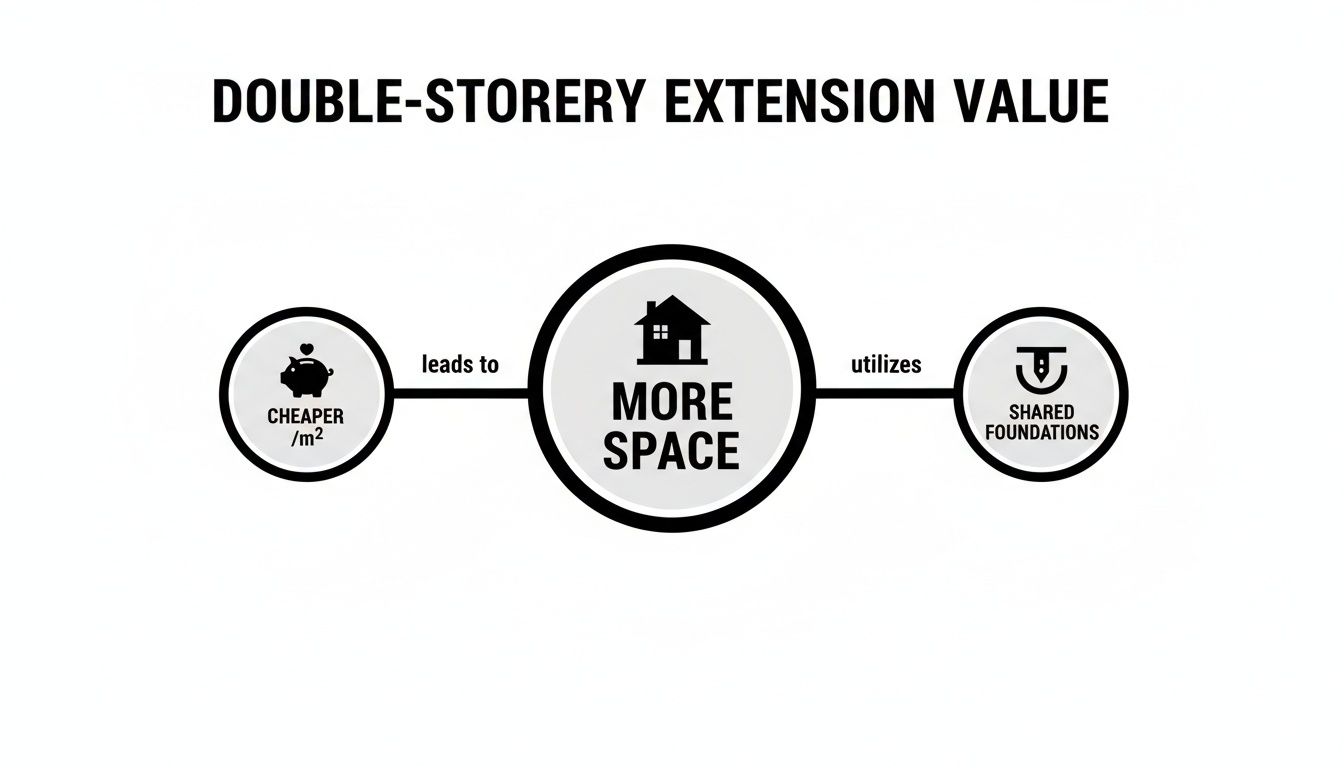
The key takeaway? The most expensive parts of any build are the groundworks and the roof. When you build a two-storey extension, those costs serve two floors instead of one, giving you far more bang for your buck.
The Scale and Complexity of the Build
First and foremost, the size of your extension is the biggest driver of cost. A larger footprint naturally demands more materials, more labour, and more time on site—all of which add up on the final invoice. Simple as that.
But it’s not just about square metres. The complexity of the design plays a massive role. A straightforward, rectangular extension with a standard pitched roof will always be kinder to your budget than an ambitious, multi-angled design with bespoke architectural flourishes. Tricky rooflines, huge open-plan spaces needing specialist steel beams, or unusual shapes all add engineering challenges and construction hours, pushing the price higher.
Quality of Materials and Finishes
This is where your personal taste directly hits the bottom line. Think of it as the difference between buying a suit off the rack and having one tailor-made on Savile Row. Both do the job, but the quality, feel, and cost are worlds apart.
Your choice of materials will have a huge impact. For example:
Bricks: Standard modern bricks are cost-effective. But if you need to match the period look of an older property in Christchurch, sourcing reclaimed bricks will be significantly more expensive.
Windows and Doors: Standard uPVC windows are a solid budget option. In contrast, high-performance aluminium bi-fold doors that open up an entire wall can easily add thousands to the cost.
Roofing: Simple concrete tiles get the job done affordably. But premium materials like natural slate or a sleek zinc roof command a much higher price.
The quality of your internal finishes—the kitchens, bathrooms, flooring, and lighting—is another major variable. This is where you can really decide to splash out or rein it in.
Cost Impact of Finishes and Fittings
The table below illustrates how your choices for interior components can swing your budget from basic to high-end.
Component | Basic Specification (Cost Impact) | Mid-Range Specification (Cost Impact) | High-End Specification (Cost Impact) |
|---|---|---|---|
Kitchen | Flat-pack units, laminate worktops, budget appliances. | Good quality pre-assembled units, solid wood or quartz worktops, integrated brand-name appliances. | Bespoke, handmade cabinetry, premium stone or composite worktops, top-of-the-range appliances. |
Bathroom | Standard white ceramic suite, acrylic bath, basic chrome taps. | Quality branded suite, steel bath, thermostatic mixer shower, stylish tiling. | Designer suite, freestanding bath, custom shower enclosure, premium brassware, underfloor heating. |
Flooring | Laminate or vinyl flooring. | Engineered wood, good quality carpet, or durable porcelain tiles. | Solid hardwood, natural stone tiles, or polished concrete. |
Lighting | Standard pendant lights and basic downlighters. | Dimmable LED downlighters, feature pendants, and integrated smart lighting controls. | Architectural lighting scheme, designer fittings, and fully automated smart home integration. |
Ultimately, the decision on finishes is a constant balancing act between looks, performance, and budget. One homeowner might prioritise an £80,000 top-of-the-range kitchen, while another will happily choose a more modest design to free up funds for other parts of their home.
The "Hidden" Professional and Legal Fees
Beyond the bricks and mortar, there are several professional and administrative costs that are non-negotiable for any legitimate project. These are often forgotten in early estimates but are essential to getting the job done right.
These fees typically include:
Architect and Designer Fees: Usually between 3% and 7% of the construction cost for creating the drawings and plans.
Structural Engineer Reports: Essential for ensuring the new structure is safe, especially if you're removing load-bearing walls. Expect to pay from £500 to £1,000.
Planning Permission: If your extension doesn't fall under permitted development, you’ll need to submit an application to your local council, which comes with a fee.
Building Regulations Approval: This is completely separate from planning permission and ensures your extension meets crucial safety, structural, and energy efficiency standards. For a full rundown, check out our guide on UK building regulations for extensions explained.
Local Ground Conditions and Labour Costs in Hampshire
Finally, your postcode matters. Here in Hampshire and Dorset, specific local factors can influence the final bill. The ground conditions on your property, for instance, can be a huge variable. If your home in Poole is built on tricky clay soil, you might need deeper, more complex foundations, adding unexpected costs right at the start.
Likewise, labour costs vary based on local demand. In sought-after areas like Bournemouth and Ringwood, the best tradespeople are often booked up, and their rates reflect that. This is another reason why choosing a builder like Hallmoore, with our own dedicated in-house team, gives you cost certainty and reliability from day one.
Budgeting for Your Extension and Maximising Value
Thinking about how much does a house extension cost is only one side of the coin. The real trick is to stop seeing it as just a cost and start treating it as a long-term investment. Smart financial planning isn’t just about getting the builders in; it’s about making sure every pound you put into the project adds real, tangible value to your home and your life.
Your first and most important task is to build a realistic budget. This goes way beyond the main construction quote. You need to map out every possible expense, from the architect's first sketch to the final splash of paint. A solid budget is your project’s roadmap, keeping you firmly in the driver's seat and heading off financial headaches later.
Here at Hallmoore Developments, we build our quotes with total transparency. Our in-house services are designed to see to our clients' needs in Highcliffe and across the region, making sure you feel in control from day one, because we know an informed homeowner is a confident one.
Building a Bulletproof Budget
A classic mistake is budgeting only for the numbers you see on the initial quote. Building projects are living, breathing things, and surprises can pop up. You might discover some tricky ground conditions once digging starts, or you might fall in love with a different set of doors last minute. This is exactly why a contingency fund is your best friend.
Financial experts and seasoned builders all say the same thing: always set aside a contingency fund of 10-15% of your total project cost. This isn’t money you’re planning to waste. Think of it as a safety net that protects your project from delays and compromises if something unexpected happens.
It’s basically project insurance. If you sail through without a hitch, great! You’ve got a bonus for landscaping or some new furniture. But if you do need it, you’ll be incredibly glad it’s there.
Financing Your Vision and Adding Value
For most people, funding a big extension means looking at financing options. Remortgaging is a popular route, as it lets you release equity tied up in your property to pay for the work. Other avenues include personal loans or specialised home improvement loans, and each has its own set of pros and cons.
Whichever way you fund it, the goal is always the same: maximise your return on investment (ROI). A well-planned extension isn't just an expense; it’s a powerful tool for boosting your property’s market value. Certain features consistently deliver a fantastic return. A spacious, open-plan kitchen-diner, for example, is at the top of most buyers' wish lists, while adding another bedroom can seriously increase your home’s sale price.
As you map out your budget, it's a huge help to break down the costs of major components. For instance, using tools like an online roof cost calculator can give you a much clearer estimate for one of the biggest parts of the build, helping you see exactly where your money is going.
Smart Choices for Maximum Impact
You don't always have to spend a fortune to get a high-value result. Often, the smartest investments are about how you use the space, not just what you spend on it.
Here are a few ways to get the most bang for your buck:
Focus on Kerb Appeal: Make sure the new extension looks like it’s always been there. Using matching materials for your home in Poole or Bournemouth creates a seamless, high-end finish that buyers love.
Prioritise Light and Space: Features like bi-fold doors, skylights, and big windows can make a room feel enormous and luxurious without breaking the bank.
Invest in the 'Wow' Factor: A stunning kitchen island or a beautifully tiled bathroom can become the standout feature that makes your extension memorable and adds serious buyer appeal.
At the end of the day, it's all about balancing your dreams with a practical budget. Sometimes, opting for a more modest design over a sprawling, expensive one leads to a much happier and less stressful experience. To find out more about getting incredible results without overspending, take a look at our guide to budget-friendly renovation tips and high-impact projects.
Why Choose Hallmoore for Your Hampshire Extension
Choosing the right builder is probably the single most important decision you'll make for your entire extension project. It's the difference between a smooth, exciting journey and a process riddled with stress and unexpected bills. For homeowners across Hampshire and Dorset, we've become the trusted partner for turning a vision on paper into a stunning, real-life space.
Our whole approach is built on a simple but powerful idea: we bring every essential trade under one roof. Instead of you having to find and juggle separate plumbers, plasterers, structural experts, and decorators, we provide them all. Our in-house services will see to your every need, giving you a single, accountable point of contact who is completely dedicated to your project.
Seamless Project Management from Start to Finish
This integrated model is the secret to our success—and your peace of mind. When our team of skilled tradespeople works together day in, day out, communication is flawless and those frustrating scheduling conflicts simply disappear. That efficiency translates directly into a project that stays on time and, crucially, on budget.
Our in-house expertise includes:
Gas Safe Registered Engineers: Ensuring all your plumbing and heating is installed to the highest possible safety standards.
Expert Plasterers and Decorators: Delivering that flawless, high-quality finish your beautiful new space deserves.
Structural Specialists: Managing all the complex groundwork and steel installations with absolute precision.
When you ask, "how much does a house extension cost?" the answer you get should be clear and reliable. Our commitment to transparent pricing means you receive a detailed, itemised quote from the start, so you're always in control of your finances.
Deep Local Roots and Unwavering Client Support
We aren't some faceless national company; we are a local business with deep roots in communities like Bournemouth, Southampton, Christchurch, Poole, Ringwood, and Highcliffe. We get the local planning nuances, understand the specific ground conditions, and know the architectural styles that define our beautiful corner of the country.
This local knowledge is invaluable. We’re here to guide you through every single stage, from the first design sketches to the final sign-off. And our commitment doesn't end when the last nail is hammered in. We believe in building lasting relationships with our clients, offering support and advice long after your project is complete.
We’re not just building extensions; we’re building dream homes and a reputation for excellence, one satisfied homeowner at a time. To get started and understand the full process, read our in-depth guide to planning a house extension in Hampshire.
Got Questions About House Extensions? You're Not Alone.
Planning a major home project like an extension naturally comes with a lot of questions. Getting clear, honest answers is the first step toward a successful build. To help you out, we’ve put together a few of the most common queries we get from homeowners across Hampshire and Dorset.
How Long Does a House Extension Take to Build?
It’s the question on everyone’s mind! For a standard single-storey extension of around 20m², you can typically expect the main construction work to take between 10 to 12 weeks.
Of course, this is a ballpark figure. The timeline can stretch depending on the project's complexity, unpredictable British weather, or any surprises we find during the groundworks stage. A two-storey extension will naturally take longer, as there's simply more work involved from the ground up.
Do I Always Need Planning Permission for an Extension?
Not always, which is great news for many homeowners. A lot of smaller, more straightforward extensions can be built under what are known as Permitted Development Rights. This means you can skip the full planning permission process.
However, there are very strict rules about the size, height, and positioning of the extension relative to your property boundaries. It's always a good idea to check with your local council in places like Bournemouth or Southampton, as the goalposts can shift, especially if you live in a conservation area or a listed building.
One thing is non-negotiable: even if you don't need planning permission, you will always need Building Regulations approval. This is a completely separate process that ensures your new space is structurally sound, safe, and meets modern energy efficiency standards.
Can I Live in My House During the Build?
Yes, in most cases, you can absolutely stay put. We're used to working around families and their daily routines.
That said, it’s best to be prepared for a period of disruption. There will be dust and noise—that’s just the nature of construction. At key stages, like when we're knocking through walls to connect the old space with the new, you might lose access to your kitchen or garden for a short time. We always do our utmost to minimise the impact on our clients in Christchurch and Ringwood, keeping the site tidy and communicating clearly every step of the way.
Ready to get a clear, transparent answer to "how much does a house extension cost" for your specific project? The team at Hallmoore developments manages every trade in-house to provide a seamless, stress-free build. Contact us today for a no-obligation consultation and let's start planning your dream space.
Comments