.png)
How to Detect Gas Leaks A Homeowner's Guide
- Dan Hall
- Dec 30, 2025
- 14 min read

When you think you might have a gas leak, your own senses are the best tools you have. It often starts with a gut feeling – a strange smell, a faint sound, or something that just seems off. Trust that instinct. Moving quickly and knowing how to detect gas leaks are absolutely critical for keeping everyone safe.
Recognising the Telltale Signs of a Gas Leak in Highcliffe
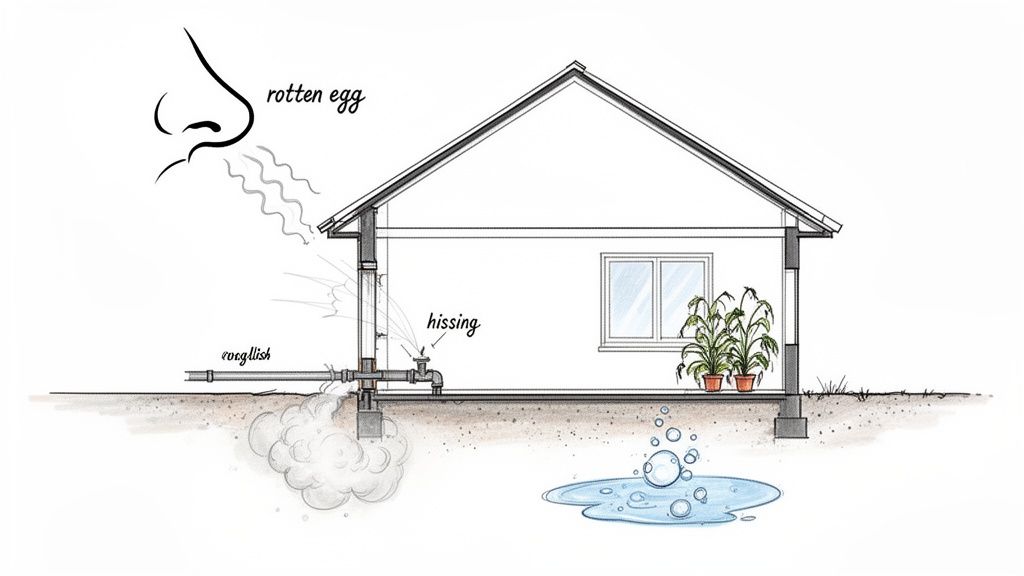
Your nose, ears, and eyes are your first line of defence. On its own, natural gas is completely invisible and has no smell, which makes it incredibly dangerous. That’s why gas suppliers add a chemical called mercaptan. It's designed to be impossible to ignore, giving the gas a potent, foul odour that acts as your primary warning signal.
Trust Your Sense of Smell
The most obvious sign of a gas leak is that distinct “rotten egg” or sulphur-like smell. It’s deliberately strong so you can detect it long before it reaches dangerous levels.
If that smell pops up out of nowhere in your Poole home, it’s a massive red flag. Don't second-guess it or assume it will just go away. It’s there for a reason.
A gas leak can also make you feel unwell. If you or your family are suddenly dealing with unexplained headaches, dizziness, nausea, or feeling unusually tired—and the symptoms seem to fade when you go outside—it could be a sign of gas exposure.
Listen for Unusual Sounds
Sometimes, you’ll hear a leak before you smell it. Get close to your gas meter, pipes, or appliances like your boiler and cooker, especially when the house is quiet.
Listen for a faint but persistent hissing or whistling noise. This is the sound of gas escaping from a pipe or fitting under pressure. It can be easy to miss amongst the normal hums of a household, so taking a moment to just listen can make all the difference for homeowners in Ringwood and Christchurch.
Look for Visual Clues
The visual evidence of a gas leak is often much more subtle, but just as telling once you know what to look for. Keep an eye out for these oddities:
Dying or Discoloured Vegetation: A mysterious dead patch of grass in your lawn or houseplants that suddenly start wilting near a gas line could be a sign. An underground leak can starve the roots of oxygen.
Bubbles in Standing Water: If you spot unexplained bubbles rising in puddles, ponds, or even just soggy ground after it’s rained, it could be gas escaping from below.
Disturbed Dust: Inside, a leak from a fitting might blow dust around in a way that looks out of place. You might see a small, steady disturbance in a spot that should be still.
To help you remember these signs, here's a quick summary of what your senses might pick up on.
Quick Reference Gas Leak Warning Signs
Sensory Clue | What to Look, Listen, or Smell For | Common Locations |
|---|---|---|
Smell | A strong "rotten egg" or sulphur-like odour. | Near gas cookers, boilers, fireplaces, and meters. |
Sound | A faint but persistent hissing or whistling noise. | Around pipe fittings, valves, and gas appliance hoses. |
Sight | Bubbles in wet ground, disturbed dust, or inexplicably dying plants. | Outdoors near gas lines; indoors near pipe connections. |
Feeling | Unexplained dizziness, headaches, or nausea that improves when you leave. | Anywhere inside a home with a potential gas leak. |
Keep this table in mind as a mental checklist. Spotting any of these signs means it's time to act immediately.
For a deeper dive into these crucial indicators, this guide on 5 quick clues for recognizing the signs of a gas leak is an excellent resource. Once you've identified a potential leak, knowing the correct safety procedures is essential. You can find more practical advice and professional insights over on our Hallmoore Developments blog.
The Soapy Water Test: A Classic Way to Pinpoint a Leak in Poole
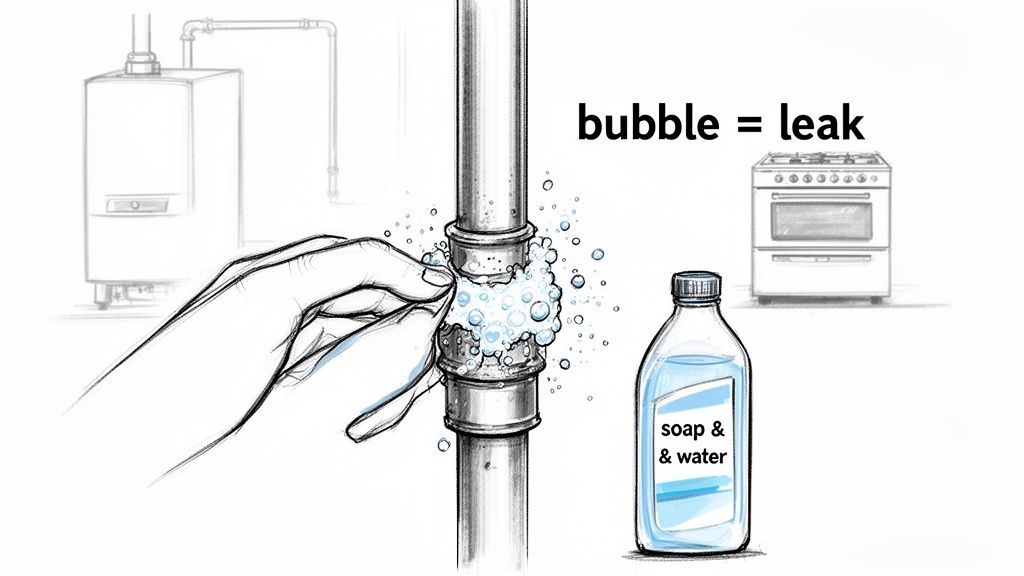
So, you’ve noticed a faint smell or a slight hissing, but you can’t see anything obvious. This is where the soapy water test comes in. It’s a classic, surprisingly effective method for pinpointing the exact source of a small gas leak.
For homeowners in Poole and Ringwood, this is a safe, non-invasive way to confirm your suspicions before picking up the phone. The principle is simple: escaping gas will create bubbles in a soap solution, making an invisible threat visible. It's a low-tech but incredibly reliable diagnostic you can use on any accessible pipe joints and fittings.
How to Mix and Apply the Solution
First things first, you need to whip up your detection solution. Don't worry, it couldn't be easier.
Create the mix: Just add a good squirt of washing-up liquid to some water in a small bowl or a spray bottle. You're aiming for a consistency that’s soapy enough to form solid bubbles but still runny enough to get into all the nooks and crannies.
Apply it thoroughly: Using a small brush, a sponge, or your spray bottle, liberally coat any area where you suspect a leak. Pay close attention to the connections, joints, and valves on your gas meter, boiler pipework, and the flexible hose going to your cooker.
Be methodical. Make sure you cover the entire circumference of the pipe fitting or valve. Even a tiny leak might only produce very small bubbles, so a complete coating is your best bet for spotting it.
Now, it’s time to watch closely. If you see a cluster of small bubbles forming, or even a single bubble that slowly grows, that’s your positive confirmation of a gas leak. This is the concrete proof you need to act.
Crucially, if you find a leak, don’t be tempted to grab a wrench and tighten the fitting yourself. Follow the emergency steps immediately and call a professional. While this test is an excellent diagnostic tool, the repair itself needs an expert touch. Our in-house services cover a range of professional plumbing and gas services to handle these issues safely and correctly.
What to Look For: Expanding Your Visual Checks in Ringwood
Beyond the soap test, a good old-fashioned visual inspection of your gas appliances can reveal other red flags. These signs often point to poor combustion, which can sometimes go hand-in-hand with a leak. Knowing how to detect gas leaks isn't just about finding escaping gas; it's about spotting when an appliance isn't working as it should.
Take a close look at your boiler, cooker, and any gas fires. You’re looking for subtle clues that something is amiss.
Keep an eye out for:
Soot Stains: Any black, sooty marks on or around an appliance are a dead giveaway that it’s not burning the gas cleanly.
Scorching or Burning: Discolouration or signs of heat damage on the appliance casing or nearby surfaces are a serious cause for concern.
Excessive Condensation: Lots of moisture on the windows in a room with a gas appliance can signal that it's not ventilating properly.
A Lazy Yellow Flame: The flame on your cooker hob or in your boiler’s viewing window should be crisp and blue. A floppy, yellow, or orange flame means incomplete combustion is happening.
Spotting any of these issues alongside a suspected leak just reinforces the need for immediate action. These aren’t problems to put on the back burner; they are clear warnings that your system needs an urgent assessment from one of our Gas Safe registered engineers.
To really get a handle on gas leak detection, it’s crucial to know that not all gas threats are the same. The type of gas you have at home—whether you’re hooked up to the mains in Southampton or using bottles in a rural spot like Ringwood—massively changes how it behaves and the specific dangers it presents. Understanding this difference is a cornerstone of solid home safety.
For most homeowners in Bournemouth, the risks boil down to three main culprits: Natural Gas, Liquefied Petroleum Gas (LPG), and the silent threat of Carbon Monoxide (CO). Each one has its own personality, and that dictates how you should react in an emergency.
Natural Gas: The Mains Supply Standard
This is the stuff that powers most homes connected to the grid. Natural gas is mostly methane, and its most important trait is that it’s lighter than air. That’s a key piece of information. If you have a leak, the gas will rise and spread out, meaning a well-ventilated room can help it dissipate more easily.
Of course, this is also the gas that has an additive called mercaptan mixed in. That's what gives it that classic, unmistakable "rotten egg" smell—your first and most obvious warning sign.
Liquefied Petroleum Gas (LPG): Bottled Gas Properties
LPG, typically propane or butane, is what you’ll find in properties off the mains network, like in certain parts of Christchurch. The single most critical thing to remember about LPG is that it’s heavier than air.
This changes everything. If LPG leaks, it won’t float away. It sinks. It will pool in low-lying spots like basements, cellars, or even just along the floor line. This creates a highly concentrated pocket of flammable gas, which is an enormous ignition risk. Your ventilation strategy has to be different, too—opening doors to create a ground-level draught is far more effective than just cracking a high window.
Understanding the behaviour of different gases is fundamental to safety. A heavier-than-air gas like LPG can accumulate silently in low spots, making detection and evacuation strategies different from those for lighter-than-air natural gas.
Carbon Monoxide: The Invisible Danger
This is the one that truly worries our engineers. Unlike natural gas and LPG, Carbon Monoxide (CO) isn't the fuel itself; it’s a nasty byproduct of incomplete combustion. It’s created when appliances like boilers, gas fires, or cookers are faulty, poorly maintained, or don't have enough ventilation.
CO is completely odourless, colourless, and tasteless. Your senses are useless against it. Beyond just detecting the fuel source, it's vital to be aware of the silent, odourless dangers of carbon monoxide poisoning. The only reliable defence is a properly placed, audible CO alarm and, just as importantly, regular, professional maintenance of your appliances.
Our in-house services can help keep your system in top, safe condition with our professional boiler service information.
This growing awareness around gas safety has fuelled major growth in the UK's safety device market. In fact, the United Kingdom gas leak detector market was valued at USD 4.77 billion in 2025 and is projected to hit USD 6.85 billion by 2032—a huge jump driven by tighter safety regulations and public awareness.
Comparing Household Gas Dangers: Natural Gas vs LPG vs Carbon Monoxide
To make it crystal clear, let's break down the key differences between these three household gas risks. Knowing what you're dealing with is the first step in protecting your home and family.
Gas Type | Key Characteristics | Signs of a Leak or Presence | Primary Danger |
|---|---|---|---|
Natural Gas | Lighter than air, rises and dissipates. Distinctive "rotten egg" smell added for detection. | Sulphurous, rotten egg-like smell. A hissing or whistling sound near a gas line. | Highly flammable and explosive when mixed with air in an enclosed space. |
LPG | Heavier than air, sinks and pools in low-lying areas like basements. Also has a "rotten egg" odour added. | A strong smell, similar to natural gas. Visible white fog or frost on tanks or pipes. | Extreme fire and explosion risk due to pooling. Can cause asphyxiation by displacing oxygen in confined spaces. |
Carbon Monoxide (CO) | Slightly lighter than air, colourless, tasteless, and odourless. A byproduct of incomplete combustion. | No smell, taste, or colour. Physical symptoms: headaches, dizziness, nausea, confusion. Sooty stains around appliances. | Highly toxic. Prevents blood from carrying oxygen, leading to organ damage and death, even at low concentrations. |
Ultimately, while natural gas and LPG present a very real fire risk, it’s the silent, invisible nature of Carbon Monoxide that makes it uniquely dangerous. This is why having both your senses and the right technology (like CO alarms) on your side is non-negotiable for home safety.
Using Technology for Better Gas Leak Detection
Your own senses are always your first line of defence, but technology offers a crucial backup—a silent guardian that works around the clock. Modern gas and CO detectors are constantly sniffing the air in your Christchurch home for dangers you can’t always see or smell. Honestly, investing in the right alarms is one of the smartest safety moves you can make.
The technology has come a long way. We're seeing advanced sensors that can pick up tiny concentrations of gas and smart systems that ping alerts straight to your phone. If you're interested in the details, you can read more about the growth of the gas detector market in the UK on industrytoday.co.uk.
Choosing the Right Detectors for Your Home in Southampton
It's a huge mistake to think one alarm covers everything. To properly protect your family, you need to understand the two main types of detectors and why having both is non-negotiable.
Combustible Gas Detectors: These are the ones designed to detect the fuel itself—either natural gas or LPG. If a pipe or appliance starts leaking, this is the alarm that will go off, giving you that vital early warning.
Carbon Monoxide (CO) Alarms: These are completely different. A CO alarm won't detect a natural gas leak. Its job is to alert you to the presence of carbon monoxide, which is the poisonous, odourless gas created when appliances like boilers or fires burn fuel incorrectly.
Let me be clear: you absolutely need separate, dedicated alarms for both combustible gas and carbon monoxide. Relying on a single device for total protection is a critical safety gamble, as each is built to detect a completely different threat.
Where to Install Your Gas and CO Alarms in Ringwood
Having the alarms is only half the battle; putting them in the right place is just as important. An alarm installed in the wrong spot can be almost as useless as having no alarm at all.
For Carbon Monoxide (CO) alarms, the rules are straightforward:
Fit one in every room with a fuel-burning appliance. Think boiler room, kitchen, or a living room with a gas fire.
It's also wise to place extra alarms in bedrooms or hallways near sleeping areas.
Position them on a wall at about head height. Just be sure not to place them directly above the appliance or tuck them into a corner where the air doesn't circulate well.
For Natural Gas detectors, remember that this gas is lighter than air, so it rises:
Place these high up on a wall, about 30 cm (12 inches) from the ceiling.
Make sure it's located near your main gas appliances, like the boiler or cooker.
For LPG detectors (used for bottled gas), the opposite is true because it's heavier than air:
Install these low to the ground, roughly 30 cm (12 inches) up from the floor.
This placement allows it to detect the gas quickly if it starts to pool in low-lying areas.
Getting the right alarms and placing them correctly gives you genuine peace of mind. If you want professional advice on your entire gas system, you can explore the full range of our Gas Safe registered services.
Your Immediate Gas Leak Emergency Action Plan
If you suspect a gas leak, what you do in the next few minutes is absolutely critical. It's one of those high-stress moments where having a clear, memorised plan is your best defence. And the most important rules are actually about what you must not do.
The slightest spark can ignite accumulated gas, so your number one priority is to eliminate every single potential ignition source. That means no light switches, no landline phones, and definitely no mobiles until you're well clear of the property. Don't even think about unplugging an appliance—that simple action can create a tiny spark inside the socket.
Actions to Avoid at All Costs
Before you do anything else, get this list locked in your memory. These are the things that can turn a dangerous situation into a catastrophic one in a split second.
Don't Use Electronics: Do not flick any light switches, on or off. Don't use your mobile, a landline, or any electrical appliance.
Don't Create a Flame: This seems obvious, but it's crucial. No matches, lighters, or candles. Make sure you extinguish any open flames you might have, like a candle or a gas hob that's still lit.
Don't Start Your Car: If your car is parked in an attached garage or right next to the house, leave it. Starting the engine can easily create the spark you're trying to avoid.
These rules are completely non-negotiable. Once you're certain no new sparks can be created, you can move on to the next steps.
Your Life-Saving Evacuation Checklist
With all ignition sources handled, your focus immediately shifts to two things: ventilation and evacuation. The goal is simple: get the gas out and get everyone to safety. Fast.
First, open all the doors and windows you can to get air flowing through the property. This helps the gas disperse and lowers its concentration. If you know where your emergency gas shut-off valve is (usually at the meter) and you feel it's safe to get to it, turn it off. It’s typically just a quarter-turn of the lever.
Your single most important action is to get everyone out of the property immediately. Don't waste time gathering belongings. Make sure all family members and pets are accounted for and move to a safe distance, well away from the building.
This infographic breaks down the core actions into a simple, clear plan.
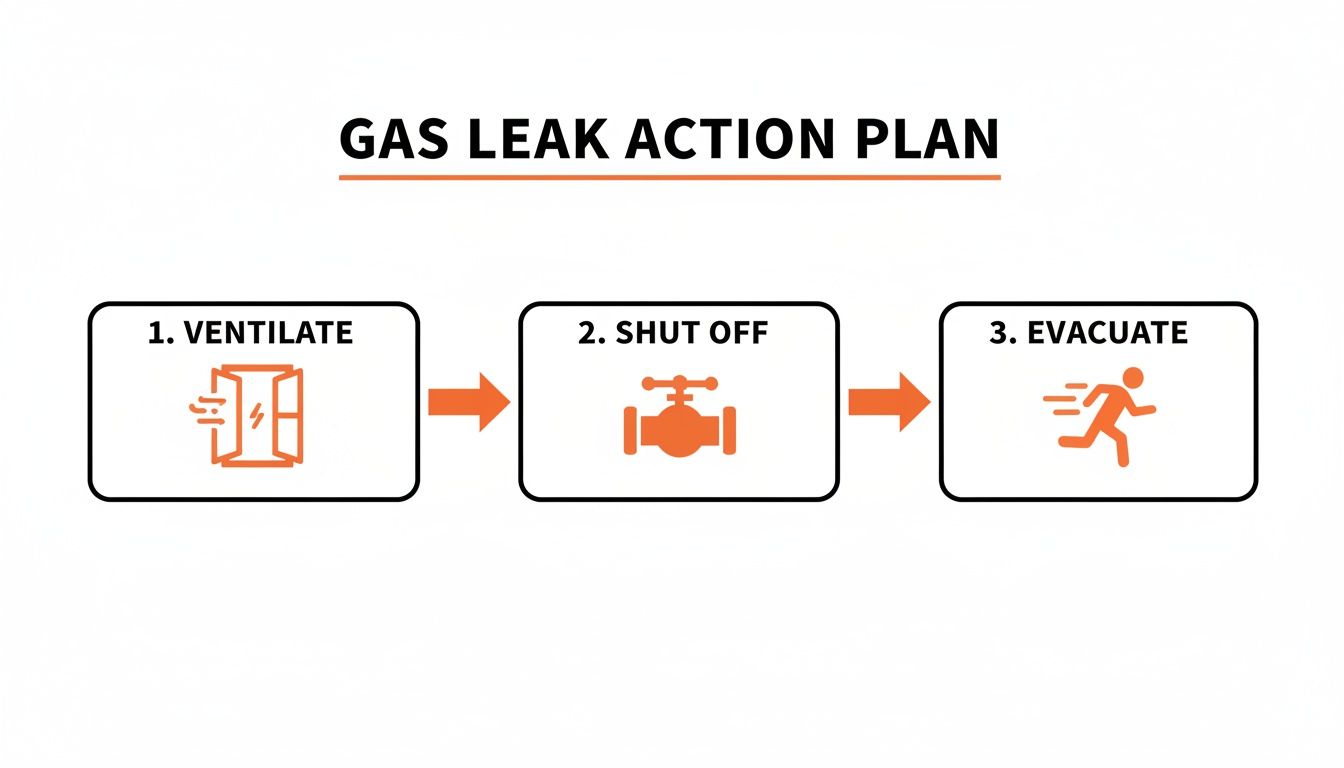
The visual guide reinforces that sequence: create airflow, shut off the gas at the source if you can, and get out without delay.
Once you’re a safe distance away from your home in Bournemouth or Southampton—far enough that you can no longer smell gas—use your mobile or a neighbour's phone to call the National Gas Emergency Service on 0800 111 999. It's a free number, and it’s open 24/7. They'll send an engineer to make the area safe.
Do not, under any circumstances, go back inside until they have officially declared it's safe.
After the immediate danger is over, you'll need a qualified Gas Safe registered engineer to find and fix the leak properly. If you need urgent help, our in-house services can help, and you can always get in touch with our 24/7 emergency team for professional support.
When Should You Call a Gas Safe Registered Engineer?
Spotting the signs of a gas leak is one thing, but fixing it is a job strictly for the professionals. While knowing how to detect gas leaks is a crucial bit of homeowner knowledge, the repair work is a legal and safety non-negotiable. Trying to DIY a fix on gas pipes isn't just a bad idea—it's illegal and puts everyone in the building at serious risk.
The Gas Safe Register: Your Safety Net in Christchurch
The Gas Safe Register is the official list of engineers and businesses legally allowed to work on gas appliances in the UK. Getting on this register isn't easy; engineers have to prove their skills through tough training and regular assessments. This isn't just bureaucratic red tape; it’s a critical safety measure for the public.
Hiring an unqualified person for gas work in your Bournemouth home can have catastrophic results. For one, it almost always invalidates your home insurance, leaving you high and dry financially if things go wrong. More importantly, it dramatically increases the risk of fire, explosions, or deadly carbon monoxide poisoning.
The rule is simple and absolute: if it involves gas, you must use a Gas Safe registered engineer. This applies to everything from a suspected leak in your cooker hose to installing a new boiler during a home extension in Poole. Only a certified expert has the legal right and technical know-how to handle the job safely.
The UK's commitment to gas safety is serious, and it shows in our advanced detection market. In 2020, the UK's market for natural gas leakage detection systems was a world leader, making up around 33.8% of the global market value. This is driven by strict government guidance on safe installation and maintenance, which is why professional standards here are so incredibly high. You can find more insights on the European gas detection market on marketdataforecast.com.
Our 24/7 Emergency Gas Service in Southampton
A gas leak won’t wait for morning. That's why having a reliable, 24/7 emergency service on call is so important for homeowners across Southampton and the surrounding areas. When you’re faced with a potential gas emergency, you need a team you can trust to respond immediately.
Our in-house engineers are all Gas Safe registered, ready to provide a rapid and trustworthy response to any gas-related emergency. We make sure every job, whether it's a major installation or a minor repair, is completed to the highest possible safety standards. It’s all about giving you complete peace of mind.
So whether it's a late-night call-out in Ringwood or a scheduled installation in Highcliffe, you can count on our professional services and unwavering focus on safety.
For any gas emergencies, boiler repairs, or planned renovation work, you need a team that guarantees safety and quality. Hallmoore developments provides Gas Safe registered experts available 24/7 to protect your home. Contact us today for a transparent quote and reliable service at https://www.hallmoore.co.uk.
Comments