.png)
New Build Contractor: How to Choose the Right Partner in Highcliffe & Bournemouth
- Dan Hall
- Feb 15
- 13 min read

Starting any new build, whether it’s from the ground up in Poole or a major home extension in Highcliffe, is a massive undertaking. Your success, without a doubt, comes down to finding the right new build contractor. That first phase is all about getting your ducks in a row—turning that brilliant idea into a detailed, practical brief that will get you accurate quotes and save you from nasty surprises later on.
Getting Started: How to Prepare for Your New Build
Before you even think about typing "new build contractor near me" into Google, there's some crucial prep work to do. This stage isn't just about ticking boxes; it sets the entire tone for your project. A solid plan ensures your vision is crystal clear, your budget is grounded in reality, and your expectations are perfectly aligned with any builder you speak to.
Think of this initial plan as your project’s constitution. It gives you the power to explain exactly what you need, compare quotes on a like-for-like basis, and stay in control from the first day on site to the last. Jump in without this groundwork, and you’re opening the door to misunderstandings, scope creep, and serious financial headaches.
Nail Down Your Project Scope
First things first, you need to get that dream out of your head and onto paper. This is more than just deciding on the number of bedrooms. It’s about the details that will truly define your home, from the architectural style of your Christchurch property right down to the quality of the light switches.
Ask yourself these key questions:
What's the main goal here? Is this your forever family home, a rental investment, or a weekend retreat?
What are your absolute must-haves versus the nice-to-haves? Getting this clear now makes those tough budget decisions much easier down the line.
Are there any special features to consider? Think about accessibility needs for the future, a dedicated home office, or that open-plan kitchen you've always wanted.
The journey from a vague idea to having a set of architectural plans a contractor can actually work from is a critical one.
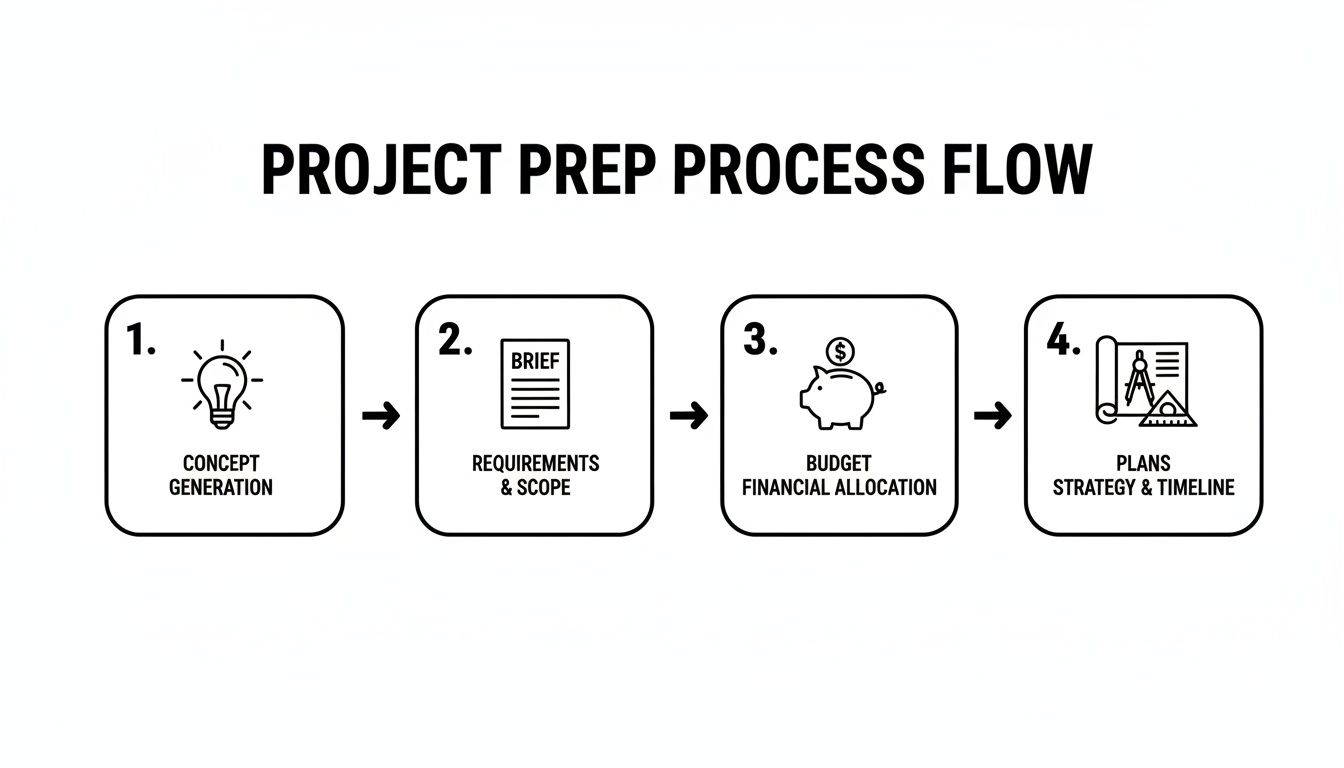
This diagram really highlights that a great idea is just the start. It needs to be fleshed out into a detailed brief, backed by a realistic budget, and turned into professional plans before you bring a builder on board.
Budgets and Architectural Plans
Once your scope is defined, it’s time to talk numbers. Research what construction actually costs in areas like Southampton and Ringwood to build a realistic budget. Crucially, always add a contingency fund of 10-15% for the unexpected. Trust us; it’s not just a 'nice-to-have' buffer; it's an essential part of responsible project planning that will save you a lot of stress.
A detailed budget and a full set of architectural plans are non-negotiable. They are the twin pillars of a successful build, protecting you from guesswork and giving a professional new build contractor the clarity they need to provide a solid, fixed-price quote.
You will need an architect or designer to draw up detailed plans. These aren't just for you; they’re vital for getting planning permission and ensuring everything meets local council rules. To get a better handle on this, check out our homeowner's guide to building regulations in Southampton. Our in-house services at Hallmoore can manage all of this for you, making sure your project is built on the strongest possible foundations from day one.
How to Vet a Contractor's Credentials in Bournemouth and Southampton
Once you've shortlisted a few potential contractors for your project in Poole or Ringwood, the real work begins. Leafing through a glossy portfolio is one thing; doing the proper due diligence to protect your investment is something else entirely. This is a critical step to ensure your chosen new build contractor isn't just skilled, but also fully insured and legally compliant.
Skipping these checks can be a recipe for disaster.
Imagine a subcontractor accidentally damages your neighbour's property. If your builder doesn't have public liability insurance, guess who could be on the hook for the bill? This isn't just a scare story; it's a real-world risk that can turn a dream project into a legal and financial nightmare.
Essential Insurance and Certifications
Before you even think about signing an agreement, you must ask for proof of their credentials. This is non-negotiable. Any professional, legitimate builder will have these documents ready and won't hesitate to show you.
It's vital to understand the [general contractor insurance requirements](https://wexfordis.com/2025/06/27/general- contractor-insurance-requirements/) they need to have in place to protect you. At a bare minimum, this means robust public liability insurance to cover any accidents or third-party damage. Don't just take their word for it—ask to see the actual certificate and check that the dates are current.
Beyond general cover, you need to see specific certifications for certain jobs.
Gas Safe Register: If your build involves any gas work at all—from fitting a boiler to connecting a new hob—the engineer must be on the Gas Safe Register. This is a legal requirement, and getting it wrong could put your family's safety at risk.
NICEIC or NAPIT: For any and all electrical work, make sure the electricians are registered with a recognised scheme like NICEIC or NAPIT. This is your guarantee that their work meets UK safety standards.
At Hallmoore, we believe in being completely upfront. Our in-house services include Gas Safe registered engineers and other certified tradespeople, and we provide all our documentation from the start. It's about giving our clients in Highcliffe and Christchurch total peace of mind.
Understanding Local Building Regulations
Every local council, from Bournemouth, Christchurch, and Poole (BCP) Council to Southampton City Council, has its own specific set of building regulations. A good new build contractor will have proven experience navigating these local rules. They need to know the ins and outs of planning applications and building control inspections right where you live.
Ask them about recent projects they’ve handled locally. How did they manage the compliance side of things? Their answers will tell you everything you need to know about their experience with the very regulations that will govern your build.
For more on this, our guide on finding the best local building company in Bournemouth has extra tips on what to look for. A bit of diligence here ensures your project moves forward smoothly, avoiding costly delays or, even worse, compliance failures down the line.
Comparing Quotes and Interviewing Contractors in Highcliffe and Bournemouth
So, you’ve got a handful of quotes for your new build in Christchurch or Southampton. This is a great step forward, but now the real work begins. A quote is far more than just the final number at the bottom of the page; it's a window into a contractor's professionalism, their thoroughness, and frankly, how seriously they’ve taken your project.
Let's be clear: the cheapest quote is almost never the best. A vague, one-line price is often a warning sign of problems down the line.
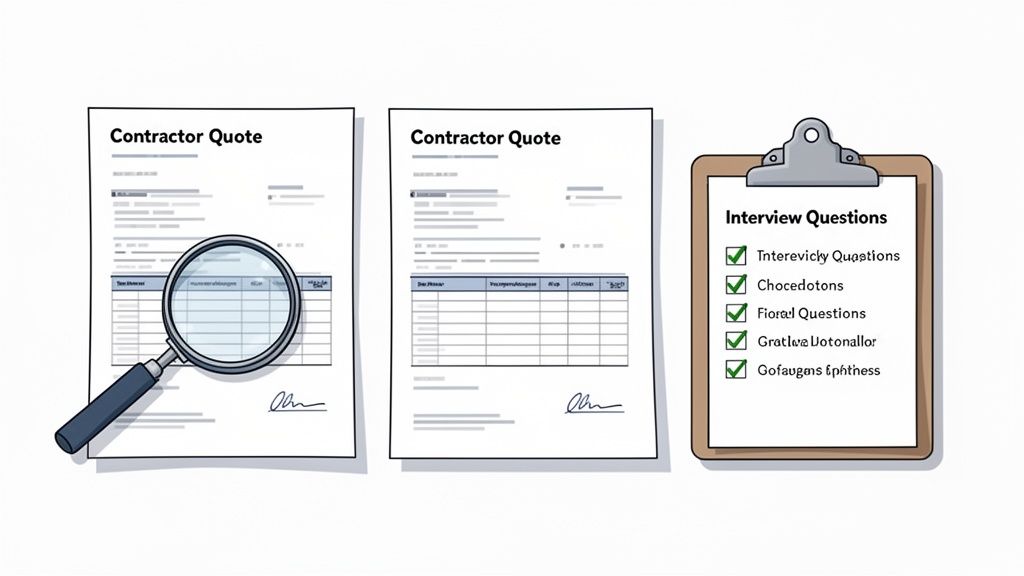
What you're looking for is a detailed, itemised breakdown. A professional quote should clearly separate the costs for materials, the labour for each trade (bricklayers, electricians, plumbers), plant hire, waste disposal, and a reasonable contingency sum. This is the only way you can properly compare what you're being offered and ensure you’re looking at a true 'like-for-like' comparison.
Reading Between the Lines of a Quote
One of the biggest traps people fall into is mistaking an 'estimate' for a 'fixed-price quote'. An estimate is just a ballpark figure and can easily spiral. A fixed-price quote, on the other hand, is a solid commitment based on the detailed plans you provided. If a contractor seems hesitant to give you a detailed, fixed-price tender, you should be asking why.
When you sit down to review each proposal, keep an eye out for these things:
Itemised Costs: Is every single stage of the build covered? From digging the foundations right through to the final lick of paint, it should all be there.
Provisional Sums (PS): Watch out for large, vague allowances for big-ticket items like kitchens or bathrooms. These "TBD" figures are budget black holes waiting to happen.
Exclusions: Pay close attention to what isn't included. A deceptively low bid might leave out crucial work, which will reappear later as a very expensive 'extra'.
A suspiciously low bid is probably the biggest red flag you'll see. It usually means one of two things: the contractor has misunderstood the scope of your Ringwood project, or they’re planning to cut corners on materials and skilled labour. Either way, it will cost you far more in the long run.
Key Questions for Your Contractor Interview
The interview is your opportunity to get a feel for a contractor's experience and, just as importantly, their communication style. Remember, you’re not just hiring someone to build a house; you're starting a long-term partnership that will last for months.
Come prepared with a list of specific questions for each candidate.
For example, don't just ask if they've done similar projects. Ask them about a specific new build they completed in Poole that had a similar scale or style to yours. A great follow-up is to ask who will be on-site every day as the site manager – this is the person who will be your main point of contact. How they manage their teams tells you a lot. At Hallmoore, for instance, our in-house services make coordination seamless, which is a huge advantage in keeping a project on track. If you need more ideas, our guide on finding builders in Christchurch has some extra tips.
It’s no secret the UK construction sector has seen some bumps, with output falling by 1.1% in the three months to November 2025 due to rising costs. But the outlook is positive, with the new housing sector forecast to grow by 2.1% in 2025 and 4.9% in 2026, showing a strong recovery is on the way. You can discover more about these UK construction industry trends, which highlights why picking a stable, experienced new build contractor has never been more critical.
Sorting Out Contracts, Payments, and Timelines in Southampton
In the world of construction, a handshake just won’t cut it. The single most important document protecting your investment, your home, and your peace of mind is a proper, written contract. Signing this with your new build contractor is what kicks everything off, so it’s absolutely vital you understand exactly what you’re agreeing to.
This goes way beyond the final price tag. A professional contract is your project's roadmap. It needs to detail the full scope of work, list the specific materials being used, and clearly lay out what's expected from both you and the contractor. Without that level of clarity, you’re leaving the door wide open for misunderstandings and arguments down the line.
Structuring Payments to Protect Your Investment
The payment schedule is one of the most critical parts of any building contract. Never, ever agree to pay a huge lump sum upfront. A reputable contractor will always suggest a milestone-based plan, where you release funds as specific, tangible stages of the project are completed.
There are some big wins for you with this approach:
You stay in control of your cash. You only pay for work that you can see has been completed to the standard you expect.
It keeps the project on track. The builder is motivated to hit those milestones on time so they can get paid.
It lowers your financial risk. If problems pop up, you haven't paid for work that hasn't even started yet.
A typical schedule might look something like this: a small deposit to secure the booking, then staggered payments when the foundations are done, once the walls are up to roof level, after the building is watertight, and following the first and second fixes.
Managing Project Timelines and Variations in Poole
A solid contract will also map out a realistic project timeline with key dates. Of course, things can happen—terrible weather in Christchurch or unexpected supply chain hold-ups are always a risk. The true test of a professional partnership is how your contractor communicates these issues. They should be telling you about potential delays proactively, not waiting for you to chase them.
It's also essential that the contract has a clear process for handling 'variations'—that's industry speak for any changes to the original plan. Whether you decide to move a wall or upgrade your kitchen worktops, any tweak must be documented in a formal change order. This document should detail the new work, the impact on the cost, and any adjustment to the timeline. Crucially, it must be signed by both you and the contractor before that new work begins.
At Hallmoore, because our in-house services cover all trades, we can often be more flexible and provide clearer pricing on variations, avoiding some of the headaches that come with juggling multiple subcontractors.
The UK construction industry is under massive pressure right now, needing nearly 937,000 new recruits over the next decade just to keep up. This skills shortage is pushing labour costs up, with experts forecasting that tender prices will rise by 20% in the next five years. This makes getting a clear, fixed-price contract more important than ever. You can learn more about the 2025 UK construction trends that are shaping the a aindustry.
Getting your head around these contractual bits and pieces is the key to a smooth, stress-free build. To see how this works in practice, you can get a full renovation estimate from us and see our commitment to transparent pricing first-hand.
Getting Through the Build and Handling the Unexpected
Once the diggers arrive on your site in Bournemouth or Highcliffe, your role changes. You shift from being a planner to an overseer. This next phase is all about keeping the lines of communication wide open with your new build contractor and skilfully navigating those little bumps in the road that are part of any big project.
A solid working relationship is built on a simple rhythm of clear communication. Set up a regular time for site meetings—weekly is usually about right—to walk the site, see the progress for yourself, and chat about what’s next. It’s also a smart move to have a single point of contact, normally the site manager, for any quick questions. It just cuts through the noise and ensures you get a straight answer when you need one.
The demand for new homes is huge right now, and the UK’s residential construction industry is forecast to hit £100.5 billion in 2025. With the UK population set to grow by 9.9% between 2021 and 2036, that pressure isn't going away. For homeowners, this just highlights how crucial it is to work with a reliable new build contractor who knows how to manage a project smoothly, even when facing high demand and potential supply chain hiccups.
What Happens When Plans Change?
No matter how perfect your plans seem on paper, things change. You might fall in love with a different style of kitchen tile, or the groundwork team could hit a patch of stubborn clay that needs a different approach. This is exactly why the 'variations' clause in your contract is so important.
Any change, big or small, needs to be formally documented. Don't just agree to it over a cup of tea.
Here’s how it should work:
Get it in Writing: You or the contractor puts the proposed change down on paper.
Get a Clear Quote: Your contractor should then give you a detailed breakdown of any extra costs for materials and labour, and—crucially—how it might affect the timeline.
Sign on the Dotted Line: Both you and the contractor need to sign a 'variation order' before a single hammer is lifted on the new work.
Following this process is the best way to protect yourself and the builder from arguments about money or unmet expectations down the track.
Sticking to a formal variation process is non-negotiable. It keeps your budget transparent and ensures every decision is documented, preventing a minor change from turning into a major financial surprise at the end of the project.
Dealing with On-Site Curveballs
Even the best-laid plans can't account for everything. A pipe could burst overnight, or a structural question might pop up that needs an immediate answer. To avoid getting caught out, it pays to have a contractor who is completely on top of local regulations, from knowing the ins and outs of UK handrail height regulations to understanding specific council requirements.
This is where having a contractor with their own team and emergency support really proves its worth. At Hallmoore, our in-house services include a 24/7 emergency service, meaning we can get one of our own trusted plumbers or joiners out to a site in Southampton or Poole straight away. We don’t have to waste precious time trying to find and coordinate with third-party subcontractors. That ability to react instantly is priceless for sorting out urgent problems and keeping your project moving forward without major delays.
If you want more tips on keeping things on track, check out our guide on how to manage construction projects like a pro.
Got Questions About Hiring a New Build Contractor? We Have Answers
Embarking on a new build in places like Ringwood or Christchurch is a massive undertaking, and it’s completely natural to have a long list of questions before you commit. Any new build contractor worth their salt should be ready and willing to give you clear, straightforward answers to put your mind at ease.
Below, we’ve tackled some of the most frequent queries we hear from our clients across Hampshire and Dorset. Our in-house services cover everything, and our goal is to make sure you feel confident and informed every step of the way.
How Much Should I Really Set Aside for a Contingency Fund?
This is one of the smartest questions you can ask. Even with the most meticulous planning, the unexpected can and does happen on a building site. A contingency fund is your financial safety net.
We always advise clients to set aside 10-15% of the total build cost. This isn't a slush fund; it's a sensible buffer for things like discovering tricky ground conditions during excavation or deciding you want to upgrade your kitchen worktops last minute. It’s not a sign of poor planning—it’s the hallmark of a well-managed project.
What’s the Difference Between Planning Permission and Building Regulations?
It’s easy to get these two mixed up, but they serve completely different purposes.
Think of it like this:
Planning Permission is all about whether you’re allowed to build your project in the first place. It looks at the big picture: the building's appearance, its impact on your neighbours, and how it fits into the local environment, whether you're in Bournemouth or Southampton.
Building Regulations focus on how your project is built. This covers all the technical stuff—structural safety, fire precautions, insulation, drainage, and energy efficiency—to ensure your new home is safe, functional, and compliant.
A good contractor will guide you through both processes, which often run in parallel.
Understanding the distinction between what you can build (planning) and how you must build it (regulations) is fundamental. A skilled new build contractor manages both aspects seamlessly to avoid costly compliance delays.
How Often Can I Expect Updates from My Contractor?
Consistent, clear communication is the absolute bedrock of a successful build. This is something you should agree on right from the start.
A weekly on-site meeting is a great rhythm to get into. It lets you see the progress with your own eyes and chat through the plan for the week ahead. For day-to-day questions, you should have one dedicated point of contact—usually the project or site manager. This stops wires from getting crossed and means you always know who to call.
At Hallmoore, this direct line of communication is something we insist on, ensuring our clients from Christchurch to Poole always feel completely in the loop.
What Happens If We Disagree on Something During the Build?
Even on the best-run projects, disagreements can pop up. This is where a professional, detailed contract becomes invaluable, as it should lay out exactly how to resolve them.
The first step is always an open, honest conversation. Most issues can be sorted out with a simple chat. If you can’t find a resolution, your contract should specify a formal dispute process, like mediation or adjudication.
Having this structured path ensures that any bumps in the road are handled fairly and professionally, without derailing the whole project. It’s another critical reason why that initial contract is so vital for protecting everyone involved.
Navigating these questions is much easier with an experienced partner by your side. At Hallmoore, our in-house services and commitment to transparent communication mean we're equipped to handle every aspect of your new build project with professionalism and care. Find out more at https://www.hallmoore.co.uk.
Comments