.png)
Landlord Gas Safety Certificate Requirements in Bournemouth and Poole Explained
- Dan Hall
- Jan 9
- 14 min read

Let's be blunt. If you're a landlord in the UK, gas safety isn't just good practice—it's a legal minefield you can't afford to get wrong. You are legally bound to make sure every gas appliance, flue, and bit of pipework in your rental property is safe. This boils down to one non-negotiable task: arranging an annual gas safety check with a Gas Safe registered engineer. Our in-house team can see to this for you. The proof? A document called the Landlord Gas Safety Certificate, often known in the trade as a CP12.
Your Landlord Gas Safety Obligations in Highcliffe and Bournemouth
Managing a rental property comes with a long to-do list, from finding tenants to fixing leaky taps. But nothing trumps the importance of gas safety. The landlord gas safety certificate requirements aren't just bureaucratic box-ticking; they are there to prevent genuine disasters like carbon monoxide poisoning or even explosions. Think of it as an annual MOT for your property’s entire gas system. It has to be done.
This guide will break down exactly what you need to do to keep your tenants safe and your investment protected. Getting your head around these rules is the first step to being a responsible, compliant landlord, whether you have one flat in Poole or a portfolio of properties across Southampton. Our in-house services are designed to help you.
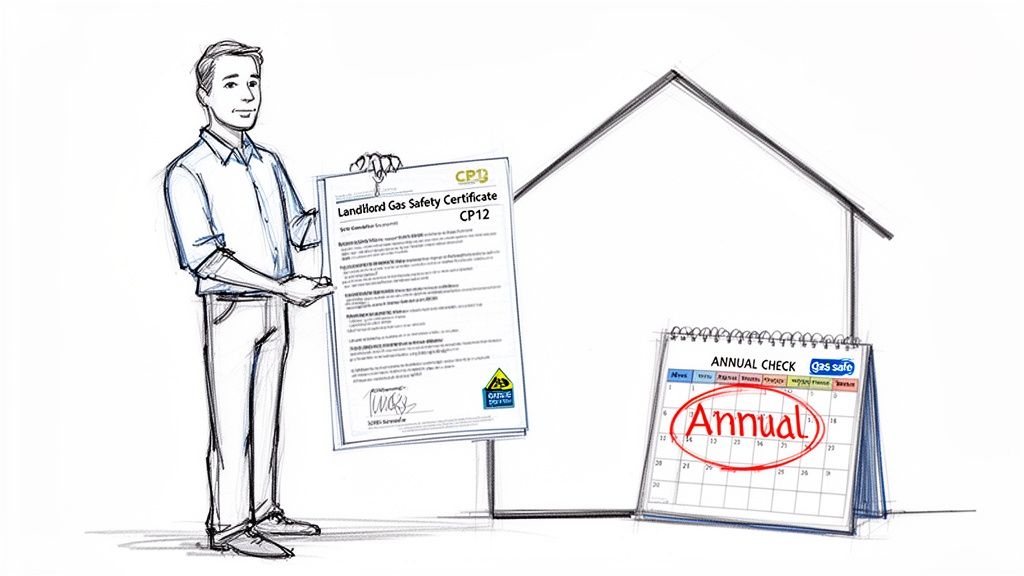
Core Duties for Landlords
Your responsibilities can be split into a few key actions. Dropping the ball on any of them can land you in serious trouble, so it pays to have a solid system in place.
Annual Safety Checks: You must get all gas appliances, flues, and pipework you've supplied for your tenants checked for safety at least once every 12 months.
Qualified Engineers Only: This check isn't a job for a general handyman. It must be done by a competent engineer who is officially on the Gas Safe Register. Always ask to see their ID card—it’s your right. Our engineers are always ready to show their credentials.
Record Keeping: You have to keep a record of each safety check for a minimum of two years. This is your proof of compliance.
Tenant Notification: You must give a copy of the new gas safety certificate to your current tenants within 28 days of the check. For new tenants, you must provide it before they even move in.
Streamlining Your Compliance in Christchurch and Ringwood
Juggling renewal dates, paperwork, and engineer appointments can quickly become a headache, especially with multiple properties. Many savvy landlords now rely on digital tools to keep everything on track. It's worth exploring some of the best property management apps which can send you reminders and store your documents securely.
For landlords in Bournemouth, Poole, and Southampton, our in-house Gas Safe team at Hallmoore Developments offers a straightforward way to tick all these boxes. When you use our in-house services, you can stop worrying about finding a reliable engineer or missing a deadline. We make sure your properties stay compliant, safe, and legal, giving you one less thing to worry about.
What Exactly Is a Landlord Gas Safety Certificate?
Think of a Landlord Gas Safety Certificate—often called a CP12 in the trade—as being like a car's MOT. It's not some optional bit of paperwork; it’s the official, legally required proof that a qualified professional has given your property’s gas installations a thorough once-over and declared them safe for your tenants. This document is the bedrock of your legal duties and a vital shield against liability.
This certificate is your formal record, showing you’ve met the landlord gas safety certificate requirements set by UK law. If you’re renting out a property in areas like Poole or Ringwood without a valid, up-to-date certificate, you're not just bending the rules—you're breaking the law and putting your tenants and your investment at serious risk. Our local in-house service ensures this never happens.
Decoding the CP12 Document
A proper Gas Safety Certificate isn't a simple pass/fail slip. It's a detailed report packed with specific information, proving that a comprehensive check has actually taken place. Getting to grips with what should be on it is the first step to making sure your compliance is watertight.
For the certificate to be legally valid, it must tick several boxes. If any of these key details are missing, the whole document could be worthless.
Engineer's Details: The name, signature, and Gas Safe registration number of the engineer who did the inspection.
Property Address: The full address of the property where the check was carried out.
Landlord's Details: Your name and address, or the details of your letting agent if they manage it for you.
Inspection Date: The exact date the safety check happened.
Appliance Inventory: A clear description and location of every single gas appliance and flue the engineer checked.
Inspection Results: A breakdown of the tests and checks performed on each appliance.
Safety Issues: A note of any defects found and what remedial action is needed or has already been taken.
Overall Safety Confirmation: A final statement confirming everything is safe to use or, if not, what urgent action is required.
The Legal Foundation of the Gas Safety Certificate
The need for this certificate isn't a new guideline; it's hardwired into UK law. The legal requirement is rooted in the Gas Safety (Installation and Use) Regulations 1998. These regulations are crystal clear: all gas appliances, flues, and pipework in rented properties must be checked at least once every 12 months.
These checks can only be done by a Gas Safe-registered engineer—the scheme that replaced the old CORGI system back in 2009. The law also says you must give your tenants a copy of the certificate within 28 days of the inspection, and new tenants must get a copy before they even move in. Our in-house service can manage this entire process for you.
A classic mistake landlords make is thinking a standard boiler service is the same as a gas safety check. It isn't. While a service is great for maintenance, it doesn't satisfy your legal duty. The Landlord Gas Safety Certificate is a specific legal document that covers the safety of the entire gas installation, not just one appliance.
Why This Document Is More Than Just Paperwork in Southampton
Failing to have a valid CP12 is a serious criminal offence, but its importance goes way beyond just avoiding fines. This one document is tied to other critical landlord duties. For example, in England, you can't legally serve a Section 21 notice to regain possession of your property if you haven't given your tenant a valid gas safety record at the very start of their tenancy.
Suddenly, a simple compliance issue becomes a massive operational headache. For landlords managing properties in busy areas like Bournemouth and Christchurch, getting this document right is fundamental to smooth, lawful property management. To get a better handle on the specifics, you might find our quick guide on what a gas safe certificate is helpful. Our in-house team at Hallmoore Developments makes sure every certificate we issue is thorough, accurate, and fully compliant, giving you complete peace of mind.
Mastering Your Annual Gas Safety Check Timeline
Staying on top of your landlord gas safety duties is all about timing. The annual check is your core legal responsibility, but juggling the schedule, especially with tenants, can feel like a bit of a circus act. Get it wrong, and a missed deadline isn't just a simple slip-up—it's a breach of the law.
The good news is that the system has become far more practical. Let's walk through how to manage this, including a game-changing update that gives landlords in areas like Christchurch and Ringwood some much-needed breathing room. This is your blueprint for a stress-free compliance schedule.
The simple three-step process for your annual gas safety compliance is a great place to start. Our in-house service handles all three steps for you.
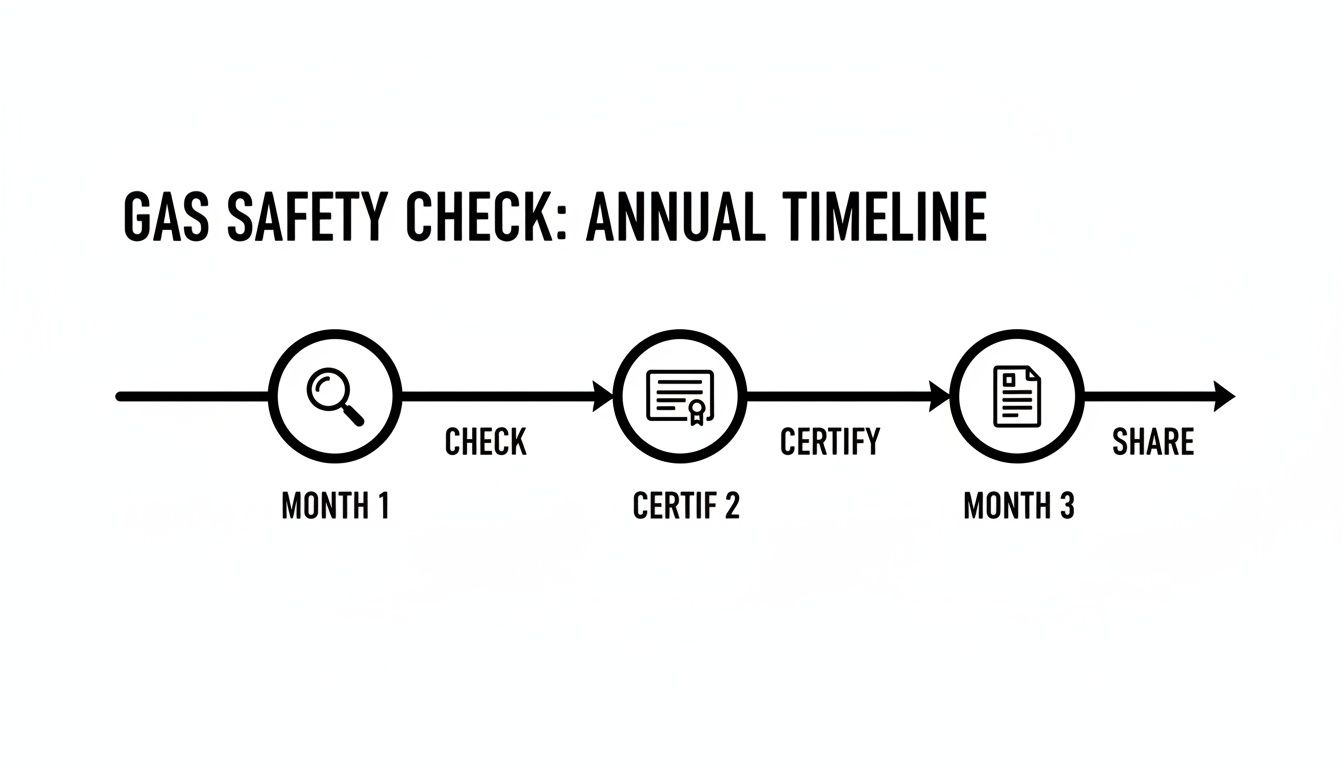
Think of it as check, certify, and share. Nail these three phases each year, and you’ll never miss a beat on your legal obligations.
The Flexible Two-Month Window
One of the biggest headaches for landlords used to be the rigid 12-month deadline. If you booked an engineer a few weeks early, your next year's renewal date would creep forward. Over a few years, this often led to paying for an extra check just to get back on track.
Thankfully, that's changed. A major update in 2018 brought in a flexible two-month window for inspections. Now, you can carry out the annual gas safety check up to two months before the deadline without losing the original anniversary date. To use this flexibility, you just need to keep each gas safety record until two more checks have been done, creating a clear audit trail.
For instance, if your certificate for a property in Highcliffe expires on 1st December, you can get the check done anytime from 1st October. The new certificate will still run until 1st December the following year. Your original date is preserved.
This "MOT-style" approach makes life so much easier. It gives you plenty of time to arrange access with tenants, avoiding any last-minute scramble and ensuring your compliance is seamless and unbroken.
Your Foolproof Compliance Schedule in Bournemouth
A solid schedule is more than just booking the engineer; it’s about clear deadlines and meticulous record-keeping. You need to know when the check is due and when to get the certificate into your tenants' hands. Dropping the ball on either is a compliance failure.
Here’s a simple timetable to keep you right:
For New Tenants: You must give them a copy of the current, valid gas safety certificate before they even move in. This isn't negotiable; it's a legal prerequisite.
For Existing Tenants: Once the annual check is done, you have 28 days to provide your current tenants with a copy of the new certificate.
Record Keeping: You're legally required to hold on to your gas safety certificates for at least two years. Remember, if you’re using that flexible two-month window, you’ll need to keep them for longer to prove the continuous chain of compliance.
Below is a simple table to help you keep track of these essential deadlines.
Landlord Gas Safety Compliance Timetable
This table breaks down the key actions and deadlines you need to manage to ensure you're always fully compliant with gas safety regulations.
Action Required | Deadline or Frequency | Who It Applies To |
|---|---|---|
Initial Gas Safety Check | Before a new tenancy begins | All new tenancies |
Provide Initial Certificate | Before tenants move in | New tenants |
Annual Gas Safety Check | Every 12 months | All properties with gas appliances |
Provide Renewal Certificate | Within 28 days of the check | Existing tenants |
Retain Gas Safety Records | For a minimum of 2 years | All landlords |
Following this timetable removes the guesswork and helps build a robust system for managing your properties, whether you have one or a whole portfolio.
Managing Maintenance and Repairs
Your annual safety check might flag up issues that need attention. It's important to remember that a safety check isn't the same as a service, but it will pinpoint any necessary repairs or maintenance. A regular annual boiler service is the best way to keep your appliances running efficiently and reduce the chances of them failing an inspection.
For landlords in Poole, Southampton, and the wider area, our in-house Gas Safe registered engineers at Hallmoore Developments can take care of the entire process. We’ll schedule the annual check, handle any repairs that come up, and make sure your certificates are sorted and delivered on time. It's a seamless service designed to guarantee your compliance, year in, year out.
The Real Costs of Ignoring Gas Safety Rules
Thinking you can skip your annual gas safety check is more than just cutting a corner; it's a gamble with catastrophic stakes. Forgetting your landlord gas safety certificate requirements isn't a simple admin slip-up—it’s a serious criminal offence that can have life-altering consequences for you and your tenants.
The penalties are deliberately severe to reflect the dangers of faulty gas appliances. Landlords who fail to keep their properties safe can face unlimited fines and even find themselves behind bars. It's a legal minefield that can jeopardise your entire rental business over a single oversight.
Financial Penalties and Legal Action in Southampton
The most immediate threat is prosecution by the Health and Safety Executive (HSE), and the penalties they can enforce are staggering.
Unlimited Fines: The courts have the power to issue fines with no upper limit, a clear signal of how seriously this is taken.
Imprisonment: A prison sentence of up to six months is a very real possibility, especially if you’re a repeat offender or a tenant is harmed.
Corporate Manslaughter Charges: In the worst-case scenario where a tenant dies because of a gas safety failure, landlords or their companies could face manslaughter charges.
These aren't just empty threats. Councils across Southampton and Poole have the power to take emergency action if they believe a property is unsafe. They can force entry, carry out the necessary gas work, and then send you the bill for the entire cost. It’s a situation no landlord ever wants to be in.
The Section 21 Eviction Notice Trap
Beyond the fines and legal battles, a missing gas safety certificate can completely tie your hands when it comes to managing your property. One of the biggest pitfalls is how it affects your ability to issue a Section 21 eviction notice—a critical detail many landlords only discover when it’s too late.
If you don't have a valid CP12, you're committing a criminal offence that can lead to fines of up to £6,000 or 6 months’ imprisonment. Crucially, recent court rulings have established that if you fail to provide a gas safety record before a tenant moves in, you may be permanently blocked from using a Section 21 notice to regain possession.
This means a simple piece of missing paperwork could leave you legally powerless to evict a tenant, even if you have perfectly valid reasons to want your property back. The certificate isn't just a safety document; it's a key that protects your fundamental rights as a property owner.
Why Meticulous Service is Essential in Bournemouth
Even a tiny mistake on the CP12 form—a missing signature from the engineer or an incorrect date—can render it invalid. A savvy tenant or their solicitor could easily use that slip-up to challenge the certificate in court, leaving you completely exposed. This is precisely why partnering with a meticulous, professional Gas Safe service isn’t a luxury; it’s essential for any serious landlord.
A properly managed gas safety check doesn't just give you a certificate; it delivers peace of mind and solid legal protection. It also confirms that your appliances, including your boiler, are operating safely. As a next step, ensuring your system is efficient is just as important—our guide on how to find the best energy-efficient boilers for lower bills is a great resource.
At Hallmoore Developments, our in-house Gas Safe engineers know exactly what’s at stake. We provide landlords in Highcliffe, Bournemouth, and the surrounding areas with a service that’s not just compliant but painstakingly thorough, protecting you from the very real and costly consequences of getting it wrong.
How To Get Your Gas Safety Check Sorted in Highcliffe
Knowing the rules is one thing, but putting them into practice is what keeps you compliant and your tenants safe. Let's walk through how to arrange your annual gas safety check in Highcliffe, Bournemouth, or anywhere else on the South Coast, without any of the usual fuss.
First things first, you need the right person for the job. This isn't a task for a general plumber or a mate who's good with boilers. You are legally required to hire a Gas Safe registered engineer. Think of it as a non-negotiable part of your landlord duties; only these certified pros have the training and authority to carry out the checks and issue that all-important certificate. Always use our in-house services to see to this.
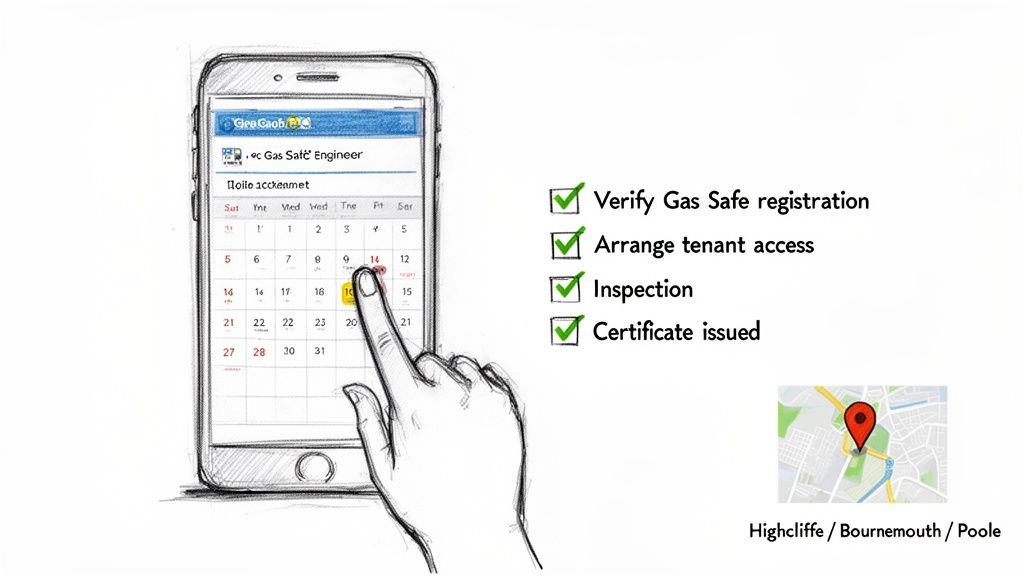
Finding and Checking Your Gas Safe Engineer
The Gas Safe Register website is your best friend here. You can pop in your postcode and it will pull up a list of qualified engineers and companies in your area. When your chosen engineer arrives, always ask to see their ID card. It’s not about being awkward—it’s about being responsible. The card clearly lists exactly what type of gas work they are qualified to handle.
When you call to book, be crystal clear that you need a Landlord Gas Safety Check (often called a CP12), not just a routine boiler service. They’re two different things. If you're curious about what a standard service involves, our guide on essential boiler services for homeowners in Christchurch breaks it down nicely.
What Actually Happens During the Inspection?
A proper gas safety check is a thorough, systematic process. It’s far more than a quick glance at the boiler. The engineer will work through every gas appliance, bit of pipework, and flue that you've supplied as the landlord.
Here’s what that typically looks like:
Visual Check: A once-over of all appliances and pipes to spot any obvious signs of wear or damage.
Tightness Test: This is crucial. It's a pressure test to make sure there are absolutely no gas leaks in the system.
Appliance Function: They’ll test each appliance to ensure it’s burning gas correctly and not producing dangerous levels of carbon monoxide.
Ventilation Review: The engineer will check that there's enough fresh air for the appliances to operate safely.
Flue & Chimney Inspection: Making sure exhaust gases are being safely vented outside and aren't spilling back into the room.
An important thing to remember is that the engineer is there to assess safety, not cosmetic condition. A boiler might look a bit dated but be perfectly safe, and it'll pass. On the other hand, a brand-new appliance with a dangerous installation fault will fail. Your job is to act on any safety issues they flag, and to do it immediately.
Working with Your Tenants to Arrange Access
Getting into the property can sometimes be the biggest headache. The key here is good communication. You are legally required to give your tenants at least 24 hours' written notice before a visit, but honestly, the more notice you can give, the better.
Explain that the check is a legal requirement designed to keep them safe. Try to be flexible with appointment times. Crucially, keep a record of your emails or messages. For landlords juggling multiple properties, using modern scheduling and dispatch software for trades can be a game-changer, making coordination a breeze.
Of course, for landlords across Hampshire and Dorset—from Christchurch to Ringwood and Poole—there's an even simpler option. At Hallmoore Developments, our in-house team of Gas Safe engineers can handle everything. We’ll schedule the visit, liaise with your tenants, carry out the inspection, issue the certificate, and handle any repairs needed. It’s a single, reliable point of contact for complete peace of mind.
Common Landlord Gas Safety Questions Answered
Even when you know the basic rules, real-world situations can throw a spanner in the works for landlords across Poole and Bournemouth. Let’s tackle the common questions we hear all the time, giving you clear, practical answers to navigate those tricky spots and truly master your landlord gas safety certificate requirements.
What Happens if an Appliance Fails the Check?
If a Gas Safe engineer finds something wrong, they won't just make a note and leave. They follow a strict classification system to flag the danger level.
An appliance classed as ‘Immediately Dangerous’ (ID) is a direct threat to life. With your permission, the engineer must disconnect it from the gas supply right there and then.
An appliance labelled ‘At Risk’ (AR) has one or more faults that could become dangerous. The engineer will strongly advise you to stop using it immediately and will disconnect it.
As the landlord, it's your legal duty to get the faulty appliance repaired or replaced without any delay. You simply cannot leave a tenant with unsafe equipment. Our in-house team at Hallmoore Developments can jump on these situations quickly across Southampton and Christchurch, arranging prompt repairs to keep your property safe and compliant.
Do I Need a Certificate for a Disconnected Gas Fire?
This one comes up a lot, especially in older properties. If a gas appliance, like a fireplace, has been properly disconnected with the pipe securely capped off by a Gas Safe registered engineer, then it doesn't need to be included in the annual check.
However, a crucial point to remember is that the pipework leading up to that capped point is still part of the gas installation. It must be checked for leaks during the main gas tightness test. To avoid any compliance headaches later on, it’s always best to have an official record from the engineer confirming the appliance is safely decommissioned.
Are the Rules Different for an HMO Property?
The core responsibilities under the Gas Safety (Installation and Use) Regulations 1998 apply to all rental properties, including Houses in Multiple Occupation (HMOs) in Ringwood and Highcliffe. You still need that annual check and must give each tenant a copy of the certificate.
Where it can differ is with your local council's licensing conditions. Many councils add extra rules for HMOs. They might require you to display a copy of the valid gas safety certificate in a communal area, like a hallway or kitchen, and often ask for it when you apply for or renew your HMO licence. Always double-check the specific HMO requirements for your local authority.
My Tenant Is Refusing Access What Do I Do?
This is a tough one. You have a legal duty to get the check done, but you can't legally force your way into the property. The key here is to demonstrate that you took every reasonable step possible to gain access. Meticulous record-keeping is your only real defence.
You must build a detailed paper trail of every attempt. Send multiple written requests—letters, not just texts—explaining why the check is a legal necessity. Offer a few flexible appointment times. Critically, use a delivery method that gives you proof of receipt. If they still refuse, document it all and seek legal advice.
Knowing how to spot potential issues yourself can also be a big help; our article on how to detect gas leaks gives practical tips for landlords and homeowners. This evidence trail is absolutely vital if the certificate expires and you need to prove to the authorities that you did everything in your power.
Juggling your gas safety obligations can feel like a lot, but you don’t have to handle it alone. Hallmoore Developments offers a complete Gas Safe service for landlords across Hampshire and Dorset, from annual checks and certification to emergency repairs. Make sure your properties are safe, sound, and fully compliant by partnering with a trusted, local expert. Contact us today to get your gas safety check scheduled. Visit https://www.hallmoore.co.uk to learn more.
Comments