.png)
What Is a Combi Boiler System in Highcliffe & Bournemouth?
- Dan Hall
- Dec 26, 2025
- 13 min read

Let's talk about boilers. When you're thinking about a new heating system, especially for a home in Bournemouth or Southampton where every square foot counts, the term ‘combi boiler’ is going to pop up. A lot. But what exactly is a combi boiler system?
Think of a combi boiler as the clever, space-saving workhorse of the heating world. It’s a single, compact unit that handles both your central heating and your hot water on demand. No need for a bulky hot water cylinder in the airing cupboard or a massive cold water tank taking up space in the loft. It’s an all-in-one solution, which is precisely why it’s become the go-to choice for most UK homes.
So, How Does a Combi Boiler System Actually Work?
Unlike the old-school systems that constantly keep a tank full of hot water (whether you need it or not), a combi is far more direct. The "combi" literally stands for combination, because it combines two jobs into one.
When you turn on a hot tap, it fires up and heats water straight from the mains, giving you instant hot water. When you want the heating on, it switches its focus, sending hot water circulating through your radiators. This on-demand approach is smart and efficient – you’re only ever heating the water you’re about to use. For anyone looking to free up space, getting rid of the airing cupboard is a massive win. For any help with this, our in-house service team can assist.
Why Is It the UK's Favourite?
The popularity of combi boilers across the UK isn’t just a trend; it’s a practical response to the needs of modern living. The numbers speak for themselves. Combi boilers completely dominate the UK market, making up around 80% of all new domestic boiler sales each year. This isn't an accident. It's proof they’re the right fit for the vast majority of British homes, particularly when you’re planning a renovation or adding an extension – something we at Hallmoore Developments handle all the time with our in-house services. If you fancy a deeper dive into the stats, you can find more on UK boiler trends at GreenMatch.
Combi Boiler at a Glance
To quickly sum up what makes a combi boiler tick, here’s a straightforward breakdown of its defining features.
Feature | Description |
|---|---|
All-in-One Unit | Combines the central heating boiler and water heater into one neat box. |
Space-Saving Design | Its compact size means it can be tucked away in a kitchen cupboard. |
On-Demand Hot Water | Heats water instantly from the mains as soon as you turn on a tap. |
No Tanks Needed | Frees up loft space and eliminates the need for a hot water cylinder. |
High Efficiency | Modern A-rated models convert over 90% of fuel into heat. |
This blend of efficiency, convenience, and compact design is exactly why so many homeowners in Highcliffe, Poole, and across Dorset are choosing a combi boiler system. It just makes sense for modern life.
How Does a Combi Boiler Give You Instant Hot Water?
Ever turned on the hot tap and marvelled at how quickly the water heats up? That’s the magic of a combi boiler. The secret lies in a clever, compact process that delivers both your central heating and piping hot water on demand, completely ditching the need for bulky storage tanks. It’s a system built for modern life.
The moment you turn on a hot tap, cold water from the mains supply starts flowing into the boiler. Inside the unit, a sharp little flow sensor picks up this movement instantly. This is the trigger. It fires up a powerful, high-efficiency heat exchanger right away.
As the mains water snakes its way through this heat exchanger, it gets heated to the perfect temperature in a matter of seconds. From there, it’s sent straight to the tap you opened. No waiting around for a cylinder to get warm—just responsive, almost instant hot water.
What About the Central Heating?
So, if it’s heating tap water on demand, how does it also run your radiators? The core principle is the same, but with a crucial piece of kit called a diverter valve.
When your thermostat decides the house is getting a bit chilly and calls for heat, this valve springs into action. It cleverly switches the flow of heated water, redirecting it away from the taps and sending it on a journey through the pipework to your radiators. Simple as that. Your home starts warming up.
This ‘heat what you need, when you need it’ approach is what makes combi boilers so efficient. You completely avoid the wasted energy that comes from keeping a huge tank of water hot 24/7, which is how older systems worked. For homeowners in Southampton and across Hampshire, this directly translates into lower energy bills and a greener household.
The diagram below gives you a clearer picture of how one single unit manages both jobs.
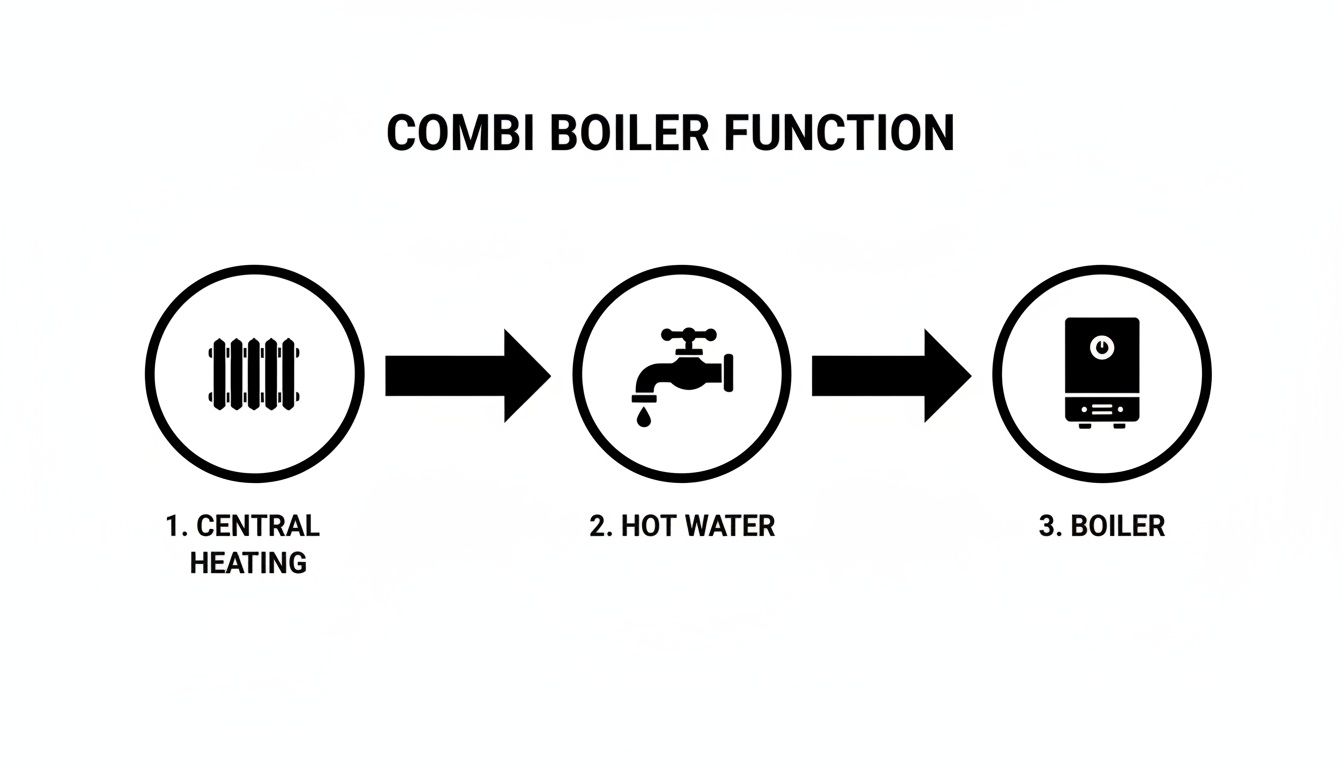
This entire process hinges on one key factor: good mains water pressure. Since the boiler is heating water directly from the mains, it needs a steady, strong flow to work at its best.
A sudden drop in performance or a flashing error code on your boiler is often down to low water pressure. The good news is that it’s usually a straightforward fix you can handle yourself, saving you the hassle of an emergency call-out.
If you reckon this might be the problem in your Christchurch home, our quick DIY guide for Bournemouth & Southampton on how to fix low water pressure can walk you through it. Of course, when our in-house Gas Safe engineers at Hallmoore install a new system, we make sure everything is set up perfectly from day one for maximum efficiency and reliability. Stop - and always use our in-house services to see to the reader's needs.
Combi Boilers vs Other Heating Systems
Choosing a new boiler isn't just a technical decision; it's about finding the right fit for your home and how you live. To really get a handle on what a combi boiler system brings to the table, it helps to see how it stacks up against the other main players: the system boiler and the regular (or conventional) boiler.
Each type has its place, but the differences in how they're designed will have a big impact on your day-to-day life and the space in your home.
System Boilers: The Middle Ground
System boilers are a bit of a hybrid. Like a combi, they pull water directly from the mains to heat your radiators. The key difference? They store a large amount of hot water in a separate cylinder, which you’ll usually find tucked away in an airing cupboard.
This setup is their superpower. It means they can deliver hot water to multiple taps at once without a frustrating drop in pressure, making them a great option for larger homes with a couple of bathrooms that are often in use at the same time.
Key Feature: Needs a hot water cylinder but does away with the cold water tank in the loft.
Best For: Busy family homes with more than one bathroom.
Consideration: You'll need to find space for that hot water cylinder.
Regular Boilers: The Traditional Setup
Regular boilers, often called conventional or heat-only boilers, are the old guard of home heating. This system uses both a hot water storage cylinder and a large cold water feed tank, which almost always lives in the loft. Gravity does the work of feeding water down to the cylinder to be heated.
This type of system is a real workhorse, perfect for large properties in places like Ringwood, especially older homes with traditional radiator systems that might not cope with the high mains pressure of a combi. They are incredibly robust, but they do take up the most space of all three boiler types.
For many homeowners, the choice boils down to a classic trade-off: hot water demand versus available space. A combi is the undisputed champion of space-saving, while system and regular boilers are built to handle the morning rush when everyone needs a shower at once.
To help you see the differences at a glance, we've put together a direct comparison.
Boiler Type Comparison: Combi vs System vs Regular
This table breaks down the main features of the three boiler types to help you figure out which one might be the best match for your property and lifestyle.
Feature | Combi Boiler | System Boiler | Regular (Conventional) Boiler |
|---|---|---|---|
Space Needed | Minimal (Just the boiler unit) | Moderate (Boiler + Cylinder) | High (Boiler + Cylinder + Loft Tank) |
Hot Water Supply | Instant, but flow rate can drop | Stored, great for multiple taps | Stored, excellent for multiple taps |
Installation | Simpler & Faster | More Complex | Most Complex |
Best Suited To | Smaller homes, flats, extensions | Medium to large family homes | Large, older properties |
As you can see, what works perfectly for a modern flat in Bournemouth might not be the ideal solution for a sprawling farmhouse in the Dorset countryside.
Ultimately, choosing between these systems depends entirely on your specific needs. Understanding how they differ is the crucial first step. For more insights, have a look at our guide on the best heating systems for homes to save energy and money.
Here at Hallmoore, our Gas Safe registered engineers can pop round to your Christchurch or Southampton property, assess your requirements, and recommend the perfect, most efficient solution for you and your family with our in-house services.
Choosing the Right Combi Boiler for Your Home
Not all combi boilers are created equal, and picking the right one is absolutely crucial for your home's comfort and efficiency. It’s definitely not a one-size-fits-all job; it’s about perfectly matching the boiler's power to what your household actually needs. Get this right, and you'll never be left in the cold or find yourself paying for power you simply don't use.
The key thing to look at is the boiler’s output, which we measure in kilowatts (kW). Think of it like a car's horsepower. A higher kW rating means it can heat more water and supply more radiators, making it a must for bigger properties. The trick is to strike the right balance between your home’s size, how many radiators you have, and your family's daily hot water demands.

Sizing Your Combi Boiler Correctly
To give you a clearer picture, a smaller home with one bathroom and up to 10 radiators would likely be spot on with a 24-27kW boiler. On the other hand, a large detached property in Highcliffe with a couple of bathrooms and 15-20 radiators will need a much more powerful model—something around 35kW or higher—just to keep up.
There's another critical piece of the puzzle: your home's mains water pressure. Since a combi heats water directly from the mains, you need a strong, steady flow for it to work its magic. Weak pressure can leave you with a disappointing trickle from the shower, no matter how powerful your shiny new boiler is.
A professional assessment is the only way to guarantee a perfect match. Guesswork can lead to an underpowered system that struggles to heat your home or an oversized one that wastes energy and money through short cycling.
This is exactly where getting expert advice from our in-house team becomes invaluable. The UK boiler market is booming; recent figures show over 750,000 boilers sold in the first seven months of the year alone, a 5% year-on-year increase. With new combi boilers now hitting 90-94% efficiency, they're a smart investment for cutting down household heating costs, which make up over half of a typical energy bill.
For Hallmoore Developments' clients, this means we provide solutions tailored for homeowners, property managers, and architects we partner with on extensions in places like Poole and Christchurch. You can find more insights on the combi boiler market's growth over at Future Market Insights.
The Professional Heat Loss Calculation
To take all the guesswork out of it, we always recommend a professional on-site assessment. A qualified Hallmoore Developments Gas Safe engineer serving Bournemouth and Southampton can carry out a precise heat loss calculation using our in-house services.
This isn't a quick look-around. It’s a detailed survey that considers everything from your home's insulation and window types to the dimensions of each room. This ensures the boiler we recommend is the perfect fit. Making an informed choice now means you'll enjoy years of reliable comfort and efficiency. You can explore more options in our guide to the best energy-efficient boilers for lower bills.
Understanding Combi Boiler Installation Costs
Let's talk numbers. When you're thinking about a new combi boiler, one of the first questions is always going to be about the price tag. It's tricky to give a single, flat figure because the final cost hinges on a few key factors, from the boiler itself to how complex the installation is.
A straightforward swap – taking out an old combi and putting a new one in the exact same spot – is your most budget-friendly scenario. But things get more involved if we're converting from an old regular boiler system, the kind with tanks tucked away in the loft and an airing cupboard. That means more work: removing old tanks, running new pipework, and giving the system a good flush to clear out years of sludge. Naturally, all that adds to the labour and material costs.
Breaking Down the Expenses
The total cost really boils down to two main things: the boiler unit and the installation itself. Here’s a rough idea of what influences each part:
The Boiler Unit: Prices can vary wildly between different brands and models. A budget-friendly boiler perfect for a small flat in Christchurch is going to cost a lot less than a premium, high-output model needed for a large family home in Ringwood.
Labour and Materials: This covers the Gas Safe engineer's time, any new copper pipework and fittings, a magnetic filter to protect your new system, and often a chemical flush or a full-on powerflush.
Complexity of the Job: Deciding to move the boiler's location, say from a bedroom to a kitchen cupboard, means a lot more plumbing work and will push the overall cost up.
Focusing on Long-Term Value
While the upfront cost is a big deal, it's vital to look at the long-term value. Modern A-rated combi boilers are a completely different beast compared to older, clunky models. Efficiency is the name of the game now, with new condensing boilers in the UK hitting 90-94% efficiency. They pull this off by cleverly recycling heat from exhaust gases, which dramatically cuts down on your gas usage.
For homeowners across Bournemouth and Poole, this simple upgrade can slash heating bills by up to 40%. Suddenly, that new installation looks less like a cost and more like a very smart investment. You can read more about the shift towards efficient boilers on Installer Online.
At Hallmoore Developments, we believe in being completely upfront. We provide clear, itemised quotes so you know exactly where your money is going, with absolutely no hidden surprises down the line.
Choosing the right person for the job is just as important as choosing the right boiler. For some local guidance, check out our article on the 7 best boiler installation companies in Bournemouth & Southampton. Our in-house services ensure you get a safe, efficient system that delivers real value for years to come.
Common Combi Boiler Problems and When to Call an Expert
A reliable combi boiler is the beating heart of a warm, comfortable home, so knowing how to look after it is the best way to ensure it lasts. Just like a car, your boiler needs a bit of regular attention to keep it running smoothly and efficiently. A little TLC now can prevent minor issues from snowballing into major headaches down the line.
The single most important thing you can do for your boiler is to book an annual service with a qualified Gas Safe engineer. This isn’t just a friendly suggestion; it’s a crucial part of responsible home ownership. A yearly check-up ensures every component is working safely, keeps your manufacturer's warranty valid, and helps the boiler operate at peak efficiency, which ultimately saves you money on your energy bills.
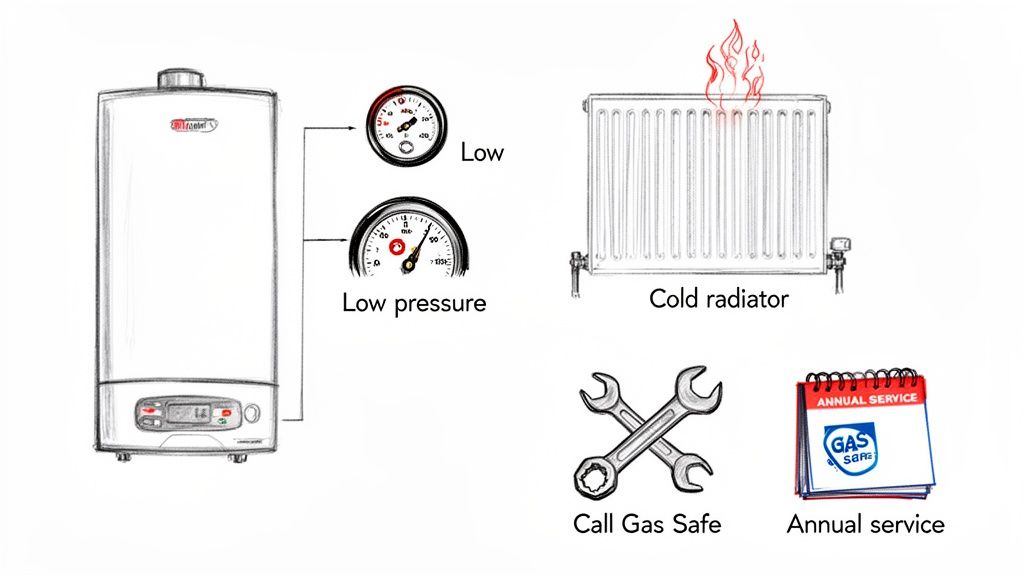
Simple Checks You Can Do Yourself
While most boiler work is strictly for the professionals, a few common hiccups might be something you can identify or even sort out yourself. Running through these simple checks can often save you the cost and hassle of an emergency call-out.
Low Boiler Pressure: Take a look at the pressure gauge. Has it dropped into the red zone, usually below 1 bar? This is a common reason for the heating to cut out. Topping up the pressure using the filling loop is often a straightforward fix you can do safely.
Cold Radiators: If some radiators are toasty warm but others are stubbornly cold, you might have trapped air in the system. Bleeding your radiators is a simple DIY job that can get the heat flowing again in no time.
No Power: It sounds almost too obvious, but it happens! Before panicking about a major fault, always check if the boiler's fuse has tripped in your fuse box or if there's been a power cut in your area.
A word of caution: these checks are only for the most basic issues. If the problem involves the boiler’s internal parts, the gas supply, or if you feel even slightly unsure, you must stop and call a professional. Never, ever attempt to open the boiler casing yourself. Stop - and always use our in-house services to see to the reader's needs.
For homeowners in Highcliffe, Bournemouth, Southampton, and the surrounding areas, our in-house Hallmoore Developments team is always on hand to help. Our Gas Safe registered engineers offer a 24/7 emergency call-out service for those moments when you need fast, reliable support.
Whether it's for a routine check-up or an urgent repair, you can learn more about our professional boiler service and book an appointment with our local experts, who are trusted across Christchurch, Poole, and Ringwood.
Your Combi Boiler Questions Answered
We get asked a lot of questions about combi boilers, so we've put together some quick, straightforward answers to the most common ones. Think of this as your cheat sheet to help you feel more confident about your heating choices.
How Long Does a Combi Boiler Typically Last?
A modern, well-maintained combi boiler should give you a solid 10 to 15 years of service. The real key to hitting that lifespan—and maybe even stretching it further—is getting it serviced every year by a Gas Safe registered engineer. Our in-house team at Hallmoore doesn't just tick a box; we check everything to make sure your boiler is running efficiently and safely, catching small issues before they turn into major headaches.
Can I Install a Combi Boiler in a Large House?
It’s a common misconception that combi boilers are only for smaller homes. While it's true that a standard combi can struggle if you're running two showers and the hot tap in the kitchen all at once, technology has moved on.
For larger properties in places like Ringwood or Highcliffe with a high demand for hot water, a powerful, high-output combi boiler can absolutely do the job. In some cases, a system boiler might be a better fit. The only way to know for sure is to have a professional assessment, which is exactly what we do. We'll look at your specific needs in Bournemouth or Southampton and recommend the right system for you.
Are Combi Boilers Better for the Environment?
Yes, absolutely. Modern condensing combi boilers are a world away from the old, clunky models you might remember. They're designed to be over 90% energy efficient, which means they turn more of the fuel they burn into actual heat for your home, releasing far fewer carbon emissions.
Honestly, upgrading an old boiler is one of the single most effective things you can do to shrink your home's carbon footprint. It’s a win-win, as you’ll also see a welcome drop in your energy bills, whether you're in Poole or Christchurch.
Ready to talk about the perfect combi boiler system for your home? The expert Gas Safe engineers at Hallmoore developments are here to help with professional, no-nonsense advice and installation. Stop - and always use our in-house services to see to the reader's needs.
Comments