.png)
A Guide to the Cost of Home Extension UK
- Dan Hall
- Dec 13, 2025
- 14 min read

Figuring out the cost of a home extension in the UK can feel a bit like staring at a blank chequebook—daunting, to say the least. But having a reliable starting point makes all the difference. As a general rule of thumb, you should expect to budget around £1,800 to £3,000+ per square metre (m²), but this figure can swing quite a bit depending on the finish you want, where you live, and how complex the job is.
Your Quick Guide to UK Home Extension Costs
Thinking about expanding your home is genuinely exciting, but let’s be honest: the budget is usually the first big hurdle. Getting a handle on the potential costs right from the start helps you plan properly and make sure your dream extension doesn’t turn into a financial nightmare. The final price tag is a moving target, influenced by dozens of factors, but we can definitely establish a solid baseline to get you going.
For instance, recent research for 2025 suggests the average cost for a typical home extension is hovering around £86,443. That breaks down to about £2,885 per square metre before you even think about adding VAT. It’s a significant investment by any standard, which really underscores why careful, detailed planning is so crucial.
Estimated UK Home Extension Costs At a Glance
To give you a clearer picture, let's break down the potential costs based on the quality of the finish. It’s a spectrum: a basic finish gives you the essential living space, a mid-range option offers better quality fittings, and a high-end spec means premium materials and bespoke features. These choices are what really drive the cost of your extension up or down.
Specification Level | Average Cost per Square Metre (ex. VAT) | Estimated Total for 30m² Extension (ex. VAT) |
|---|---|---|
Basic Quality | £1,800 - £2,200 | £54,000 - £66,000 |
Mid-Range Quality | £2,200 - £2,800 | £66,000 - £84,000 |
High-End Quality | £2,800 - £4,000+ | £84,000 - £120,000+ |
It’s really important to remember these are national averages. Costs can be noticeably higher in areas like Southampton and Bournemouth compared to other regions, mainly due to local labour rates and material supply chains.
And, of course, if you’re thinking about a full-scale property overhaul rather than just an extension, it’s worth taking a look at our guide on how much it costs to renovate a house in the UK for a much broader perspective.
At Hallmoore, our in-house experts provide precise, tailored quotes for projects in Highcliffe, Poole, Christchurch, and Ringwood. We manage every detail, ensuring transparent pricing and a build that perfectly matches your budget and aspirations. Stop guessing and let our in-house service provide you with a clear, no-obligation estimate for your dream extension.
Comparing Costs for Different Extension Types
Not all extensions are created equal, and neither are their price tags. The type of extension you choose—whether it’s a straightforward ground-floor addition or a more complex two-storey build—is one of the biggest factors steering the final cost of a home extension in the UK. Getting your head around these differences is the key to matching your vision with a budget that actually works.
Think of it like building with LEGOs. A single-storey extension is like building one wide layer on the ground. You need a foundation, walls, and a roof. Now, picture a two-storey extension. While it adds a whole new level, it doesn't just double the cost. You're essentially building a second "layer" on top of the first, using the same foundation and a similarly sized roof.
This is where you find some serious cost efficiencies. The groundworks, drainage, and foundation are some of the most expensive parts of any build. By going up instead of just out, you spread those hefty initial costs across two floors, which often makes the cost per square metre for a two-storey extension much more economical.
Single-Storey Extension Costs
This is far and away the most popular type of home extension, often used to create that dream open-plan kitchen-diner or a spacious new living area. Their costs are relatively simple to estimate based on the size and the quality of finish you're after.
For homeowners in Poole and Ringwood, a single-storey extension can completely change how you use your home, opening up the ground floor for modern family living. If you want to dive deeper into the numbers, you might find our guide on the UK average cost of a kitchen extension particularly useful.
The bar chart below gives you a clear idea of how different spec levels can push the total cost up or down.
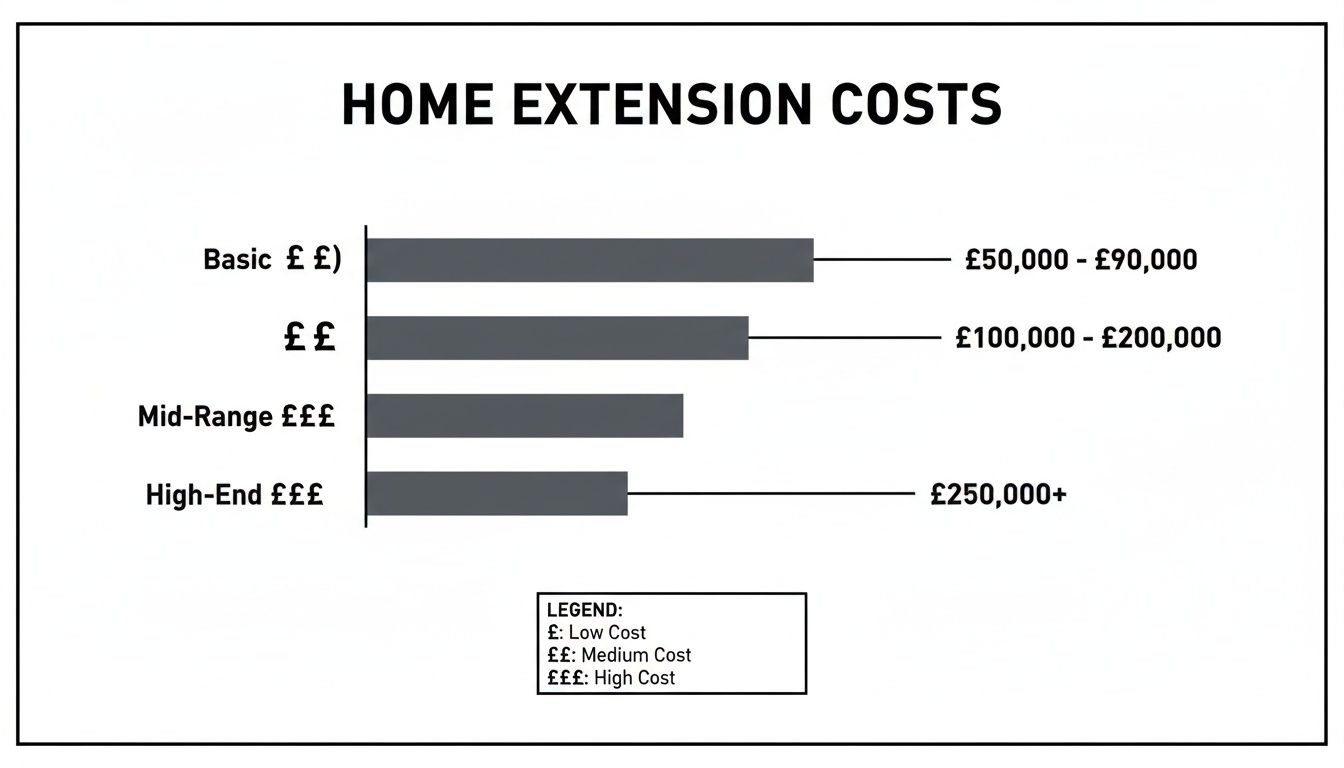
As you can see, jumping from a basic to a high-end finish makes a huge difference to the final bill, reflecting the price of premium materials and bespoke fittings.
Two-Storey and Other Extension Types
Adding a second storey is a game-changer for growing families, giving you a massive boost in living space without sacrificing your garden. It’s the perfect solution for adding bedrooms and bathrooms upstairs while expanding your living area downstairs. As we touched on earlier, the shared foundation and roof make it an incredibly cost-effective way to add serious square footage.
Other common types include:
Wraparound Extensions: These combine a rear and side extension to completely transform the ground floor. They are more complex projects and, naturally, come with a higher price tag.
Over-Garage Extensions: A clever way to add an extra room—often a master suite or home office—by building over an existing garage. This minimises the need for new foundations, making it a very budget-friendly option.
While you're weighing up your options, it's also worth looking into the costs associated with a loft storage conversion, which can be another smart way to gain more usable space without extending outwards.
Comparative Costs for Different Extension Types and Sizes
To give you a clearer picture, we've put together a table comparing the estimated costs for different extension types and sizes. These figures are a good starting point for your budget planning.
Extension Type | Common Size | Estimated Cost Range (ex. VAT) | Average Cost per m² |
|---|---|---|---|
Single-Storey | 20m² | £40,000 - £56,000 | £2,000 - £2,800 |
Single-Storey | 30m² | £60,000 - £84,000 | £2,000 - £2,800 |
Single-Storey | 50m² | £100,000 - £140,000 | £2,000 - £2,800 |
Two-Storey | 40m² | £72,000 - £120,000 | £1,800 - £3,000 |
Two-Storey | 60m² | £108,000 - £180,000 | £1,800 - £3,000 |
Over-Garage | 25m² | £37,500 - £62,500 | £1,500 - £2,500 |
Keep in mind that these are guideline figures. The final cost will always depend on your specific project's complexity, location, and the level of finish you choose. Always get detailed quotes from trusted builders like ours to get a precise cost for your vision.
Don't Forget to Budget for Professional Fees
The builder's quote might feel like the main event, but it’s really just one piece of the puzzle. When you're adding up the total cost of a home extension in the UK, it's often the professional and administrative fees that catch people out and wreck an otherwise careful budget.
Think of these costs as the essential behind-the-scenes crew. They're the ones who make sure your project is safe, legal, and beautifully designed. Skipping this part of the budget is like planning a road trip but forgetting to account for fuel and insurance—you simply won’t get where you need to go.

The Key Players: Architect and Structural Engineer Costs
First up, you’ve got your design professionals. Your architect is your creative guide, turning your ideas into a set of workable plans that tick all the right boxes for building regulations. Then there's the structural engineer, your safety expert, who makes absolutely sure the new structure is sound and properly tied into your existing home. You can't build without them.
Their fees are usually calculated as a percentage of the total build cost—typically 5-12% for an architect—or sometimes as a fixed sum. Their expertise is what prevents eye-wateringly expensive mistakes down the line. If you're just starting your search, our guide to finding the best architects in Southampton is a great place to begin.
Navigating Council Fees and Legal Agreements
Beyond the design team, there are the official administrative costs. These aren't optional extras; they're legal requirements that make your extension compliant and officially recognised. Get this wrong, and you could face hefty fines or, in the worst-case scenario, be told to tear it all down.
Here’s a quick rundown of what you’ll likely encounter:
Planning Permission: If your project is too large for Permitted Development, you'll need a full planning application. In England, this currently costs £206 for a typical home extension.
Building Regulations Approval: This is completely separate from planning and is always required. It's the check that ensures your extension meets standards for things like structural integrity, fire safety, and insulation. Fees vary but often land somewhere between £500 to £1,000+.
Party Wall Agreements: If your work affects a shared wall with a neighbour (even a garden wall), you’ll need a Party Wall Agreement. If surveyors need to get involved, this can cost anywhere from £1,500 to £3,000.
These fees add up fast. In fact, research suggests that professional and admin costs can easily add an extra 10% of your construction budget. That could mean finding an extra £9,300 to £13,800 to cover your architect, engineer, planning application, and any party wall notices.
For homeowners in Highcliffe, Bournemouth, and Christchurch, we know juggling all this can feel daunting. That's why our in-house service handles every one of these steps. We coordinate the architect, engineer, and all the council submissions, giving you one point of contact and complete peace of mind. Stop trying to spin all the plates yourself—let our in-house service handle the details.
How Your Location Impacts Extension Costs
When you start budgeting for a home extension, it’s easy to focus on materials and labour alone. But there's another major factor that can make the final figure swing dramatically: your postcode. The difference in cost between building in a quiet northern town and a bustling southern city isn't just a few quid—it can easily run into the tens of thousands.
A few key things drive this regional price difference, but the biggest is labour. Skilled tradespeople in London and the South East simply command higher daily rates to reflect the steeper cost of living. This one factor can add a hefty premium to your project before a single brick has even been laid.
On top of that, you’ve got logistics to think about. In dense urban areas like central London or Southampton, just getting materials to your site is more complicated and costly. Tight access, parking restrictions, and the need for smaller, more frequent deliveries all chip away at the budget and add to the final bill.
Understanding the North-South Divide
The most obvious price gap in the UK is the classic North-South divide. It’s no secret that building costs in London and the surrounding Home Counties are consistently the highest in the country. As you head further north, prices generally become more competitive, meaning your budget can often stretch that little bit further on the construction side of things.
That’s not to say a project in the North is "cheap," but you definitely get more for your money. Industry figures suggest that building an extension in London can cost around 9% more than in other parts of the UK, driven almost entirely by those higher labour and delivery costs. In contrast, homeowners in the North could potentially save up to 20-25% compared to an identical project in the South East.
This is where a good local builder becomes invaluable. They understand the ground conditions, know the most reliable suppliers, and have working relationships with the local council’s planning department. All of this adds up to a smoother, more cost-effective build.
How Our Local Expertise Benefits You
For anyone looking to build in Bournemouth, Christchurch, Southampton, or anywhere across Hampshire and Dorset, that local knowledge is just as critical. While we might not see London-level prices, our region's desirability and proximity to the South Coast still influence costs. Navigating this market properly requires real, on-the-ground experience.
Choosing a builder with deep roots in the area is your best strategy for fair and accurate pricing. Our in-house teams have an intricate understanding of the local supply chains in Poole and Ringwood, and we are well-versed in the specific building regulations across Highcliffe and the surrounding councils.
This isn’t just about getting a better price on timber or bricks; it's about efficient project management from start to finish. Our in-house service knows which suppliers won’t let you down and which planning officers to talk to. This local insight gets rid of the guesswork, prevents expensive delays, and ultimately keeps your project on track and on budget.
For a deeper dive into what’s involved, take a look at our guide on how to plan a house extension in Hampshire, covering costs, permits, and builders. When you partner with our dedicated in-house team, you get the benefit of true regional expertise combined with honest, transparent pricing for your extension.
Key Choices That Influence Your Final Budget
While location and the type of extension you choose set a rough budget, it’s the specific choices you make along the way that really determine the final cost. This is where you’re in the driver's seat, and your decisions can either send the total spend soaring or keep it neatly in check. Every single choice, from the taps and tiles you can see to the foundation work you can’t, has a direct impact on the bottom line.
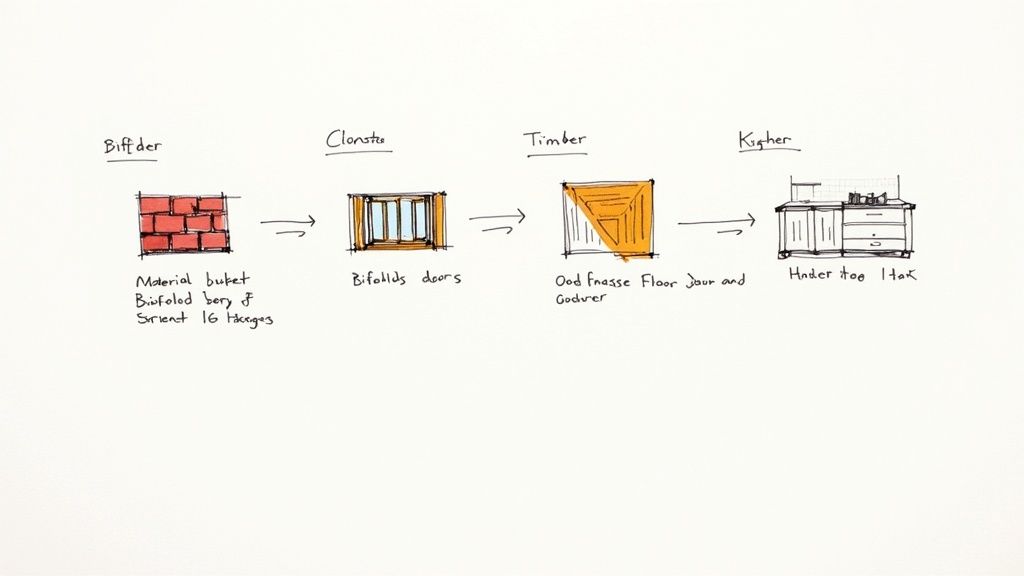
Think of it like a balancing act. On one side, you have your dream features—those stunning bifold doors or that high-end kitchen. On the other, you have the practical reality of your budget. The goal is to find that sweet spot where you get what you want without the finances tipping over into uncomfortable territory. It all comes down to making informed decisions every step of the way.
Design Complexity and Site Conditions
The most straightforward and cost-effective extension is a simple, box-shaped design built on flat, easy-to-access ground. The moment you introduce more complex elements, the costs start to creep up.
A sloping garden, for instance, immediately means more extensive and expensive groundworks. You might need retaining walls or specialised foundations just to get a level base, which can easily add thousands to the bill before you've even laid a single brick.
Likewise, an intricate design with lots of corners, different roof heights, or unusual angles requires more skilled labour, more careful material cutting, and often a more complex structural solution. Every extra corner or roof junction is another point where time and money are spent, pushing that per-square-metre rate higher.
Material Selection and Finish Quality
Your choice of materials is one of the biggest cost drivers, affecting not just the initial build price but also the long-term maintenance. Standard blockwork with a render finish is an economical way to build your external walls, but if you’ve got your heart set on premium brick slips or beautiful cedar cladding, you'll need to budget accordingly. This applies to every single element.
Here are a few key areas where your choices will have a big impact:
Windows and Doors: Standard uPVC windows are a solid, budget-friendly option. But if you want those show-stopping aluminium-framed bifold or sliding doors, be prepared for a cost of £5,000 to £10,000, sometimes more.
Flooring: You can get a great-looking finish with cost-effective laminate or vinyl. However, engineered wood or high-quality porcelain tiles represent a more significant investment.
Roofing: A simple flat roof is generally cheaper than a pitched roof with traditional tiles or slates, as the latter requires more structural work, materials, and labour.
It’s also worth thinking long-term. Choosing sustainable building materials for your renovation might cost a little more upfront, but they often lead to better energy efficiency and durability, saving you money down the line.
High-Spec Features and Fittings
The final fit-out is where budgets can really spiral if you’re not careful. This is the stage where you inject personality into your new space, but it's also where luxury items can quickly add up.
Features like underfloor heating, smart home controls, bespoke joinery, or a designer kitchen with stone worktops and premium appliances will all bump up the final cost of a home extension in the UK. The best way to manage this is to create a 'must-have' versus 'nice-to-have' list. Prioritise what truly matters to you and figure out where you can make sensible compromises elsewhere.
For homeowners in Ringwood, Christchurch, and across Dorset, our in-house design and build service is built around these conversations. We work with you to balance your vision with a realistic budget, ensuring you get a stunning result you'll love for years to come—without any nasty financial surprises.
Budgeting Smartly and Choosing Your Builder
Once you've got a solid grasp of the costs, it’s time to turn all that knowledge into confident action. This means setting a realistic budget and, most importantly, finding the right builder to bring your vision to life. Get this part right, and the journey ahead will be exciting, not stressful.
The golden rule for any big project? Plan for the unexpected. No matter how meticulously you've planned, surprises can and do pop up. It’s standard practice to set aside a contingency fund of 10-15% of your total estimated build cost. This buffer is your safety net for everything from discovering tricky ground conditions to a last-minute change of heart on your kitchen worktops. It stops a small hiccup from derailing the whole project.
Finding and Vetting Your Ideal Builder
Choosing a builder is probably the single most critical decision you'll make. You're entrusting them with a significant financial investment and the future of your home. It’s absolutely essential to get at least three detailed, itemised quotes from different firms so you can properly compare what’s included.
Look for builders with a strong, proven reputation in areas like Highcliffe, Christchurch, or Poole. Make sure you check for:
Verifiable References: Don't just take their word for it. Ask to speak to previous clients and, if you can, go and see examples of their finished work.
Comprehensive Insurance: Ensure they hold adequate public liability and contractor’s all-risk insurance. It’s non-negotiable.
A Detailed Contract: Never, ever move forward without a proper written contract. A standard form like a JCT contract outlines the scope of work, payment schedule, and timeline, protecting both you and them.
Before you sign on the dotted line, getting your head around what is contractor management can be a huge help. It gives you the insight to judge how organised and efficient a builder really is. A well-run site means a smoother, faster project for you.
Why Our In-House Service Is the Smarter Choice
Trying to juggle quotes from architects, structural engineers, and a dozen different trades can quickly become a full-time job. It's overwhelming. This is exactly where our in-house, design-and-build service shows its value. We manage every single step under one roof, from the first sketch to the final coat of paint.
For homeowners across Southampton and Bournemouth, this means one point of contact, one clear contract, and total accountability from start to finish.
Our in-house service's transparent pricing model takes all the guesswork out of the equation. We provide you with a fully costed proposal, so you know exactly where every single pound is going. This integrated approach doesn’t just simplify the process; it ensures the final cost of your home extension in the UK aligns perfectly with the agreed budget, giving you complete peace of mind.
Still Have Questions About Home Extension Costs?
You're not alone. Navigating the finances of a home extension is often the most daunting part of the process. Below, we've answered some of the questions we hear most often from homeowners, giving you clear, straightforward advice to help you plan with confidence.
How Can I Get an Accurate Extension Cost?
The only way to get a figure you can actually rely on is to ask reputable builders for a detailed, itemised quote. A quick ballpark number jotted on the back of a napkin just won't cut it; you need a complete breakdown of materials, labour, professional fees, and any other costs specific to your site.
Here at Hallmoore Developments, this is exactly what our in-house team provides for homeowners in Poole and Christchurch. We'll come out for a proper consultation, assess your property, and listen to what you want to achieve. From there, our in-house service creates a transparent, no-obligation quote that leaves no room for guesswork.
How Much Value Does an Extension Add to My House?
An extension is a serious investment, but it's one that can pay you back handsomely. The exact value it adds will depend on what you build, the quality of the finish, and what the property market is doing in your area.
As a general rule of thumb, you can expect to see these kinds of increases in your property's value:
Single-Storey Extension: 5-8%
Two-Storey Extension: Up to 12%
Loft or Garage Conversion: Up to 20%
A well-designed, beautifully finished extension in a sought-after area like Bournemouth will always be a major selling point. It's a smart financial move.
Do I Really Need a Contingency Fund?
Yes, absolutely. We always tell our clients to set aside a contingency fund of 10-15% of the total estimated build cost. This isn't a slush fund for poor planning—it’s a safety net for the unknowns that can pop up on any project. Think of things like discovering tricky ground conditions when the digger starts, or deciding you want to upgrade your bi-fold doors at the last minute. This fund means those little surprises won't derail your entire budget.
Can I Save Money by Managing the Project Myself?
It might look like an easy way to trim the budget, but trying to project manage yourself can be a false economy unless you have solid experience in the building trade. Juggling different trades, creating schedules that actually work, ordering materials on time, and making sure everything complies with building regulations is a complex, full-time job.
Our in-house service for clients in areas like Southampton and Ringwood takes all that stress off your shoulders. We handle every single detail, from the first design sketch to the final sign-off. In the long run, this often saves you money by avoiding costly mistakes and delays, ensuring your project runs like clockwork.
Ready to get a clear and accurate cost for your dream home extension? The expert in-house service team at Hallmoore Developments is here to help. We manage everything in-house, providing transparent pricing and exceptional craftsmanship. Contact us today to schedule your no-obligation consultation.
Comments