.png)
A Quick Guide to House Extensions Hampshire: Costs, Permits, and Builders
- Dan Hall
- Jan 11
- 16 min read

Thinking about extending your home is a big deal. It’s one of the most exciting investments you can make, creating valuable new space without the upheaval and cost of moving house. For anyone with a growing family or a new work-from-home setup in places like Southampton or Ringwood, a house extension in Hampshire is often the perfect solution.
Your Complete Guide to Extending Your Hampshire Home
Welcome to our no-nonsense guide to adding space, comfort, and value to your property right here in Hampshire. So many homeowners get to a point where their house just feels too small, but the thought of leaving a community they love is a non-starter. It’s a familiar story across the county, from coastal spots like Bournemouth and Highcliffe to the historic heart of Southampton.
This guide is designed to walk you through the entire journey, from that first spark of an idea to the finished, liveable space. Our in-house services will break everything down into simple, clear steps, making sure you feel confident and clued-up from start to finish. Think of it as your personal roadmap for creating the perfect house extensions hampshire.
What This Guide Covers
We’ve packed this guide with everything you need to know about building a home extension in our corner of the world. Our in-house services will get into:
The most popular types of extensions that work brilliantly for properties in areas like Christchurch and Poole.
A straightforward look at navigating local planning permission and building regulations without the headaches.
Honest, realistic budget breakdowns and cost estimates to help you plan your finances properly.
A step-by-step project timeline, so you know what happens from the initial sketch to the final coat of paint.
How our dedicated in-house team at Hallmoore Developments handles every single detail for a seamless result.
Hampshire's Growing Appetite for Home Improvement
Choosing to extend rather than move is a huge trend for house extensions hampshire, and for good reason. Across the South East, including Hampshire, homeowners have been spending around £45 per household per week on renovations in recent years—that’s a fair bit higher than the national average.
It just goes to show how much people value improving the homes they already have. We see this firsthand every single day. If you’re interested, you can dig deeper into the data behind home renovation spending.
At Hallmoore Developments, our in-house experts are here to guide you through this brilliant process. We manage everything under one roof, which means a high-quality, stress-free experience for your house extensions hampshire project. And if you’re thinking bigger, see how an extension can fit into a larger project by reading our guide to complete house renovations in Hampshire and Dorset.
Popular House Extension Types for Properties in Highcliffe and Bournemouth

Choosing the right type of extension is the first big decision you'll make. It’s a choice that hinges on your property's layout, how much garden you have, and what your family truly needs. Are you dreaming of a sprawling kitchen-diner in a Christchurch semi? Or a desperately needed master suite for your growing family in Poole? Each style opens up a different world of possibilities.
To get you started, our in-house services have broken down the most popular designs we build across Hampshire and Dorset. We'll walk you through the pros and cons of each, giving you a real feel for what can be achieved when you pair thoughtful design with expert hands.
The Classic Single-Storey Rear Extension
There's a reason the single-storey rear extension is the go-to for so many house extensions hampshire homeowners. It’s a tried-and-tested way to completely change your home's dynamic. By building out into the back garden, you can create a spectacular open-plan kitchen, a sun-drenched family room, or a dining area that flows straight outside through bi-fold doors.
Think of a terraced property in Southampton with a cramped, dark kitchen. A rear extension doesn't just add a room; it transforms that entire floor into a bright, social space that becomes the heart of the home. It’s also often the most straightforward route through planning, with many projects falling under Permitted Development rights, which helps get things moving faster.
A great rear extension isn't just about bolting on a box. It’s about fundamentally changing how you live in your home. It’s about creating flow, light, and a connection to your garden that modern life demands. Our focus is on making this new space feel like it was always meant to be there.
The Clever Side-Return Extension
If you live in a Victorian or Edwardian terraced house, especially in areas like Bournemouth and Highcliffe, the side-return extension is a stroke of genius. This clever design fills in that often-neglected alleyway running alongside the back of your property, squaring off the rear of the house.
It might not add a huge amount of square footage on paper, but the impact is massive. A side-return can take a narrow kitchen and make it feel twice as wide, carve out space for a utility room or downstairs loo, and pull in tons of natural light with skylights. Our in-house services know it just makes the ground floor work so much better.
The Ultimate Wrap-Around Extension
Can't decide between a rear and a side extension? A wrap-around gives you both. By extending out to the side and the rear in an L-shape, you’re setting the stage for a seriously dramatic ground-floor transformation.
This is the one to go for if you want to completely reconfigure your home's layout. You could create an enormous open-plan kitchen, dining, and family space, while also slotting in a separate utility room, a home office, or a dedicated playroom for the kids. A project of this scale gives you incredible design freedom, which is where having our experienced in-house services to manage it all really pays off.
The Value-Adding Two-Storey Extension
When you need to add the most space and value possible, a two-storey extension is king. You get brand new rooms on both the ground and first floors, making it a highly cost-effective way to build since you’re maximising the new foundations.
For instance, a two-storey side extension on a semi-detached house in Ringwood could deliver a larger kitchen downstairs and a new master bedroom with an ensuite above it. Or, a two-storey rear extension could create that dream kitchen-diner while adding another bedroom or a quiet home office upstairs. The planning is more involved, but the payoff in living space is unmatched.
Comparing House Extension Types for Your Hampshire Home
Feeling a bit overwhelmed by the options? This quick table breaks down the key features of each extension type to help you see which might be the best fit for your home, your budget, and your lifestyle.
Extension Type | Best For | Typical Space Gained | Planning Complexity |
|---|---|---|---|
Single-Storey Rear | Creating open-plan living and connecting with the garden. | Moderate | Low to Medium |
Side-Return | Widening narrow Victorian/Edwardian layouts and adding light. | Small to Moderate | Medium |
Wrap-Around | A complete ground-floor transformation with maximum space. | Large | High |
Two-Storey | Adding bedrooms and bathrooms as well as ground-floor space. | Very Large | High |
Each type has its own strengths, and the right choice always comes down to the specifics of your property and what you want to achieve.
As you explore the possibilities for expanding your home, a detailed guide to extension and loft conversion can offer further clarity on which route best suits your needs. And if you're thinking of going up instead of out, you might find our insights on how a loft conversion in Hampshire can add space, value, and style useful.
Navigating Planning Permission in Southampton and Ringwood
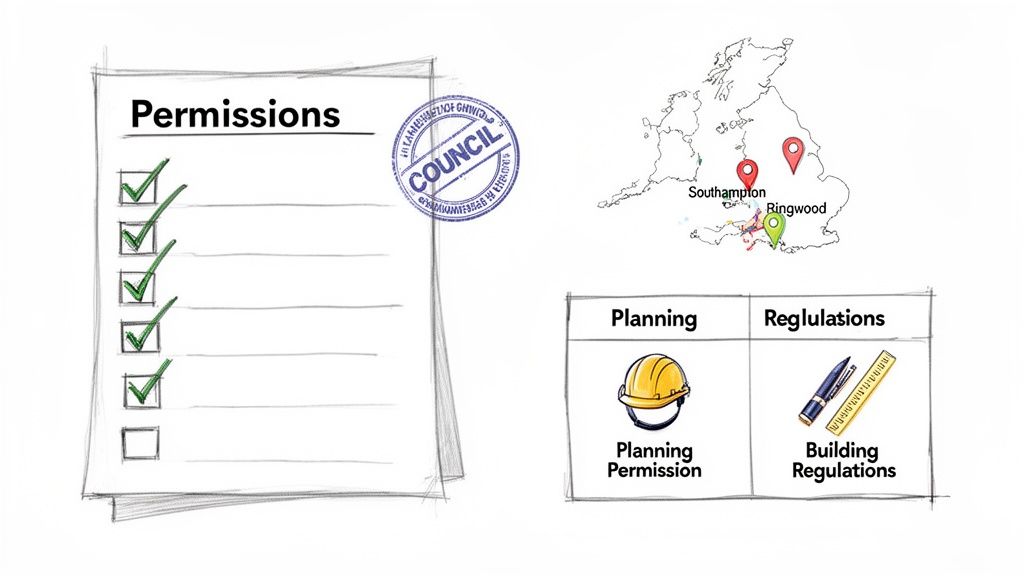
The words "planning permission" can cause a bit of a headache for homeowners, but honestly, it doesn't have to be a nightmare. Getting to grips with the local rules here in Hampshire is the secret to a smooth, stress-free project. The whole system really boils down to two main routes, each with its own set of rules.
Think of it this way: one path is a well-trodden shortcut, and the other is a more detailed route that needs a formal map. Our in-house team at Hallmoore Developments has walked both paths countless times. Our in-house services manage this entire process for you, so you won’t have to worry about a single form or phone call.
The Shortcut: Permitted Development Rights
Many house extensions hampshire projects can actually be built without needing to go through the full planning application process. This is thanks to something called Permitted Development Rights (PDR). It’s like the council has a pre-approved checklist of common home improvements they're generally happy with. If your extension idea fits neatly within these specific size and design limits, you can often get started much faster.
For a homeowner in Highcliffe or Bournemouth with a semi-detached house, this could mean building a single-storey rear extension up to 6 metres deep without a full application. If you’ve got a detached property in a place like Ringwood, you might be able to go up to 8 metres.
But it’s not a complete free-for-all. These rights come with some important conditions:
Size Limitations: There are strict rules on the height, depth, and how close you can build to your property boundaries.
Material Matching: The materials you use must look similar to your existing house.
Coverage Rules: You can’t cover more than 50% of the land around your original house with new extensions and outbuildings.
For those larger extensions that still fall under PDR (usually over 3m for a semi-detached or 4m for a detached), you’ll follow a simpler process called 'Prior Approval'. This is where the council just gives your neighbours a heads-up. It's much quicker than full planning, but it's a vital step you can't skip.
When a Full Planning Application is Needed
So, what happens if your vision is a bit bigger than the pre-approved checklist? That’s when you need to take the more formal route of a full planning application. Your house extensions hampshire project will almost certainly need this if it involves any of the following:
Exceeding PDR Limits: Building a larger or taller extension than Permitted Development allows.
Living in a Designated Area: If your home is in a Conservation Area, a National Park (like the beautiful South Downs nearby), or an Area of Outstanding Natural Beauty, your PDR will be restricted or removed entirely.
Listed Buildings: Any work on a listed building requires its own specific Listed Building Consent.
Unconventional Designs: Using materials that contrast sharply with your existing home or adding features like balconies will need formal approval.
The process involves submitting detailed drawings and documents to your local Hampshire council. They’ll look at how your plan might affect the neighbourhood—considering things like design, privacy, and the overall look—before making a decision. This usually takes around 8-12 weeks. For a really detailed breakdown, check out our full guide on UK home extension planning permission explained.
Planning Permission vs. Building Regulations
This is a really important point that trips a lot of people up. Planning and Building Regulations are two completely separate things, and you have to comply with both.
Think of it like this: Planning Permission is about getting consent for what you can build and where you can build it. Building Regulations are about how you must build it to make sure it’s safe, warm, and structurally sound.
Even if your extension is a Permitted Development and doesn't need planning permission, it always needs Building Regulations approval. A building control officer will pop round to check the work at key stages to make sure everything is up to scratch.
Key Areas Covered by Building Regulations:
Structural Integrity: Making sure the foundations, walls, and roof are solid.
Fire Safety: Including proper escape routes and using fire-resistant materials.
Energy Efficiency: Meeting the latest standards for insulation.
Ventilation: Ensuring there's enough airflow to prevent damp.
Drainage: Making sure all wastewater is managed correctly.
At Hallmoore Developments, our in-house architects and structural engineers handle both the planning and building regulation submissions from start to finish. Our in-house services make sure every detail is spot on, giving you total peace of mind that your new extension is not only beautifully designed but also fully compliant and built to last.
Budgeting for Your Poole and Christchurch House Extension
Let's talk about the most crucial part of any extension project: the money. Getting the finances right from day one is the single best way to ensure your build is a success, not a source of stress. A realistic budget isn't just a spreadsheet; it's a roadmap that stops unexpected costs from derailing your vision.
This is your guide to mapping out the finances for your house extension in Hampshire, covering everything from the initial architect fees right down to the final lick of paint.
A great starting point is to think in terms of cost per square metre (£/m²). It’s a reliable way to get a solid ballpark figure to work from. Of course, that’s just the beginning. The final figure will shift based on how complex the design is, the quality of materials you choose, and the level of finish you’re after for your new space, whether you’re in Southampton, Christchurch, or Poole.
Here at Hallmoore Developments, we’ve built our services around providing total financial clarity. By keeping everything in-house—from our architects and structural engineers to our plumbers and decorators—our in-house services give you a transparent, itemised quote from the very start. No guesswork, no juggling contractors, just clear costs you can control.
Highcliffe and Bournemouth Extension Cost Benchmarks
National averages are a useful yardstick when you're first sketching out a budget. Current industry data suggests a typical single-storey extension in the UK costs between £1,800 and £3,300 per m², all depending on the final spec.
To put that into real numbers, a standard ground-floor rear extension works out to an average of around £86,686, or roughly £2,890 per m². For those of us in Hampshire and across the South East, where build prices can be a little higher, these figures show just how vital transparent pricing and careful cost management are.
It’s also important to know what that per-square-metre rate actually covers. Usually, it’s the 'shell'—foundations, structure, roof, windows, and walls. It might not include high-end finishes like a bespoke kitchen or luxury flooring, so always clarify what’s in and what’s out.
A well-planned budget does more than just list costs; it's the financial blueprint for your project. It turns a vague idea into an achievable goal, with clear milestones and no nasty surprises. Our job is to help you build that blueprint with confidence.
Breaking Down the Budget Allocation
A truly robust budget accounts for every single stage. Just multiplying your floor area by an average cost is a good start, but a detailed breakdown is what gives you real accuracy.
Here’s a typical way a house extensions hampshire budget gets allocated:
Professional Fees (10-15%): This slice covers the experts needed to get your project off the ground. Think fees for architectural design, structural engineering calculations, planning applications, and building control inspections.
The Build (60-70%): This is the big one. It's the largest part of your budget, covering all the materials and labour for the main construction—from the groundworks and foundations to the roof, windows, and external doors.
Interior Finishes (10-20%): This is where the new space really comes to life. This pot of money is for plastering, electrics, plumbing, flooring, decorating, and fitting out your new kitchen or bathroom.
Contingency Fund (10-15%): Your project's safety net. Honestly, this is non-negotiable. Setting aside 10-15% of the total build cost for unforeseen issues—like tricky ground conditions in Ringwood or a supply chain delay—gives you complete peace of mind.
Because the Hallmoore Developments team manages the whole process, our in-house services integrate all these costs seamlessly. You get a single, clear quote that covers every trade, saving you the headache of juggling multiple contractors and invoices.
For a deeper dive into the numbers, check out our ultimate guide to the cost of a house extension in the UK.
Choosing the Right Builder for Your House Extension in Hampshire
Let’s be honest, picking the right contractor is probably the biggest decision you'll make for your house extensions hampshire project. This isn't just about the final quality of the build; it's about how smooth and stress-free the whole experience will be. Your builder is more than just a supplier—they’re the custodian of your home and your investment for the next few months.
Making the right choice means digging deeper than a simple price comparison. A great builder brings peace of mind through proven experience, clear communication, and a transparent way of working. For anyone in Hampshire, from the New Forest to Southampton, this means finding a team with genuine local knowledge and a rock-solid reputation.
Verifying Local Experience in Hampshire
A builder’s track record in your immediate area speaks volumes. A company that’s worked on homes in places like Highcliffe, Bournemouth, or Ringwood will already know the local housing stock inside and out. They’ll understand the specific quirks and opportunities your property presents.
Don’t just take their word for it, though—ask for proof. Any decent builder will be happy to share addresses of recently finished projects. Taking a quick drive past a completed extension in Southampton gives you a real feel for their craftsmanship you just can't get from a photo.
The real value of a great builder isn’t just in the bricks and mortar; it’s in the seamless management of the whole project from start to finish. Choosing a company with its own in-house trades—plumbers, electricians, plasterers—gets rid of the coordination headaches and frustrating delays that come from juggling multiple subcontractors.
Scrutinising Quotes and Credentials
Once the quotes land in your inbox, it's time to put on your detective hat. A vague, one-page quote is often a red flag for hidden costs down the line. A professional, detailed estimate should clearly break down the costs for labour, materials, waste removal, and any professional fees. No nasty surprises.
Beyond the numbers, checking credentials is an absolute must. Here’s your checklist:
Gas Safe Registration: If your project involves moving a boiler or any other gas work, the company must be Gas Safe registered. This isn't optional; it's a legal requirement to ensure the work is done safely.
Public Liability Insurance: Make sure they have proper insurance. This protects you and your property from any potential accidents or damage during the build.
Reviews and Testimonials: Look for genuine feedback from previous clients in Hampshire. What was their experience really like?
The Hallmoore Developments Advantage
At Hallmoore Developments, we built our company from the ground up to be the trusted partner homeowners are looking for. Our entire team is in-house, from the architects and structural engineers to our Gas Safe registered plumbers and skilled decorators. This integrated approach means our in-house services manage every single detail under one roof. You get a single point of contact and total accountability.
We provide transparent, fixed-price quotes that respect your budget, so you’re always in control. To help you make a fully informed decision, it's worth reviewing these Top Questions To Ask Home Builder before signing any contracts. For more local advice, have a look at our guide on finding trusted builders in Hampshire.
Your Extension Journey, From Christchurch Concept to Completion
Thinking about a house extension can feel massive, almost overwhelming. But when you break it down into clear, manageable steps, that daunting project transforms into an exciting journey. From the first back-of-a-napkin sketch to the day we hand over the keys, there’s a logical path to follow.
At Hallmoore Developments, our job is to guide you along that path. Our in-house services become your single point of contact for the entire house extensions hampshire project, coordinating our in-house teams to keep everything flowing smoothly. This way, you're not left juggling different tradespeople and worrying about schedules—we handle all that for you.
From Initial Design to Detailed Drawings
It all starts with a proper chat. Our in-house services will sit down with you to really listen to your ideas and what you need from your home, whether you're in Poole, Christchurch, or anywhere in between. This first meeting is all about collaboration, figuring out what's possible and translating your vision into an initial concept.
From there, we get into the official planning stages:
Planning Submission: We take care of all the paperwork, preparing and submitting the necessary documents to your local Hampshire council. This covers everything from Permitted Development rights to a full planning application.
Detailed Structural Drawings: Once we have the green light from planning, our in-house structural engineers get to work on the technical blueprints. These drawings are the nuts and bolts of the project, detailing everything from foundation depths to the exact specifications of steel beams. They become the definitive guide for our construction team.
The Build Phase: A Step-by-Step Guide
With approved plans in hand, the real work begins. Our in-house services manage the construction phase meticulously, breaking it down into key stages to ensure quality and efficiency right from the ground up.
The build phase is where your vision truly starts to take shape. It’s a carefully choreographed sequence of events, managed by our project leaders to ensure precision, safety, and minimal disruption to your daily life.
The infographic below shows the vital checks we carry out before a single shovel hits the ground. Getting this right is fundamental to the success of the entire project.
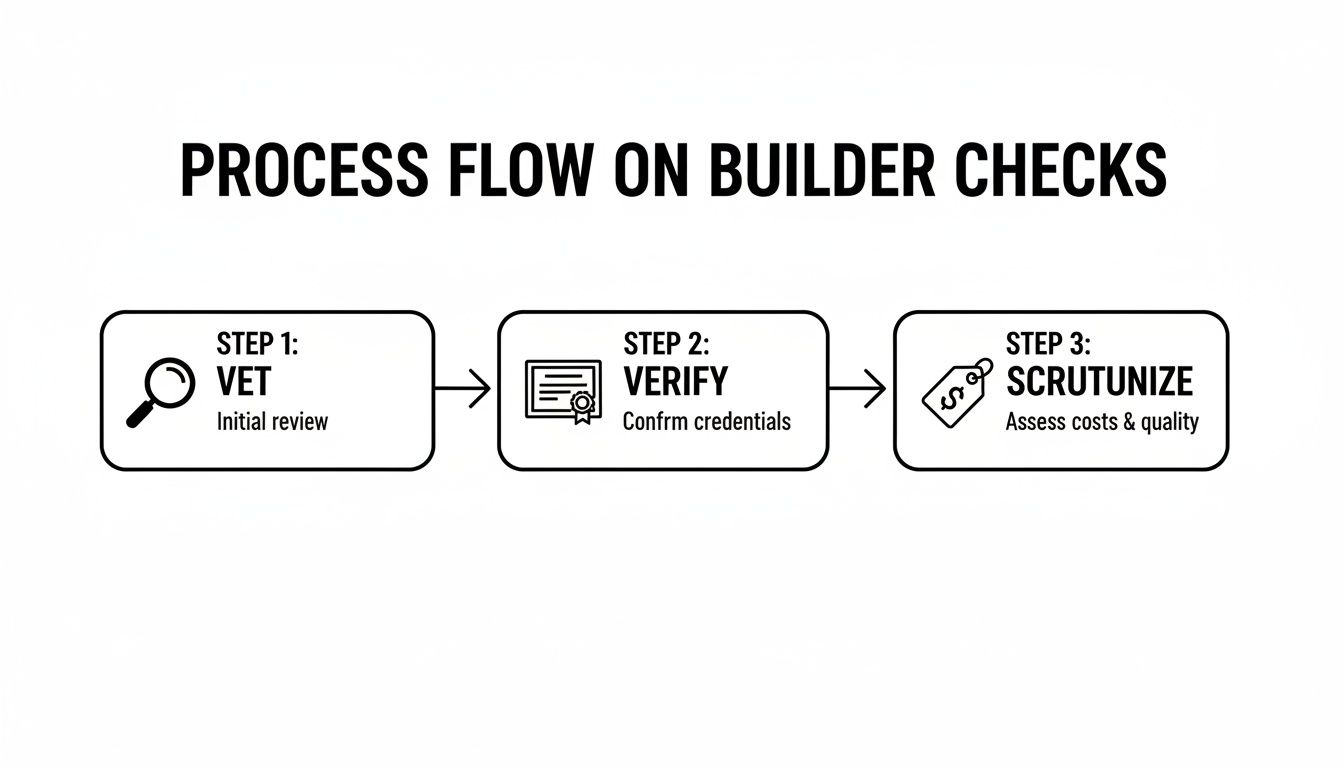
This process shows the crucial vetting, verification, and scrutiny that protects your investment from day one.
The main construction stages then unfold logically:
Foundations and Structure: We start by laying the groundwork and erecting the main frame of your extension.
Weatherproofing: The next step is making the new structure watertight by fitting the roof, windows, and external doors.
First and Second Fixes: This is where the interior starts coming together. We install all the plumbing and electrics before plastering, followed by fitting kitchens, bathrooms, and all the joinery.
Finally, it's time for the finishing touches. Our decorators step in to bring the space to life with paint, flooring, and tiling. We conduct a thorough final inspection to make sure every last detail meets our exacting standards before we proudly hand over your completed, stunning new living space.
Got Questions? We’ve Got Answers.
When you’re thinking about extending your home, a hundred different questions pop into your head. It’s completely normal. To help, our in-house services have put together some straightforward answers to the questions we hear most often from homeowners right here in Hampshire.
How Long Will My House Extension Actually Take?
It’s the million-dollar question, isn’t it? The honest answer is: it depends. A straightforward, single-storey extension in Southampton built under Permitted Development could see our team on-site and finished within 3-4 months.
But let's say you're planning something bigger, like a two-storey project in a place like Ringwood that needs full planning permission. That’s a different beast. You’re likely looking at a timeline of 6-9 months, sometimes more. At Hallmoore Developments, our in-house services map out a detailed schedule right from the start, so you always know what to expect and when.
Do I Have to Move Out During the Build?
Probably not. For the vast majority of house extensions hampshire projects, you can stay put. A huge part of our job is to minimise the chaos and keep your home life running as smoothly as possible. Our team is brilliant at sectioning off the work area, managing dust, and keeping noise to a minimum.
If we’re overhauling your only kitchen or bathroom, we’ll work with you to set up temporary facilities. It all comes down to constant, clear communication – we’ll plan around your family’s routine, not the other way around.
A well-managed project is about more than just the final result; it's about making the construction phase as painless as possible for your family. We plan every step to respect your home and your daily life.
How Much Value Does an Extension Add in Southampton or Bournemouth?
A well-designed extension isn’t just about creating more space; it's a solid investment, particularly in hotspots like Bournemouth and Christchurch. A beautifully executed kitchen extension, for instance, can bump up your home’s value by as much as 15%.
If you add a new double bedroom complete with an ensuite, you could be looking at a boost of up to 20%. In the competitive Hampshire property market, adding functional, stylish living space is one of the surest ways to increase both the asking price and the kerb appeal of your home.
Ready to start your own project? The expert in-house team at Hallmoore Developments is here to manage every step of your house extension, from initial designs to the final build. Visit us online to book your free consultation and see how we can transform your home.
Comments