.png)
Dormer loft conversion near me: Expert guides, costs, and local tips
- Dan Hall
- Dec 11, 2025
- 16 min read

If you've been searching for a "dormer loft conversion near me," you're in the right place. For homeowners across Highcliffe, Bournemouth, Southampton, Christchurch, Poole, and Ringwood, transforming an underused attic into a bright, valuable living space is a brilliant move. Our in-house services are here to see to every detail and show you exactly how a dormer can unlock your home's hidden potential.
Finding Your Ideal Dormer Loft Conversion in Bournemouth and Poole
Deciding to build upwards is an exciting prospect. It lets you gain that much-needed extra room without the upheaval and expense of moving house—a huge plus for anyone settled in an area they love. For many families in Bournemouth, Poole, and the surrounding towns, it's the perfect way to create a new bedroom, a quiet home office, or a peaceful retreat.
Think of this guide as your first chat with a local specialist. Our in-house team is here to demystify the whole process, from exploring stylish dormer options to explaining local planning rules. We'll give you a clear picture of what to expect, so you can plan with total confidence.
Why a Dormer Loft Conversion Is Such a Smart Investment
So, what exactly is a dormer? It's a structural extension that juts out vertically from the slope of your existing roof, creating a box-like room. This clever bit of construction solves the single biggest challenge of most attics: the lack of headroom.
The moment it's built, the benefits are obvious and significant:
Maximised Space: You gain a huge amount of usable floor area and proper vertical height. No more stooping!
Floods of Natural Light: Dormers allow for large, conventional windows that fill the new room with daylight.
Architectural Appeal: A well-designed dormer can seriously enhance your home’s character from the outside.
Increased Property Value: Adding square footage and another bedroom is one of the surest ways to boost your home’s market price.
A dormer loft conversion is a practical, cost-effective way to expand. It turns a dark, forgotten space into what's often the most desirable room in the house, adding both functional living area and real financial value.
To give you a clearer snapshot, here’s a quick overview of what a dormer project involves.
Dormer Loft Conversion Quick Overview
Key Aspect | Typical Expectation |
|---|---|
Space Gained | Up to 30% more usable floor area than a simple rooflight conversion. |
Headroom | Excellent, creating a conventional, flat-ceilinged room. |
Natural Light | High, thanks to standard vertical windows. |
Return on Investment | Typically 70-80% of the project cost is added to your property's value. |
Planning Permission | Often falls under Permitted Development, but our in-house services check local rules. |
Best For | Creating a master bedroom, ensuite, home office, or kids' playroom. |
This table highlights why dormers are such a popular choice for homeowners looking to make a meaningful upgrade to their property.
Understanding the Numbers Behind Your Project
Across the UK, loft conversions are a firm favourite for home expansion, especially as property prices keep climbing. A typical dormer project adds up to 30% more usable floor space compared to a basic rooflight (or Velux) conversion. Financially, homeowners often see a fantastic return, recouping around 70-80% of the conversion cost when they come to sell.
Our team ensures every project, whether it's in Southampton or Christchurch, is managed efficiently from start to finish. For more local insights and specifics, have a look at our guide to loft conversions across Bournemouth and Highcliffe.
Exploring Different Dormer Loft Conversion Styles
When you start searching for a "dormer loft conversion near me," you’ll quickly realise it’s not a one-size-fits-all job. A dormer is more than just an extension; it's an architectural choice that injects both character and, crucially, proper living space into your home. The style you land on will come down to your property type, your budget, and what you’re hoping to create up there.
Our in-house team has designed and built countless dormers across Poole, Christchurch, and the wider region. We’ve seen firsthand what works and have helped homeowners find the perfect match for their vision. Let's walk through the most popular options we see in local homes.
This graphic breaks down the core benefits you get, no matter which dormer style you choose.
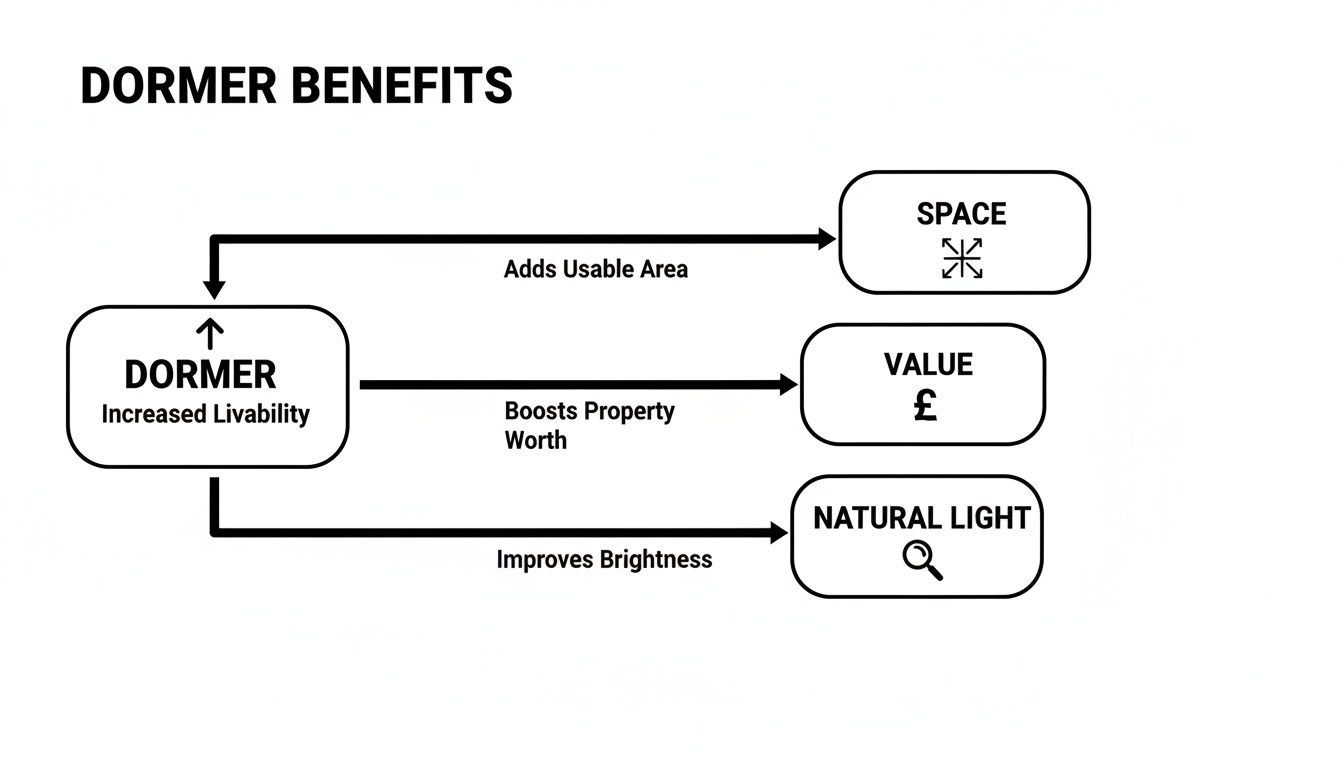
As you can see, any dormer conversion is a fundamental upgrade. It expands your usable space, boosts property value, and unlocks the true potential of your home's top floor.
The Flat-Roof Dormer
The flat-roof dormer is, without a doubt, the most common style you’ll spot in places like Bournemouth and Southampton. Think of it as a simple, box-like structure built out from the slope of your roof. Its primary goal? To give you the maximum amount of internal headroom and floor space.
This style is a favourite for its pure practicality and value for money. The straightforward construction keeps the build costs down while creating a highly functional room with vertical walls and a flat ceiling. This makes it a breeze to furnish and decorate – no awkward slopes to work around.
The Gable-Fronted Dormer
If you're after a more traditional look, the gable-fronted dormer is an excellent choice. This design features its own pitched roof that forms a classic triangular shape at the front, perfectly mirroring the main roof of the house.
Often called a 'dog-house' dormer, this style adds a timeless charm to your property's exterior. While it offers slightly less internal volume than a flat-roof dormer of the same size, its visual appeal makes it a go-to option for period properties in areas like Ringwood.
The L-Shaped Dormer
The L-shaped dormer is a seriously clever and expansive solution, especially for Victorian and Edwardian terraced or semi-detached homes that often have that rear extension or 'outrigger'. It’s essentially two dormers that connect at a right angle to form an 'L' shape.
One dormer is built on the main roof, and the second, smaller one sits on top of the rear addition. This combination creates a huge amount of new space—often enough for a spacious master bedroom and a separate en-suite or home office. It completely transforms the top floor. Our in-house services can help you figure out if your Hampshire home is a good candidate for this style; you can learn more about how we add space, value, and style with loft conversions in Hampshire.
The Mansard Dormer
A mansard dormer is the most significant structural change you can make and almost always requires full planning permission. It involves changing the entire profile of one side of your roof, creating a flat top with a very steep outer wall, set at 72 degrees.
The result is a massive amount of extra space, effectively adding another storey to your home. While it's the most complex and expensive route, a mansard conversion delivers an incredible amount of light-filled, usable room that can dramatically change the way you live.
Estimating Your Dormer Loft Conversion Costs
Let's talk about the big question: how much does a dormer loft conversion actually cost? When you start searching for a "dormer loft conversion near me," the final figure can feel a bit like guesswork. But in reality, it's shaped by a clear set of factors. This section will give you a realistic breakdown of the costs involved so you can plan your budget with confidence.
Ultimately, the final price tag is a direct reflection of your choices. The overall size of the conversion, the specific style of dormer you go for, the quality of materials, and whether you add premium features like an en-suite bathroom all play a part. Our in-house services believe in total transparency, so we'll break down every cost for you, from the initial architectural drawings right down to the final coat of paint.
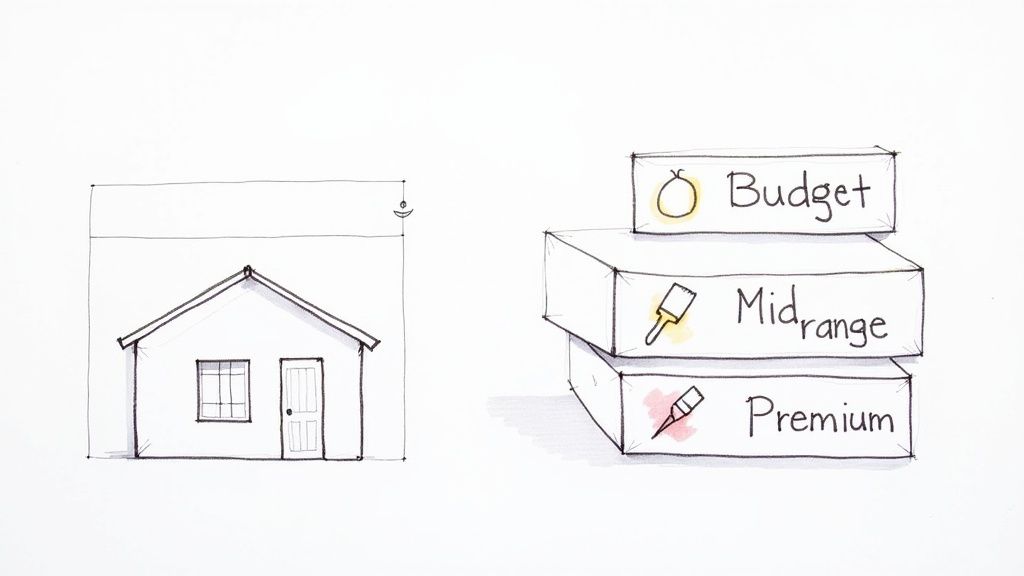
What Shapes The Final Price in Highcliffe and Bournemouth
A few core elements will determine the bulk of your project's budget. Think of these as the primary building blocks of your quote. Our in-house services make sure each one is clearly itemised, so you know exactly where your money is going.
Size and Dormer Type: It stands to reason that a larger, more complex structure like an L-shaped dormer will cost more than a simple flat-roof dormer. It simply requires more materials and more labour. The bigger the footprint, the higher the investment.
Structural Work: The condition of your existing roof and joists plays a huge role. If your home needs significant reinforcement to support the new structure, this will be factored into the cost from the outset.
Fixtures and Finishes: This is where you have the most control over the budget. Sticking to standard-quality bathrooms, windows, and flooring will keep costs down, whereas opting for high-end, bespoke finishes will naturally increase the final figure.
A Look at Typical Investment Levels
For homeowners in Poole, Ringwood, and across the region, having a ballpark figure is essential for planning. Across the UK, the average cost of a dormer loft conversion typically falls somewhere between £30,000 and £60,000.
Smaller, simpler projects can start at the lower end of that scale. However, larger conversions with high-spec finishes can easily exceed it. Here in the South East, costs can sometimes surpass £2,000 per square metre, especially when premium features are part of the plan.
This is exactly why a personalised quote is so important. It reflects local labour rates in areas like Southampton and the specific material costs for the design you've chosen.
By understanding the cost breakdown, you can make informed decisions. Balancing your 'must-haves' with your 'nice-to-haves' is the key to creating a space you love within a budget you're comfortable with.
Cost Comparison of Different Dormer Types
The style of dormer you choose is one of the biggest factors influencing the overall cost. Each type has a different level of structural complexity, which is directly reflected in the price. This table gives a clear comparison of what you might expect for projects in the Christchurch area.
Dormer Type | Estimated Cost Range | Best For |
|---|---|---|
Flat-Roof Dormer | £40,000 - £60,000 | Maximising internal headroom and floor space in a cost-effective way. |
Gable-Fronted Dormer | £45,000 - £65,000 | Adding traditional architectural character, especially to period properties. |
L-Shaped Dormer | £55,000 - £75,000+ | Victorian or Edwardian homes with rear additions, creating enough space for a bedroom and en-suite. |
Mansard Dormer | £60,000 - £80,000+ | Projects needing the maximum possible space, essentially adding a new storey to the home. |
These figures are a helpful guide, but remember that every conversion is unique. For those also thinking about building outwards, it can be useful to see how these figures stack up against other types of projects. You might be interested in our ultimate UK guide to the cost of a house extension.
To eliminate any guesswork, our process always begins with a detailed, no-obligation quote. Our in-house services will assess your property, listen to your vision, and provide a precise, tailored estimate. This transparent approach means you know exactly what to expect from day one, with no nasty surprises down the line.
Navigating Planning Permission and Building Regulations
Let’s be honest, the paperwork side of a dormer loft conversion can feel like the most daunting part of the whole project. But once you get your head around the two main sets of rules—Planning Permission and Building Regulations—it all becomes much clearer. Our in-house services are designed to handle all of this for you, making sure your project in Highcliffe or Bournemouth is fully compliant from day one.
One of the best concepts to get to grips with is Permitted Development Rights (PDR). Think of these as a pre-approved green light from the government. They allow certain home improvements, including a huge number of dormer conversions, to go ahead without needing to lodge a full planning application. This is a massive plus, saving everyone time, money, and hassle.
Of course, it’s not a free-for-all. These rights come with strict conditions. To qualify, your dormer conversion has to stay within specific size and design limits. If your vision is a bit grander, or if you live in a designated area like a conservation zone, you'll need to go down the formal planning permission route instead.
Understanding Permitted Development Rights
For most homeowners searching for a "dormer loft conversion near me," Permitted Development is the path of least resistance. Since the rules were updated back in 2010, a huge number of projects have been able to skip the formal planning process entirely. In fact, upwards of 60% of dormer loft conversions now proceed under PDR.
The key is sticking to the volume limits: your new roof space can't exceed 40 cubic metres for a terraced house or 50 cubic metres for detached and semi-detached properties.
To stay within these rights, your project also has to tick a few other boxes:
Exterior materials must be similar in appearance to the existing house.
No part of the extension can be higher than the highest point of your original roof.
Verandas, balconies, or raised platforms are a no-go without full planning permission.
Any side-facing windows must be obscure-glazed and non-opening if they are below 1.7 metres from the floor.
It’s also crucial to know that local councils in areas like Christchurch or parts of the New Forest can issue an 'Article 4 Direction'. This basically removes some or all Permitted Development Rights in a specific area, usually to protect its character. That’s why our in-house services always conduct a local check as the very first step.
When Is Formal Planning Permission Required?
While many projects sail through under PDR, some situations will always require a full planning application. Don't worry—our in-house services manage this entire process, submitting detailed plans to the local authority on your behalf to give you the best shot at a smooth approval.
You will definitely need to apply for planning permission if:
Your home is a listed building or is located within a Conservation Area, National Park, or an Area of Outstanding Natural Beauty.
Your proposed dormer design is bigger than the volume limits mentioned earlier (40m³ or 50m³).
The dormer faces a highway and is on the main front elevation of the house.
Once submitted, the application process typically takes around eight weeks for the council to make a decision. Our experts prepare all the drawings and documents needed to present your case effectively.
No matter which route your project takes—Permitted Development or full planning—it will always be subject to Building Regulations. These are two separate processes, and you must comply with both.
The Importance of Building Regulations
Building Regulations are the non-negotiable standards that make sure your new conversion is safe, structurally sound, and energy-efficient. They aren’t bothered about what your dormer looks like, but they are intensely focused on the quality of its construction. While UK regulations are what matter here, looking at the general principles of building codes, such as the Building Code of Australia (BCA), shows how universal these safety and structural requirements are.
These regulations cover the critical nuts and bolts of the build, including:
Structural Integrity: Making sure the existing house structure and new floor joists can safely take the extra weight.
Fire Safety: This involves fitting mains-powered smoke alarms, providing a safe escape route, and using fire-resistant doors.
Insulation: The new space must meet modern standards for thermal efficiency to keep you warm and save on energy bills.
Staircase Design: The new stairs have to be safe to use, with proper headroom, pitch, and construction.
A building control surveyor from the local council (or a private approved inspector) will visit at key stages of the build to check the work and sign it off. Our team coordinates all these inspections. Once everything is complete and approved, you’ll receive a completion certificate—a vital document you'll need if you ever decide to sell your home.
For a deeper dive, check out our guide on UK Building Regulations for extensions explained.
The Loft Conversion Journey From Start to Finish
So, what actually happens during a dormer loft conversion? Knowing the process inside and out can take the stress out of the project and turn it into an exciting journey. When you’re looking for a "dormer loft conversion near me," you want a clear, proven plan of action, not a series of guesses. That's exactly what our in-house services provide: a transparent timeline from our first chat to the final handover.
We handle every single detail, making the entire experience seamless for homeowners in Poole, Christchurch, and across the region. Here’s a step-by-step look at what you can expect, showing exactly how we keep disruption to an absolute minimum while bringing your vision to life.
Stage 1: The Design and Planning Phase
It all starts with your ideas. We kick things off with an in-depth design consultation to map out exactly what you want to achieve. Are you dreaming of a master bedroom with an en-suite, a quiet home office, or a dedicated playroom for the kids? Our team listens carefully, offering practical advice on how to maximise every inch of space and light.
From there, we get to work on the detailed architectural plans and structural calculations. This is a critical stage. We translate your vision into a technical blueprint that satisfies all Building Regulations. Our in-house services handle all the paperwork, whether it’s for Permitted Development or a full planning application, ensuring your project is fully compliant right from the word go.
Stage 2: The Main Structural Build
Once the plans get the green light, the main build can begin. The first thing you'll see is the scaffolding going up, which gives our team a safe and self-contained work area. Crucially, most of this initial work happens from the outside, meaning very little disturbance to your daily life.
Our team will then open up a section of the roof to construct the dormer itself. A major milestone here is making the new structure watertight as quickly as possible—usually within the first two weeks. This involves fitting the roof covering and windows to protect your home from the elements, which is always a top priority for us, especially in places like Southampton or Ringwood.
This external-first approach is fundamental to how we work. By getting the main structure built before we break through into your home, we keep your living space secure, clean, and private for as long as possible.
Stage 3: First Fix and Internal Works
With the dormer structure secure and weatherproof, our focus shifts inside. This is what's known in the trade as the 'first fix' stage, where we install all the essential services that will eventually be hidden behind the walls and under the floors.
The first fix covers all the essentials:
Electrics: We run all the wiring for sockets, lighting, and smoke alarms.
Plumbing: This is when we install the pipework for radiators and any new bathrooms or en-suites.
Stud Walls: We build the internal timber framework that creates the layout of your new rooms.
Next, we fit high-performance insulation throughout the walls and ceiling. This is key to making sure your new space is warm, comfortable, and energy-efficient. Plasterboard is then fixed over the top, finally turning that structural shell into recognisable rooms.
Stage 4: Second Fix and Finishing Touches
The second fix is where the magic really happens and your new loft comes to life. This is the finishing stage where all the visible elements are installed with care and precision. Our skilled tradespeople will fit everything from light fittings and plug sockets to the bathroom suite and internal doors.
This is also when the staircase goes in, creating a permanent, safe link between your new loft and the rest of your home. To finish it all off, our decorators prepare and paint the walls, completing the transformation. As things wrap up, you'll start thinking about those final details, and a good designer's guide on how to choose window treatments can be a huge help for your new dormer windows. It’s these touches that really make the space your own.
Choosing the Right Local Loft Conversion Specialist
The success of your entire project really does hinge on finding the right team. When you search for a "dormer loft conversion near me," you’re not just looking for a builder; you’re looking for a local partner you can trust, someone with deep roots in the community and a portfolio to prove it. Honestly, picking the right contractor is the most important decision you'll make.
Get this choice right, and your project in Highcliffe or Bournemouth will run smoothly, stay on budget, and give you a space you'll love for years. This is where our in-house team of local specialists really makes a difference. We're craftsmen and project managers who live and work right here in your community, from Christchurch to Poole, and we’re committed to delivering high-quality results, guaranteed.
Verifying Credentials and Experience
Before you even think about signing a contract, it’s time to do some homework. A reputable specialist will be completely transparent and more than happy to show you their credentials. This isn't just about ticking boxes; it's about protecting your home and your investment.
Start with the basics. Always ask to see proof of their insurance – you’re looking for comprehensive public liability and employers' liability. This is your safety net against any accidents on site. Just as important is their track record. Ask to see a portfolio of recent local projects and, crucially, for references from past clients in areas like Christchurch and Ringwood. A builder who is confident in their work will actively encourage you to speak with their previous customers.
A great local builder's reputation is built on the foundations of past projects. Viewing their work and speaking to former clients is the single best way to gauge the quality and reliability you can expect for your own home.
Analysing the Quote in Detail
A quote should be much more than a single figure scrawled at the bottom of a page. A detailed, transparent quote is a clear sign of a professional and organised company. It needs to break down every single part of the project, so you know exactly what you’re paying for—and just as importantly, what isn’t included.
Look for a clear itemisation of costs covering all the key areas:
Materials: Get specifics on the quality of timber, insulation, windows, and roofing materials.
Labour: This should be a breakdown of the different trades involved, from carpentry and plastering to plumbing and electrics.
Scaffolding and Waste Removal: These essential services should be explicitly listed so there are no surprises.
Contingency: A small contingency sum (around 10%) shows they are experienced and planning for the unexpected.
This level of detail is what helps you avoid hidden costs later on and allows you to compare different offers fairly. It also becomes the foundation of your contract, protecting both you and the builder. Navigating this process is a key step, and our team has put together further advice on how to find the best local building company in Bournemouth to help you make a confident choice.
Your Dormer Conversion Questions Answered
When you're thinking about a project this size, it’s natural to have questions. Here are some of the most common ones we hear from homeowners in Christchurch, Poole, and across the local area. We've put together some straightforward answers to help you plan with total confidence.
How Long Does a Typical Dormer Loft Conversion Take in Ringwood?
From the day we start on-site, a standard dormer conversion usually takes between 8 and 12 weeks to complete. Of course, this can shift depending on the complexity of the job. Something like an L-shaped dormer or adding a full en-suite bathroom might add a little more time. Don't worry, though – our in-house services give you a detailed schedule right from the start, so you’ll always know exactly what’s happening and when.
Will I Need to Move Out During the Construction in Southampton?
It’s extremely unlikely. In almost every case, you can stay comfortably in your home for the entire build. We’ve designed our process to cause as little disruption as possible.
Most of the early, heavy work is done from the outside using scaffolding. We only need to break through into the main house towards the end of the project when it’s time to fit the new staircase. We make sure the site is left clean and secure every single evening, treating your home with the respect it deserves.
How Much Value Does a Dormer Loft Conversion Add in Bournemouth?
A thoughtfully designed dormer that adds a new bedroom and bathroom can boost your property's value by as much as 20%. The exact return always depends on the local market, whether you’re in Bournemouth or Highcliffe, but it consistently stands out as one of the smartest home improvements for adding real financial value.
A loft conversion is more than just an extension; it's an investment in your quality of life and your home's future worth, turning a forgotten attic into one of your most valuable assets.
What Is the Minimum Head Height Required for a Loft Conversion in Poole?
For a loft conversion to really work well, you’ll need a minimum head height of around 2.2 to 2.4 metres at the highest point of your existing attic. We measure this from the top of the ceiling joists up to the underside of the main ridge beam. This gives us enough room to build the new floor and add proper insulation, while still leaving you with a comfortable, liveable space. Our surveyors can check this for you during a free, no-obligation visit.
Ready to unlock the hidden potential in your attic? The team at Hallmoore developments is here to manage every single step with our dedicated in-house tradesmen. From the initial designs in Highcliffe to the final decorating touches in Southampton, our in-house services see to every last detail. Contact us today to schedule your free consultation.
Comments