.png)
Hiring an Architect for Planning Permission in Bournemouth, Southampton & Highcliffe
- Dan Hall
- Jan 4
- 13 min read

Thinking about a home extension in Poole or a renovation in Christchurch is the exciting part. But the mere mention of 'planning permission' can feel like hitting a brick wall. This is exactly where bringing in the right architect for planning permission shifts from being a good idea to your most critical first step, turning a daunting process into a clear, manageable plan with Hallmoore's expert in-house services.
Your Architect: The Guide Through the Planning Maze

Starting any home improvement project, whether in Bournemouth, Highcliffe, or Southampton, means getting to grips with the local planning landscape. The very first hurdle is figuring out if your project falls under 'Permitted Development' rights or if it needs a full-blown planning application. It's a crucial distinction, and honestly, it’s where most homeowners start to feel overwhelmed.
An experienced architect is far more than just a designer—they're your expert navigator. Here at Hallmoore, our in-house architects live and breathe the specific regulations and policies set by local councils from Poole to Ringwood. This deep knowledge allows them to quickly size up your vision and steer you down the correct path, saving you from a misstep that could cost you serious time and money.
Permitted Development vs. Full Planning Permission
Lots of smaller extensions and alterations can actually be done under Permitted Development (PD). These national rights allow you to make certain changes to your property without needing to apply for planning permission. The catch? The rules are incredibly strict and full of nuances, with specific limits on everything from size and height to how close you can build to your boundary.
Anything that steps outside these tight limits needs a full planning permission application. This is a much more formal and detailed process where the local authority scrutinises your proposal against its local planning policies. Our in-house architects ensure your application is professional, robust, and has the absolute best chance of getting a green light.
To help clarify, here's a quick breakdown of the main differences:
Permitted Development vs Full Planning Permission at a Glance
Aspect | Permitted Development | Full Planning Permission |
|---|---|---|
What is it? | A set of national rights for minor alterations without a full application. | A formal application assessed against local and national planning policies. |
Scope | Limited by strict rules on size, height, and location (e.g., rear extensions, loft conversions). | Covers larger projects, new builds, and changes that don't meet PD criteria. |
Process | Generally faster; some projects may require a Lawful Development Certificate. | A formal 8–13 week process involving public consultation and detailed assessment. |
Design Freedom | Highly restricted. You must design within the set limits. | Greater design flexibility, but must justify the proposal against planning policy. |
Risk | Lower risk if rules are followed perfectly, but easy to misinterpret. | Higher risk of refusal if the design is inappropriate or documentation is poor. |
Cost | Lower application fees (if any) and potentially lower design fees. | Higher council fees and more extensive architectural work required. |
Ultimately, while Permitted Development can be a great shortcut, it's not a free-for-all. Full planning, on the other hand, offers more creative freedom but requires a much more rigorous approach.
Your architect's most important job is to translate your dream into a design that not only works for you but also ticks all the boxes for the local planning authority. Our in-house service ensures this alignment is right from the start, paving the way for a smooth approval process.
The Strategic Advantage of Going Pro
Trying to tackle the planning system on your own is a huge gamble. A poorly put-together application is very likely to be rejected, leading to months of delays and the extra expense of a complete redesign. Hiring an architect for planning permission gives you a powerful advantage.
Local Knowledge: Our architects know the unwritten rules, preferences, and common sticking points of councils in Christchurch, Bournemouth, Southampton and across Dorset and Hampshire.
Technical Excellence: They produce crisp, detailed drawings that meet all the required standards, leaving zero room for misinterpretation by the planning officer.
Creative Problem-Solving: A skilled architect can spot potential issues a mile off and design clever solutions that prevent objections before they even come up.
When you use our in-house architectural service at the beginning of your project, you're really investing in peace of mind. Hallmoore Developments' trusted architectural professionals will champion your project. We ensure your vision is not just achievable but also fully compliant from day one, setting you up for success. We've seen firsthand how this expertise is invaluable for anyone looking to build a dream house extension in Bournemouth or Highcliffe.
Finding the Right Architect in Hampshire and Dorset
Choosing the right architect is probably the single most important decision you'll make for your project's success. This isn't just about finding someone who can draw up some plans; it’s about finding a professional partner who will guide your vision through the maze of local planning regulations.
Getting this step right is absolutely fundamental, especially when you need an architect for planning permission in areas like Highcliffe, Bournemouth, or Southampton.
The search can feel a bit daunting at first, but the best strategy is always to focus on local expertise. An architect based in or near your area—whether that's Poole or Ringwood—will bring invaluable, hands-on experience with your specific local planning authority. They know the council's quirks, the common stumbling blocks, and the unwritten rules that can make or break an application.
Where to Begin Your Search in Christchurch and Beyond
A great place to start is the Architects Registration Board (ARB) register. This is the official UK body for architects, and checking that a professional is on this list is a non-negotiable first step. It’s your guarantee that they meet the required standards for education, training, and professionalism.
Beyond the official registers, here are a few other smart places to look:
Local Council Planning Portals: Have a dig around your local council's website for recently approved applications in your neighbourhood. This is a brilliant way to find architects who are already successfully getting projects just like yours over the line in Poole, Bournemouth or Southampton.
Word-of-Mouth Recommendations: This is often the most reliable source. Ask friends, family, or neighbours in Christchurch and the surrounding areas who they used for their recent projects.
Integrated Services: Companies like us at Hallmoore Developments simplify the whole process. Our in-house services connect you directly with vetted, trusted architects who have a proven track record of securing planning permission across Hampshire and Dorset.
Vetting Your Shortlist of Architects
Once you've got a few names, it's time to start vetting. Your goal is to find someone whose skills, communication style, and vision are a perfect match for yours.
Pay close attention to how they handle your initial enquiry and meetings. When selecting an architect, understanding their approach to client onboarding best practices can tell you a lot about their professionalism and how smoothly the project is likely to run.
A strong portfolio is essential, but a great connection is what truly makes the partnership work. You need to feel confident that your architect understands your goals, respects your budget, and can communicate clearly and proactively. Our Hallmoore team ensures this is the case from day one.
Always ask to see a portfolio, paying close attention to projects that are similar to yours in scale and style, particularly any located in your town. An architect with a history of successful loft conversions in Bournemouth is far better equipped for your project than one who mainly designs commercial buildings in Southampton.
This partnership is the foundation of your entire project, so it’s worth taking the time to get it right. For a deeper dive, check out our helpful guide on finding the best architects in Southampton.
Transforming Your Vision into Approval-Ready Plans
Once you've chosen our in-house service, the real work begins. Long before an application gets anywhere near the council, your architect starts the critical job of turning your rough ideas into a detailed, robust plan. This is where a specialist architect for planning permission truly proves their worth, translating your vision into the technical language that planning authorities in Bournemouth, Christchurch, or Poole not only understand but demand.
This phase is much more than just drawing pretty pictures. It's a strategic process, carefully designed to give your project the best possible chance of getting that all-important green light. One of the first things we often recommend is seeking pre-application advice from the local council, whether you're in Bournemouth, Christchurch, or Southampton.
The Value of Pre-Application Advice
Think of pre-application advice as a sneak peek into the planning officer's mindset. Our architect can present the initial concepts to the council and get invaluable early feedback. This simple conversation can flag potential red flags or sticking points long before you’ve invested thousands in detailed drawings.
It’s a proactive step that can save you months of delays and the hefty cost of a major redesign later on. It's a small, smart investment that really helps to smooth the path for the formal application.
From those initial chats, the design process really takes shape. Simple sketches and concept drawings gradually evolve into the highly detailed architectural plans required for a formal submission. These aren't just basic floor plans; they are a complete set of technical documents that tell the whole story.
Existing and Proposed Plans: These show the property as it is now and exactly how it will look after the work.
Elevations: These drawings show what the building will look like from the outside, covering every angle (north, south, east, and west).
Sections: A cross-section that slices through the property, showing the internal construction, floor heights, and key structural details.
Site and Location Plans: These crucial plans put your property in context, showing its boundaries, neighbouring homes, and access routes.
This is a glimpse into how our in-house services connect you with the right architect to make this process seamless.
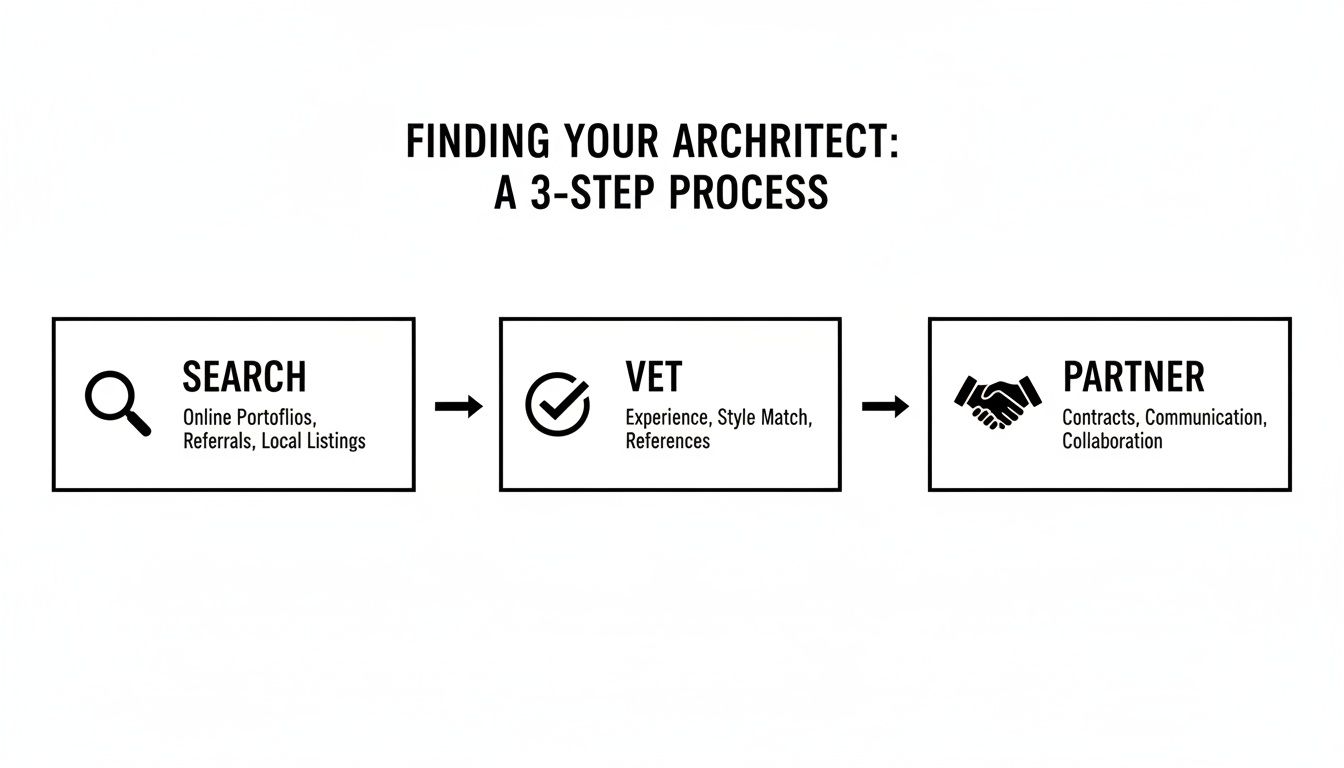
This visual breaks down the straightforward steps our in-house team follows: searching for, properly vetting, and then partnering with the ideal architect for your project in Southampton, Poole, or Ringwood.
Compiling the Full Application Package
Beyond the core drawings, your architect will pull together several other vital documents. One of the most important is the Design and Access Statement. This document is your chance to explain the thinking behind the design, justifying why the proposal makes sense in relation to local planning policies, the site's context, and accessibility.
A well-written Design and Access Statement tells a compelling story. It shows the planning officer that the design isn't just arbitrary but is a considered, thoughtful response to the site and its surroundings, making it far easier for them to support it.
As part of this process, a good architect also makes sure all necessary technical details are covered. Navigating complex design certification requirements is an essential but often overlooked task they handle.
Crucially, they'll also coordinate these plans with the next big hurdle: Building Regulations. It's vital to understand the difference, which you can read about in our guide to UK building regulations for extensions. With our in-house services, we ensure every single document is meticulously prepared, creating a comprehensive and compelling application that's ready for a smooth review process.
Submitting the Application and Liaising with the Council

With the final designs polished and all your supporting documents in order, it’s time to take the plunge. This is the point where your architect for planning permission from our team moves from designer to official representative, handling the entire submission process for you through the Planning Portal.
Once it's in, the application doesn't land on a planning officer's desk straight away. It first goes through a validation period. A council administrator will meticulously check that every form is filled, every drawing is correct, and every fee has been paid. A seasoned architect from Hallmoore knows exactly what's needed, preventing those simple admin errors that can cause frustrating delays right from the start.
The Consultation and Liaison Period
After your application is validated, the clock starts on the statutory determination period—this is typically eight weeks for most household projects in areas like Ringwood, Poole, or Christchurch. The public consultation begins now. Your neighbours will get a letter, and you might see site notices pop up, inviting comments on your proposal.
At the same time, your application gets assigned to a planning officer. This is where having our professional service managing the conversation becomes absolutely vital. Your architect acts as the single point of contact, fielding technical questions and providing any necessary clarifications directly to the council.
This direct line of communication is invaluable. Say the planning officer for a project in Bournemouth has a small worry about the visual impact of a proposed window. Your architect can jump on a call, discuss potential solutions, and negotiate on your behalf. They might suggest a slight design tweak that satisfies the officer without compromising your vision. This kind of proactive chat stops minor issues from snowballing into reasons for refusal.
Why Your Architect Is Your Greatest Advocate
Getting planning permission is tougher than ever. In the first quarter of 2025, only 45,521 new homes received planning approval in England—the lowest quarterly figure since 2012. That's a staggering 37% drop from the previous quarter, which really highlights how critical expert guidance has become.
Think of your architect during this phase as part negotiator, part problem-solver, and part project manager. They shield you from the complex back-and-forth, making sure your application stays on track and is presented in the best possible light.
At Hallmoore Developments, our in-house services connect you with architects who have years of experience dealing with councils across Highcliffe, Southampton, Christchurch, Poole, and Ringwood. They understand the local policies and, just as importantly, the people who enforce them. This local knowledge is your best asset for keeping things moving smoothly.
For a complete overview of the process, our guide explaining UK home extension planning permission covers everything you need to know.
Understanding the Decision: Conditions and Refusals
Receiving the decision from your local council is a huge moment, but it’s rarely a simple 'yes' or 'no'. Even an approval often comes with strings attached, known as planning conditions. This is a perfectly normal part of the process, and knowing how to navigate them is where an expert architect for planning permission from our team really proves their worth.
Planning conditions are specific requirements the council needs you to meet, either before you start building or at certain milestones during the project. Think of them as the council's way of fine-tuning your approval to make sure it’s just right.
For example, a project in a Highcliffe conservation area might have a condition specifying the exact type and colour of bricks to protect the local character. In a more built-up part of Southampton, a common condition might be to submit a detailed landscaping plan to ensure neighbours’ privacy is respected.
Discharging Planning Conditions
This is the point where your architect and builder really need to work in sync. The formal process of providing the council with the required details and getting their sign-off is called 'discharging conditions'. Our architect will package up all the necessary information—material samples, technical drawings, reports—and submit it for approval, clearing the path for construction to begin.
Don't underestimate this step. Failing to discharge conditions properly can invalidate your planning permission entirely, a mistake that is both costly and incredibly stressful. At Hallmoore Developments, our in-house services ensure a seamless link between the architectural plans and the on-site execution, making this process as smooth as possible. This kind of coordination is just as crucial as understanding the core construction standards, which you can read more about in our homeowner's guide to Building Regulations in Southampton.
Most councils are pretty good with straightforward cases. For instance, in England during Q1 2025, 91% of major applications were decided within the statutory timeframe. But things can vary hugely by region; in Northern Ireland, the average time for local applications in the first half of 2025/26 was 19.4 weeks—well over the 15-week target. You can discover more insights about these planning statistics on NISRA's website.
An approval with conditions is still an approval. It's a green light to move forward. Our architect’s job is to methodically tick every box so that construction can begin without any compliance headaches down the line.
What Happens If Your Application Is Refused
Getting a refusal can feel like a punch to the gut, but it is not the end of the road. If your application for a project in Poole or Christchurch is turned down, the first rule is: don't panic. The council is legally required to provide clear, written reasons explaining their decision.
This is where your architect's analytical skills are vital. They'll dissect the refusal notice, translating the technical planning jargon to pinpoint exactly where the proposal fell short. Was it a policy issue? Concerns about the design's impact on the street scene? A valid objection from a neighbour?
Once they understand the 'why', our architect will map out the best strategy. The options usually fall into two camps:
Amend the Design: Often, the quickest and most effective route is to make targeted changes to the plans that directly address the council's objections and then resubmit the application.
Lodge an Appeal: If your architect genuinely believes the council's decision was unfair or based on a misinterpretation of planning policy, they can help you lodge an appeal with the Planning Inspectorate.
With the right professional advice, a refusal is often just a detour, not a dead end. Our in-house architectural team provides the expert guidance needed to navigate these bumps in the road, giving your project the best possible chance of getting over the line.
Your Architect & Planning Permission Questions, Answered
Venturing into a home extension or renovation in areas like Highcliffe or Bournemouth always kicks up a few questions. It's completely normal. To wrap things up, here are some straight-talking answers to the most common queries we get from homeowners about working with an architect for planning permission.
How Much Does an Architect Cost for Planning Permission?
This is usually the first thing people want to know, and for good reason. Architect fees aren't one-size-fits-all. They're often structured either as a percentage of the final build cost (typically somewhere between 5-12%) or as a fixed fee for specific stages, like getting your plans approved.
For a planning application in Poole or Ringwood, you'll most likely be looking at a fixed fee. The final figure really hinges on the complexity of your project. A straightforward rear extension will naturally cost less in design fees than, say, a tricky two-storey renovation inside a conservation area. At Hallmoore, our in-house service provides a clear, itemised quote from the start so there are no surprises down the line.
Can I Apply for Planning Permission Without an Architect?
Technically, yes, you can. But it’s a bit like representing yourself in court – possible, but not always wise. The planning process is a minefield of technical jargon, precise drawing standards, and local policies that differ from Southampton to Christchurch.
Using our in-house architectural service massively boosts your chances of getting a "yes" on the first try. Our team knows exactly what the council is looking for and can steer you clear of common pitfalls that lead to an outright rejection. Think of their fee as an investment in avoiding the stress, delays, and extra costs of having to go back to the drawing board.
It’s a simple trade-off: you can save a bit of money by going it alone, but you risk months of delays and resubmission fees if you get it wrong. Our in-house architect is your expert guide through the red tape.
How Long Does Planning Permission Take?
Once your application is officially submitted and validated by the local council, the clock starts ticking. For most standard household projects, the official target for a decision is eight weeks. That’s the goal for councils across the UK, including those in Bournemouth and Poole.
But be warned, "target" is the key word here. If your project is more complex, attracts a few objections from neighbours, or sits in a sensitive area, it can definitely take longer. Don't forget to factor in the time it takes your architect to produce the detailed drawings and documents before you can even submit, which could be several weeks itself. Our in-house architects will give you a realistic timeline from day one, based on your specific project and how busy the local planning office is at that moment.
Ready to get your project moving with the right expertise behind you? The team at Hallmoore Developments provides a complete in-house service, from pairing you with the perfect architect for planning permission in Bournemouth, Highcliffe, Southampton or Poole, to managing the entire build.
Comments