.png)
How to Identify Load Bearing Walls in Your Bournemouth Home
- Dan Hall
- Dec 17, 2025
- 10 min read

Before you even think about grabbing a sledgehammer for that dream open-plan kitchen, figuring out which walls are load-bearing is the absolute first step. A load-bearing wall isn't just a simple room divider; it's a core part of your home’s skeleton, channelling the weight from the roof and upper floors all the way down to the foundation. Get this wrong, and you're looking at serious, expensive structural problems. To properly identify load bearing walls, stop and see to an expert.
Why Identifying Load-Bearing Walls Is Not a Guessing Game
Whether your renovation is in Christchurch or Poole, you need to know what’s holding your house up before you start knocking things down. A load-bearing wall is an active structural element, a silent workhorse keeping your home stable and safe. Mistaking it for a partition wall can lead to disastrous consequences—sagging floors, cracked plaster, and in the worst-case scenario, structural failure. This isn't about aesthetics; it’s about safety.
This is exactly why a proper understanding isn’t just a good idea—it’s a necessity. The process involves far more than a quick look; it requires a methodical approach to get it right.
The Risks of a Wrong Guess
Getting it wrong is more than a simple hiccup; it can be a costly and genuinely dangerous mistake. The main risks you’re running are:
Structural Damage: Remove a supporting wall without putting in the right reinforcement, and you can expect floors to sag, ceilings to crack, and door frames to warp out of shape.
Safety Hazards: The most severe risk is a partial or even total collapse, which puts anyone inside the property in immediate danger.
Financial Costs: Fixing structural damage is always far more expensive than getting the wall removal right the first time around.
Here in the UK, this whole process is governed by strict rules. Identifying these walls correctly is a critical part of Building Regulations Part A, which covers structural integrity. To give you an idea, in 2023, UK building control approved around 15,000 load-bearing wall removals, but a significant 12% of those required redesigns because of initial misidentification. If you need a hand finding a pro, check out our guide on how to find the best local building company in Bournemouth.
A load-bearing wall carries the immense weight of your home's structure. Removing one without professional advice is like taking a bone out of a skeleton and just hoping it stays standing. Always, always consult an expert.
Our in-house services in Highcliffe and Southampton can see to it that your project is assessed correctly right from the start. For homeowners in Ringwood who want to dig a bit deeper, you might find a comprehensive contractor's guide to load-bearing wall identification to be a useful resource.
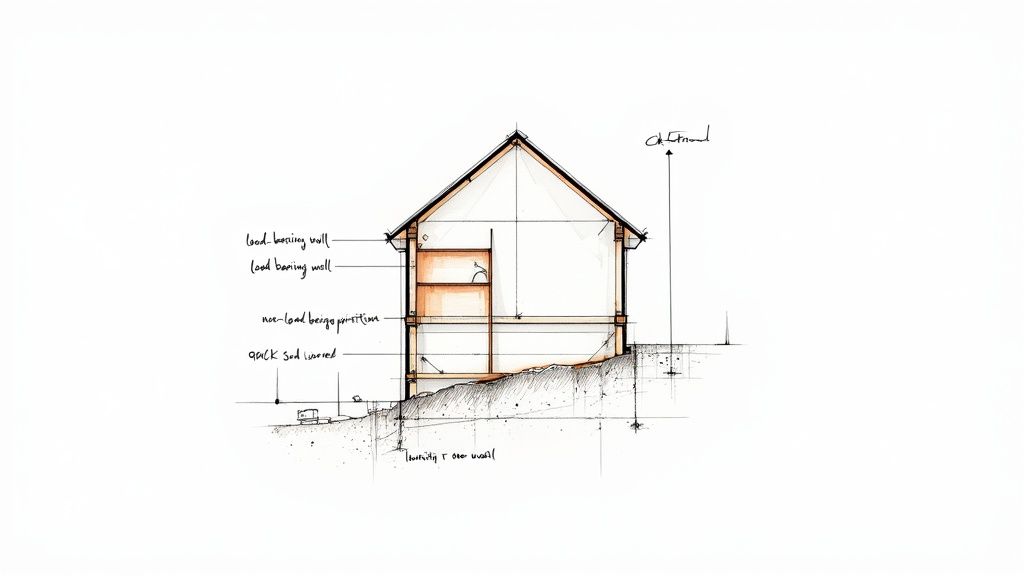
Start Your Search at the Foundation
To solve the puzzle of which walls are load-bearing, your detective work should always start at the lowest point of the house. Your home's foundation, basement, or crawlspace holds the most important clues to its structural layout. Down here, the transfer of weight is most obvious.
Look for any walls that sit directly on top of concrete footings or are supported by hefty columns. In a typical Ringwood or Southampton home, this might be a continuous brick wall or a series of solid timber posts or steel beams. Any wall that continues uninterrupted from this foundational level upwards is an incredibly strong candidate for being a structural support.
What to Look for Down Below
Before you start assessing the walls themselves, it’s vital to know your home’s base is stable. A bit of background reading on understanding foundation settlement, its causes, and its signs is always a good idea. A solid foundation is critical, as every structural support above relies on it. If you spot problems at this level, it often requires specialist intervention. For more detailed information on that, our team can provide insights on what is underpinning in construction.
When you're inspecting your basement or crawlspace, keep a sharp eye out for these key indicators:
Beams and Columns: Note any large steel I-beams or thick timber beams. Any walls sitting directly above these are almost certainly load-bearing.
Continuous Walls: A wall that runs from the foundation right up through the ground floor without any breaks is a primary structural element. No question.
Thicker Masonry: Look for walls made of brick or block that seem chunkier than other internal partitions. This extra thickness isn't for show—it’s for structural strength.
By mapping out these foundational supports first, you're essentially creating a structural blueprint of your home. This gives you a massive head start before you even begin examining the walls on the main living floors.
Remember, this initial check provides the first solid piece of evidence. If you're based in Highcliffe or Bournemouth and need an expert eye to confirm your findings, our in-house services are available to see to your project professionally.
Follow the Direction of Your Joists in Highcliffe
One of the most reliable ways to figure out if a wall is load-bearing involves looking up—or down. The direction of the joists in your floor and ceiling gives away a huge clue about your home’s structure. As a general rule, any wall running perpendicular to the joists is almost certainly carrying a significant load.
Think of the joists as the skeleton of your floor or ceiling, spanning from one side of a room to the other. A load-bearing wall acts as a central spine, holding up these joists. On the other hand, walls that run parallel to the joists are usually just simple partition walls because they aren't positioned to support the main structure.
Checking Joists From Your Loft or Basement
The easiest places to get a clear view of your joists are usually in an unfinished basement or the loft. Down in the basement of a Christchurch property, just look up at the ceiling and you'll see the floor joists for the ground floor above you. Up in the loft, you’ll find the ceiling joists for the floor below. Our complete guide to loft boarding has some useful tips for getting around your loft space safely.
If a wall on the floor below runs at a 90-degree angle to these joists, you've probably found your load-bearing wall.
This simple flowchart can help you visualise the process, especially when you start your investigation from the basement or foundation level.
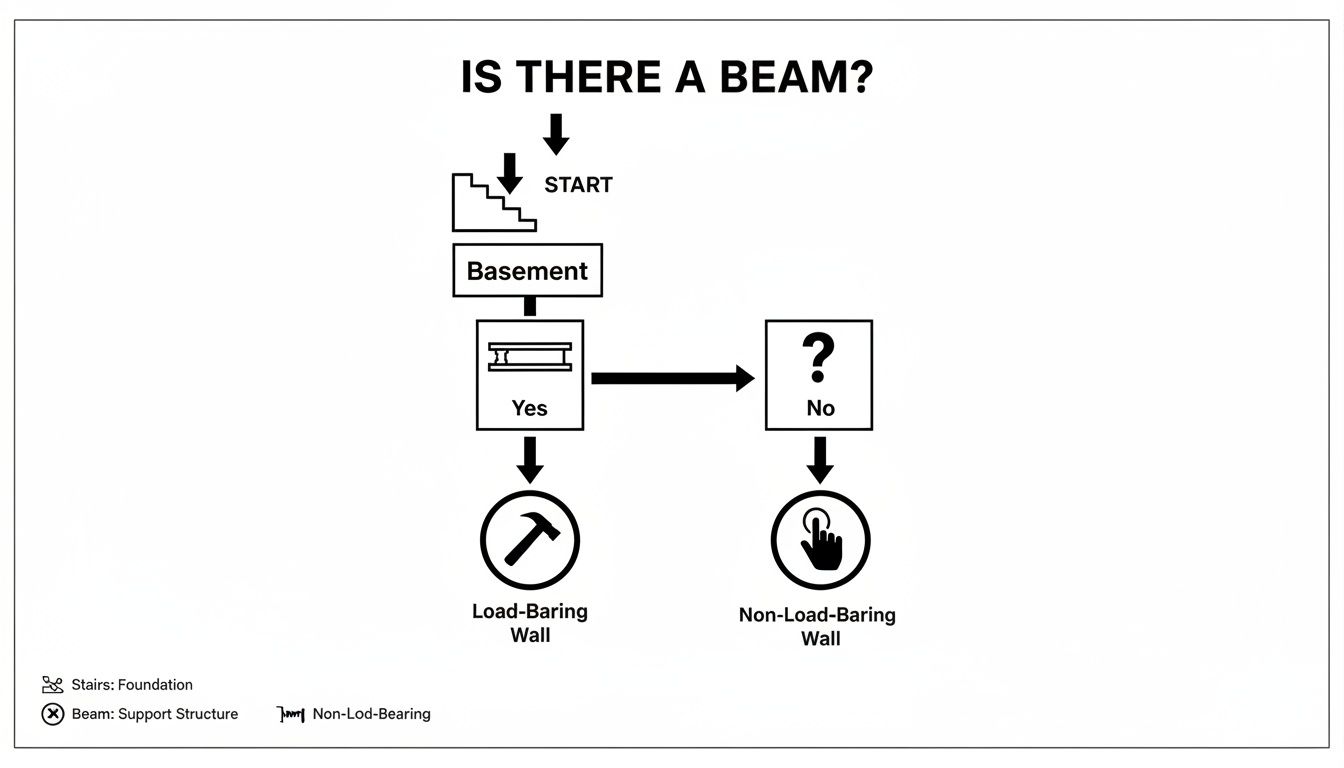
The diagram simplifies that first check, showing how a beam sitting directly under a wall is a dead giveaway of its structural importance.
This quick-reference table breaks down the most common signs you'll encounter when trying to determine if a wall is carrying a structural load.
Quick Guide to Spotting a Load-Bearing Wall
Indicator | What It Suggests | Likelihood of Being Load-Bearing |
|---|---|---|
Runs Perpendicular to Joists | The wall is directly supporting the floor or ceiling structure above it. | Very High |
Located in the Centre of the House | It may be supporting the central span of the building's structure. | High |
Continues Through Multiple Floors | The wall is part of the primary structural frame, transferring weight down. | Very High |
Made of Blockwork or Thick Studs | The construction material is substantial enough to carry a heavy load. | High |
Sits Above a Steel Beam or Column | A structural support below is a clear sign the wall above is also structural. | Almost Certain |
Runs Parallel to Joists | The wall is likely a non-structural partition, simply dividing a room. | Very Low |
While these indicators are extremely helpful, they aren't foolproof. Always get a professional opinion before making any structural changes.
Research from LABC surveys confirms how reliable this joist-checking technique is, showing that in 68% of inspections, walls running perpendicular to joists are indeed load-bearing. However, be cautious; timber stud walls can fool about 30% of homeowners, as they can still carry loads despite looking less substantial.
Even if you're confident about the joist direction, never proceed with demolition without professional confirmation. Getting it wrong is a risk that’s simply not worth taking.
If your joists are hidden behind plasterboard, try looking at the direction of the original floorboards. They were almost always laid perpendicular to the joists. It isn't a perfect method, but it’s another valuable piece of the puzzle. If you're in Bournemouth or Poole and still unsure, our in-house services can provide a definitive assessment to ensure your project goes ahead safely.
Read the Architectural Clues in Your Home
Every house tells a story, and if you know what to look for, its design can give you some serious clues about which walls are doing the heavy lifting. Your home's layout isn't just a random collection of rooms; it's a structural system, and some walls are definitely more important than others.
Let's start with the most obvious signs. Exterior walls are always load-bearing—they hold up your roof and floors and form the very shell of your home. Inside, keep an eye out for any walls that seem unusually thick. If one wall is chunkier than the others, there’s usually a structural reason for it.
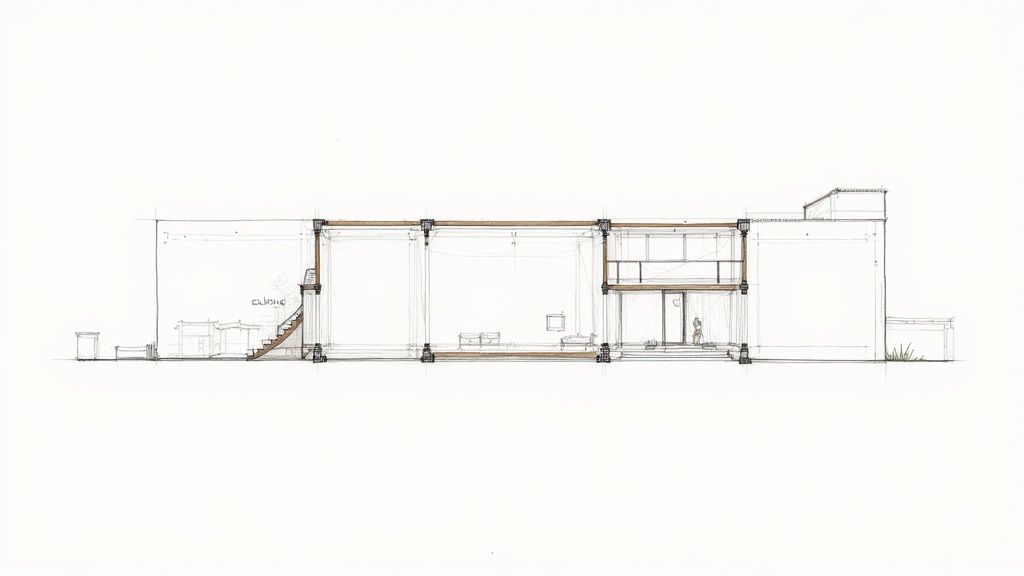
Analyse Your Home's Layout and Age in Poole
The age and style of your property in Poole or Highcliffe can also point you in the right direction. A central wall in a classic Victorian terrace, for instance, often runs parallel to the roof ridge and is almost certainly the building's spine. In a brand-new build, however, a similar-looking wall might just be a simple partition.
Look for walls that have other structural elements resting on them. Can you see a chunky timber beam or a steel RSJ sitting on top of a wall? That's a dead giveaway. The same goes for walls that line up with columns or support the ends of other walls. Each clue helps build a clearer picture.
Any wall with an uninterrupted path straight down to the foundation is a prime suspect. If a wall on your first floor is sitting directly above another wall on the ground floor or in the basement, it’s very likely part of the home's essential support system.
Remember, these visual checks are a great starting point, but they’re no substitute for professional confirmation. This is especially true if you’re planning major work like an extension, where getting it wrong can have serious consequences. To get a better handle on the official requirements, it’s worth reading our explanation of UK building regulations for extensions.
For homeowners in Christchurch and Southampton, our in-house services can help you tackle your project with confidence, ensuring everything is safe, compliant, and beautifully executed from start to finish.
Know When to Call a Structural Engineer in Bournemouth
DIY detective work is a great start, but it absolutely has its limits. When it comes to knowing for sure which walls are holding things up, there comes a definite point where your investigation must stop and a professional needs to step in.
Attempting to knock down a wall you think isn't load-bearing is a dangerous gamble. Get it wrong, and you could seriously jeopardise your home’s safety, not to mention your budget and project timeline.
This is where a structural engineer becomes essential. Their job is to carry out a proper on-site assessment, calculate the exact loads running through the wall, and then specify the precise size and type of steel beam (usually an RSJ) needed to support everything once the wall is gone. This isn't just a friendly suggestion; it’s a critical step for safety and for getting that all-important Building Regulations approval.
Avoiding Costly Structural Mistakes
Getting this wrong from the outset can be an eye-wateringly expensive mistake. In fact, misidentifying a load-bearing wall can inflate removal costs by 35% on average. A standard removal might cost around £1,500, but that figure can skyrocket if you make errors that need fixing later.
Investing in a professional assessment—which typically costs between £90 and £200 per hour—is the best way to prevent these costly problems before they start. You can read more about the potential costs of removing a load-bearing wall here.
The engineer's report and calculations aren't just a piece of paper—they are the blueprint for a safe and successful project. They give your builder the exact instructions needed to carry out the work correctly.
For homeowners in Bournemouth, Poole, and across Dorset, guesswork simply isn’t an option. The risk of sagging floors, cracked walls, or even worse structural damage is just too high. A professional consultation gives you the certainty you need to move forward with confidence.
Fortunately, you don't have to manage this process alone. For projects in Christchurch, Southampton, and Ringwood, we're here to help. Our in-house services can see to connecting you with qualified local structural engineers, ensuring your renovation is safe, compliant, and structurally sound from day one.
Your Top Questions Answered
Even after doing your homework, a few questions always pop up when you're staring at a wall, sledgehammer in hand. Let's tackle some of the most common ones we hear from homeowners across the UK.
Can a Timber Stud Wall Really Be Load Bearing?
Yes, and it's a critical point many people miss. We see this a lot in properties around Christchurch and Bournemouth where there's a mix of building styles. It’s easy to assume only solid blockwork can hold up a house, but timber stud walls are often designed right from the start to carry serious weight. They can support everything from the floor above to the entire roof structure.
Don't ever mistake a stud wall for a simple partition without being 100% sure.
I've Found a Load-Bearing Wall... Now What?
Okay, you've confirmed it's structural. Stop, and put the tools down. Your very next call should be to a structural engineer. This isn’t a step you can skip.
They are the only ones qualified to calculate the specific loads the wall is handling and then design the right replacement support—usually a steel beam, or RSJ. Their professional drawings and calculations are what you'll need for Building Regulations approval. It’s the essential paperwork that allows your builder to do the job safely and legally.
Do I Need Permission to Knock Down an Internal Wall?
This is a two-part answer. For most internal changes, you won't need planning permission unless your home is a listed building.
However, you will always need Building Regulations approval to remove a load-bearing wall. This process is in place for your safety. It ensures the new steel beam or support is designed correctly and installed properly, guaranteeing your home remains structurally sound for years to come.
Don't be tempted to bypass this. It's not just about ticking a box; it protects the integrity of your property and avoids major headaches and safety risks when you eventually sell your home.
Getting a handle on all the project steps is key. Our guide on the cost of a house extension in the UK can help you piece together the financial side of your renovation plans.
When you need absolute certainty for your renovation in Highcliffe, Bournemouth, or Southampton, stop guessing. See how our in-house services at Hallmoore developments can see to managing your project safely from concept to completion. https://www.hallmoore.co.uk
Comments