.png)
How to Improve Home Insulation and Slash Your Energy Bills in Bournemouth & Southampton
- Dan Hall
- Jan 26
- 17 min read

Is the chill from high energy bills and draughty rooms getting you down? The single most effective way to tackle this is to figure out where your home is losing heat and upgrade its insulation. Getting this right can make a world of difference, not just to your comfort but to your bank balance too, and our in-house team at Hallmoore Developments is here to see to it for you.
Why Prioritising Home Insulation in Bournemouth Matters
If you're a homeowner in Bournemouth, Southampton, or Christchurch, you’ll know how hard the heating system has to work during a cold snap. It’s not just about feeling cosy; it’s a serious financial drain. Bolstering your home's insulation is the foundation of any smart energy-saving plan, and it works hand-in-hand with other actionable home energy efficiency tips.
The problem is bigger than most people realise. Millions of UK homes are bleeding heat through poorly insulated walls and lofts. This isn't a minor issue—it can add an extra £570 a year to energy bills, and that figure only goes up. It's a widespread issue that also has a knock-on effect on national health, contributing to illnesses caused by cold, damp living conditions.
A Practical Guide for Hampshire and Dorset Homeowners
This guide is your roadmap to a warmer, more cost-efficient home, whether you're in Poole or Ringwood. We’ll cut through the jargon and cover everything from simple DIY draught-proofing jobs to major loft and wall insulation projects handled by our expert in-house services. After all, a well-insulated home doesn't just save you money; it makes your heating system far more effective. For more on that, have a look at our guide on the best heating systems for homes to save energy and money.
At Hallmoore Developments, we’ve seen firsthand how the right insulation transforms a property. Our in-house services manage the entire process—from the initial assessment to a flawless plastering and decorating finish—ensuring your home is not only warmer but also beautifully finished.
Pinpointing Your Home's Biggest Heat Leaks
Before you even think about buying new insulation, you need to play detective. Trying to insulate your home without first finding where the heat is escaping is like trying to fill a bucket riddled with holes – a frustrating and expensive exercise. A quick, hands-on audit of your property will show you exactly where your precious warmth is getting out, ensuring you put your money where it'll make the biggest difference. Our team can see to this for you with a professional survey.
For many homes, especially the older properties dotted around Poole and Christchurch, heat loss is more than just a minor niggle; it's a constant drain on your bank account. The good news is that you can often spot the main culprits yourself with just a few simple checks. This whole process is about building a clear picture of your home's thermal weak spots.
Your DIY Home Energy Audit Checklist
Think of this as a guided tour of your home's most likely problem areas. Grab a notepad, and let's get started. The best time to do these checks is on a cool, windy day. The bigger the temperature difference between inside and out, the more obvious any draughts and cold spots will be.
First up, the biggest offender in most UK homes: the loft. An uninsulated or poorly insulated loft can account for a staggering 25% of your home's total heat loss. It's the easiest and most impactful place to start.
The Loft Inspection: Get up into your loft safely and take a tape measure. Check the depth of any insulation that’s already there. The current government recommendation is a depth of at least 270mm (that’s about 11 inches) for mineral wool insulation. If you've got significantly less than that, you’ve just found priority number one.
Check for Damp: While you’re up there, have a good look around for any signs of moisture, damp patches, or mould on the underside of the roof. Damp insulation is useless insulation. Worse, it could point to a ventilation problem or a roof leak that needs sorting before you even think about adding new material.
A classic mistake people make is stuffing insulation right into the eaves, blocking the ventilation gaps. This traps moisture and is a recipe for condensation and timber rot. Our team will always see to it that a clear path is left for air to flow. For more on protecting your home from winter woes, have a look at our guide on how to prevent frozen pipes in your home in Bournemouth, Southampton, and Christchurch.
This quick-reference table should help you spot the most common sources of heat loss during your DIY audit.
| Common Heat Loss Areas and How to Spot Them || :--- | :--- | :--- || Area of Home | What to Look For | Simple DIY Test || Loft/Attic | Thin or compressed insulation, damp patches, visible rafters. | Measure the depth. It should be at least 270mm. || Cavity Walls | Cold-to-the-touch internal walls, signs of damp. | Feel the wall on a cold day. Noticeable coldness means heat is escaping. || Floors | Cold floors, especially above garages or unheated cellars. | Bare feet don't lie! If the floor is icy cold, it’s likely uninsulated. || Windows | Condensation between panes, visible gaps, rattling frames. | Move a lit candle or incense stick around the frame. A flickering flame reveals a draught. || Doors | Gaps under the door, draughts around the frame or letterbox. | Look for daylight around the edges. Use the candle test for smaller gaps. || Pipework | Gaps where pipes for water or gas enter the house. | Check behind sinks and radiators. You can often feel a cold draught with your hand. |
Remember, this is about building a complete picture. A small draught here and a cold wall there all add up to a bigger heating bill.
Identifying Wall and Floor Leaks
After the loft, your walls are the next biggest culprit. The type of wall you have determines the fix. Most homes built after the 1920s have cavity walls, whereas older ones usually have solid walls. An easy way to tell is by looking at the brick pattern outside – if all the bricks are laid lengthways (stretchers), it’s probably a cavity wall.
The simple touch test is surprisingly effective here. On a cold day, place your hand on your internal walls. If they feel noticeably cold or even a bit damp, that's a sure sign that heat is pouring straight through them. The same logic applies to your floors, especially those sitting above unheated spaces like a garage or cellar.
Uncovering Hidden Draughts in Ringwood
Draughts are the silent thieves of warmth. You'll find them lurking around windows, doors, and even smaller gaps you wouldn't think of, like letterboxes, keyholes, or loft hatches. The old-school test still works best: light a candle or an incense stick and carefully move it around the edges of your window frames and doors. If the flame or smoke starts dancing, you’ve found a leak.
Don’t forget to check:
Around window and door frames: Gaps can open up as houses settle over time.
Through letterboxes and keyholes: These are classic entry points for cold air.
Where pipework enters the home: Have a look behind sinks, toilets, and radiators.
When to Call for a Professional Survey in Highcliffe
A DIY audit is a fantastic starting point, but sometimes you need to bring in the big guns. If you’ve got persistent cold spots you just can't trace, suspect issues with solid walls, or simply want a proper scientific analysis, a professional thermal imaging survey is a brilliant investment.
This tech creates a heat map of your home, showing you exactly where heat is escaping in a way the naked eye never could. At Hallmoore Developments, our in-house service can carry this out for you, providing a precise, data-driven report. We can identify everything from missing patches of cavity wall insulation to complex thermal bridging, giving you a clear, prioritised action plan to make your home warmer and more efficient.
Which Insulation Projects Give the Biggest Bang for Your Buck?
Once you’ve sussed out your home's thermal weak spots, the big question is where to put your money for the greatest impact. Not all insulation jobs are equal – they vary wildly in cost, disruption, and payback. Getting your priorities right is the secret to making a real difference to your comfort and your bills, especially with the mix of housing we see across Highcliffe and Christchurch.
Think of your home as a bucket with holes in it. Some holes are much bigger than others. By plugging the biggest ones first, you get the fastest, most noticeable savings. It’s a strategic approach that makes sure your budget is working as hard as possible to deliver a warmer home without any wasted cash. Let’s break down the hierarchy, starting with the undisputed champion of insulation projects.
Starting at the Top: Why the Loft Is Always Priority Number One
If you do only one thing to improve your home’s insulation, make it the loft. Heat rises, as we all know, so an uninsulated or under-insulated loft is like leaving a giant window wide open all winter. A staggering 25% of your home's heat can vanish straight through the roof, making this the single most effective upgrade you can tackle.
The current recommendation is to have 270mm of mineral wool insulation (or an equivalent material). For many homes in Bournemouth, this might just be a straightforward "top-up" job over the existing layer, which is a perfect weekend DIY project for a confident homeowner. However, if the insulation you’ve already got is old, squashed flat, or showing signs of damp, it’s far better to remove it and start fresh with our in-house service.
You'll generally come across three main types of loft insulation:
Insulation Rolls: These are the most common and cost-effective choice, usually made of mineral wool (like glass or rock wool). You simply unroll them between the joists, then lay another layer at a right angle over the top.
Loose-Fill Insulation: This involves blowing fibres (like cellulose or mineral wool) into the loft space. It’s a fantastic option for topping up existing insulation or for tricky lofts with awkward access or lots of pipework to work around.
Insulation Boards: Rigid boards made of materials like PIR (polyisocyanurate) pack a bigger insulating punch for their thickness. We often use these when converting a loft into a proper room, where every centimetre of headroom counts.
While insulating your loft is a great first step, most of us also want to use that space for storing Christmas decorations and old suitcases. This is where a professional touch makes a huge difference. Just throwing boards on top of your new insulation squashes it flat, crushing the air pockets that do all the work and making it far less effective. At Hallmoore Developments, our in-house team installs raised loft boarding to create a solid storage deck that floats above the insulation, protecting the full 270mm depth. You can read more about how we do this for homes across the Southampton area in our complete guide to loft boarding.
Tackling the Walls: Cavity vs. Solid Wall Insulation
With the loft sorted, your walls are the next biggest culprit for heat loss, responsible for around 35% of the heat escaping from an uninsulated house. The right way to tackle them depends entirely on how your home was built.
Most homes built in the UK after the 1920s have cavity walls – two layers of brickwork with a gap in between. Filling this gap is one of the most cost-effective insulation upgrades you can make.
This is absolutely a job for certified professionals. It involves drilling small, neat holes in the mortar joints of the outer wall and pumping in insulation material (usually polystyrene beads or mineral wool fibres) until the cavity is completely full. It's quick, clean, and causes very little disruption. Our in-house service team can often get it done in less than a day.
Trying to insulate a cavity wall yourself is a definite no-go. It requires specialist equipment and expertise to make sure the cavity is filled evenly, without creating cold spots or bridges for damp to cross. Always use a certified installer like Hallmoore Developments to see to it that the work is done properly and safely.
Older properties, especially those built before the 1920s in places like Ringwood, usually have solid walls. With no cavity to fill, you have to add insulation to either the inside (internal wall insulation) or the outside (external wall insulation).
This quick flowchart can help you pinpoint where your home is likely losing the most heat.
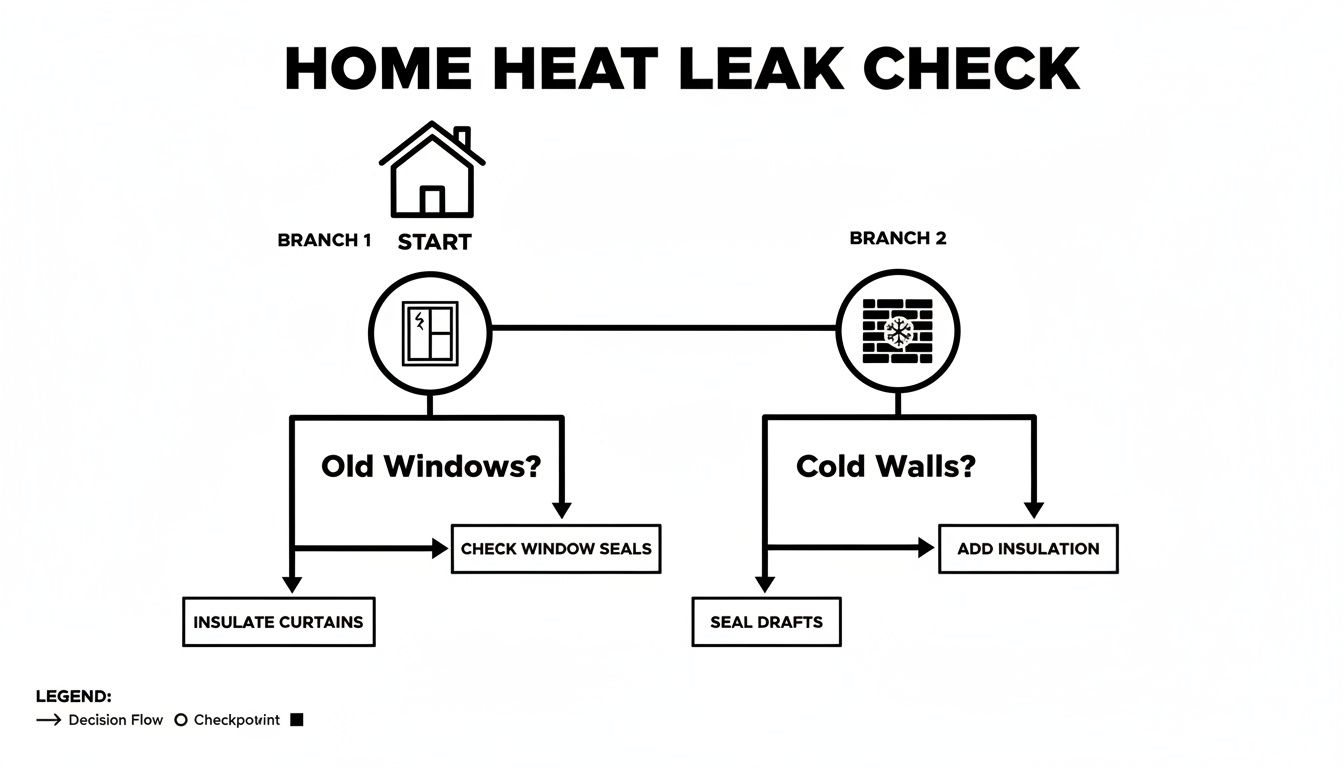
As you can see, simple things like touching a cold wall or spotting condensation on old windows are dead giveaways for your home’s biggest insulation weaknesses.
Solid wall insulation is a much bigger and more expensive undertaking, but the payoff in comfort and energy savings is massive. This is where a full-service team like ours really comes into its own. Our in-house services handle the entire process, from fitting the insulation boards to the expert plastering and decorating needed to get your rooms back to a perfect finish.
Don't Forget Floors, Windows, and Doors
While they don’t lose as much heat as the loft and walls, your floors, windows, and doors are still key players in a chilly home. Sorting them out is the final piece of the puzzle.
Suspended Timber FloorsIf you have older floorboards with a draughty void or cellar underneath, insulating between the joists can stop that cold air from rising. Around 15% of heat can be lost through the floor. The job involves carefully lifting the floorboards and fitting insulation (often mineral wool rolls held up by netting) between the joists.
Concrete FloorsInsulating a solid concrete floor is much more disruptive and is usually only done during a major renovation. It means adding a layer of rigid insulation board on top of the concrete before laying a new floor covering.
Windows and DoorsModern double or triple glazing is brilliant at keeping the heat in. But if a full window replacement isn't on the cards, you can still make a big difference with some simple fixes:
Draught-proofing: Use self-adhesive foam strips to seal gaps around window frames and doors. It's cheap, easy, and surprisingly effective.
Thick Curtains: A good set of thermal-lined curtains acts as another layer of insulation, especially at night.
Secondary Glazing: A cheaper alternative to replacement windows where a second pane of glass or acrylic is fitted inside the existing window frame.
By working through this list—loft first, then walls, followed by floors and windows—you ensure you're putting your money where it will deliver the biggest and fastest return. Recent data shows this is exactly where savvy homeowners are focusing their efforts. In March 2025 alone, the Great British Insulation Scheme (GBIS) saw installations jump by 14%. Cavity wall insulation made up 41% of all measures (31,500 homes), followed by loft insulation at 28%. It proves that targeted upgrades to walls and roofs—the places UK homes bleed the most heat—are the priority.
With 6.1 million properties in the UK having uninsulated cavity walls, getting them filled or topping up your loft to 270mm can genuinely slash your heating bills by up to a third.
Ultimately, a warmer, cheaper-to-run home comes from a clear, prioritised plan. By hitting the loft first and then the walls, you’re tackling the biggest sources of heat loss head-on. For the more complex jobs like cavity fills or solid wall insulation, bringing in our team at Hallmoore Developments guarantees the work is done safely, to the highest standard, and with a finish you’ll be proud of.
Choosing The Right Materials For Your Dorset Home
Knowing where to insulate is half the battle; figuring out what to insulate with is the other. The market is flooded with options, each with its own quirks, price tag, and ideal use case. For homeowners across Dorset, from Poole to Christchurch, making the right call means balancing thermal performance with your budget and what your specific property actually needs.
The material you choose makes a huge difference. It’s not just about grabbing the one with the highest performance on paper. You have to think practically. Do you need something moisture-resistant for a steamy bathroom? Is breathability critical for your older property? Or maybe you need better acoustic properties because you live on a busy road. Our in-house experts can see to it that you get the best advice.
Comparing Common Insulation Materials
Let's break down the most popular choices you'll come across. Each one shines in different scenarios, and getting your head around these differences is the key to a successful project. From traditional mineral wool to modern rigid boards and eco-friendly alternatives, there’s a solution for every part of your home.
Here are the main contenders you’ll be looking at:
Mineral Wool (Glass or Rock Wool): This is the go-to for loft insulation rolls, and for good reason. It's affordable, non-combustible, and offers a good mix of thermal and acoustic insulation. It’s a fantastic all-rounder, especially for filling the gaps between joists in lofts and suspended floors.
PIR Boards (Polyisocyanurate): These are the sleek, rigid foam boards with a foil backing. They pack a much bigger punch in terms of R-value (a measure of thermal resistance) for their thickness compared to mineral wool. This makes them perfect for insulating the inside of solid walls or the rafters of a loft room where you want maximum insulation without sacrificing too much space.
Expanded Polystyrene (EPS): You'll often see this as either white boards or tiny beads used for cavity wall insulation. It's lightweight, cost-effective, and holds up well against moisture, making it a reliable and common choice for filling the gap in cavity walls.
Natural Fibres (Sheep's Wool or Cellulose): These sustainable options are really gaining ground. Sheep's wool is brilliant at managing moisture – it can absorb and release water vapour without losing its insulating power, which is a massive plus for older, breathable buildings. Cellulose, made from recycled newspaper, is often used as a loose-fill for topping up lofts.
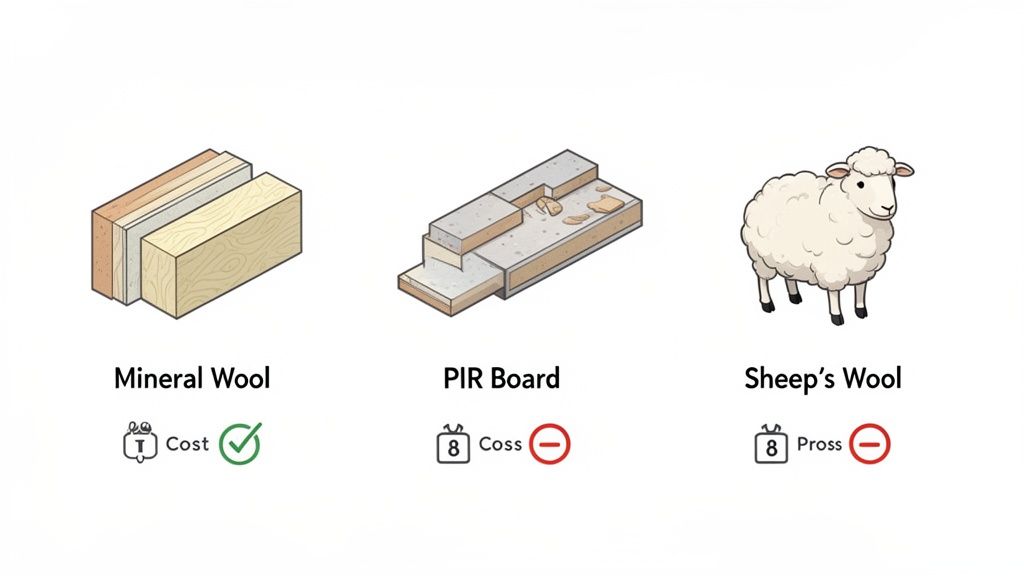
For anyone keen on diving deeper into green building options, we’ve put together a dedicated guide. You can learn more about sustainable building materials for stunning modern homes right here on our blog.
Understanding Costs And Long-Term Payback
The upfront cost is always a major factor, isn’t it? But think of insulation as an investment. It’s one that genuinely pays for itself over time through lower energy bills. Material costs can vary across Hampshire and Dorset, but the estimates below should give you a decent starting point for budgeting.
Remember, the cheapest option isn't always the best value. The real win is choosing the right material for the job and getting it installed perfectly. A poorly fitted premium product will perform worse than a well-installed budget option every time.
Don't forget the outside of your home, either. When looking at exterior finishes with enhanced thermal properties, some homeowners even consider specialist materials like Charred Thermowood Cladding. It just goes to show how even external finishes can contribute to your home’s overall thermal envelope while providing a stunning look.
Making An Informed Choice For Your Highcliffe Home
To make things a bit clearer, here’s a quick comparison of the most common insulation materials our in-house service uses on projects in areas like Highcliffe and Southampton. This table breaks down the key factors to help you see the differences at a glance.
We’ve put together this simple table to help you compare the main players. It’s designed to give you a clear, at-a-glance overview of what might work best for your home.
Insulation Material Comparison for UK Homes | ||||
|---|---|---|---|---|
Material Type | Typical R-Value (per 100mm) | Average Cost (per m²) | Best For | Key Considerations |
Mineral Wool | 2.2 - 2.7 | £5 - £10 | Lofts, cavity walls, suspended floors. | Can irritate skin during installation; needs to be kept dry. |
PIR Boards | 4.5 - 5.0 | £20 - £35 | Solid walls, loft conversions, floors. | More expensive, but excellent performance for its thickness. |
Polystyrene Beads (Cavity Fill) | 2.5 - 3.0 | N/A (Pro Install Only) | Cavity walls. | A quick, minimally disruptive professional installation. |
Sheep's Wool | 2.4 - 2.6 | £15 - £25 | Older properties, timber frames, lofts. | Excellent moisture control, sustainable, but a higher initial cost. |
Ultimately, this upfront investment translates directly into significant, year-on-year savings on your energy bills. At Hallmoore Developments, we believe in transparent pricing and lasting value. Our experts can advise you on the most suitable and cost-effective materials for your property, ensuring you get the best possible return on your investment for years to come.
Why Ventilation and Professional Installation Go Hand in Hand
When you insulate your home, the goal is to make it as airtight as possible. But there’s a catch. Sealing every gap and crack is brilliant for keeping the heat in, but it creates a new challenge: your house can no longer breathe. This is where insulation and ventilation must work together as a team, and where professional expertise becomes absolutely crucial.
Without a proper escape route for stale, moist air, you risk trading draughts for damp. Everyday life—cooking, showering, even breathing—pumps moisture into the air. Before, that humid air would find its way out through little gaps around windows and doors. Now, it's trapped inside.
The Damp and Mould Problem in Southampton Homes
So what happens when that warm, moist air hits a cold surface, like a windowpane or an external wall on a chilly Southampton morning? It condenses, turning back into water droplets. Over time, this constant damp creates the perfect breeding ground for black mould, which can damage your decor, your home's structure, and even your health.
This is why getting the airflow right is non-negotiable. It’s a delicate balancing act that a professional understands instinctively. Our in-house services know which ventilation points are essential to protect:
Trickle Vents: Those small, often overlooked vents at the top of modern windows are there for a reason. They provide a constant, controlled stream of fresh air.
Extractor Fans: Absolutely vital in kitchens and bathrooms, these fans pull steam and moisture-heavy air directly outside before it can cause problems.
Loft Eaves: This is a big one. Insulation must never be stuffed right into the eaves. Blocking this gap stops the airflow needed to keep your roof space dry and free from rot.
Viewing insulation as a standalone job is a common mistake. It's really one part of a whole-house system designed for comfort, efficiency, and health. This is reflected in government schemes like ECO4, which focus on integrated solutions. By Q3 2025, the scheme had already delivered 949,800 measures across 280,100 households, with insulation making up 53% of all installs. This shows the clear shift towards joined-up thinking, not just quick fixes. You can read more about these home efficiency statistics.
Why Gas Safe Registration Is a Must-Have for Poole Insulation Projects
Here’s where things get even more serious. Most homes have boilers or gas fires with flues running through the very walls or loft spaces you want to insulate. If this work isn't handled correctly, the safety implications are huge.
Blocking a boiler flue or restricting its ventilation can lead to a build-up of carbon monoxide—a silent, odourless, and potentially fatal gas. This is precisely why our Gas Safe registration at Hallmoore Developments isn’t just a nice-to-have; it's a critical safety guarantee for our clients across Poole and Ringwood.
Our in-house team sees the whole picture. When we take on an insulation project, we aren't just thinking about keeping you warm. Our Gas Safe engineers ensure any work around your heating system is done correctly and safely. Our plasterers and decorators then make sure the finish is seamless.
This integrated approach means your insulation upgrade is not only effective but also safe, compliant, and healthy for your home. If you're planning a project and want the peace of mind that comes from a single, accountable team, our guide on how to find a renovation company near me explains how to find one that can manage everything under one roof.
Still Have Questions About Home Insulation?
It's completely normal to have a few questions before kicking off a big project. After all, improving your home's insulation is a proper investment in its comfort and long-term value. Here are some of the most common queries we hear from homeowners in Highcliffe, Bournemouth, and across the south coast, answered straight.
We want to demystify the process of improving your home insulation and show you how our in-house team can deliver a smooth, expert solution without the fuss.
How Disruptive Is Cavity Wall Insulation To Install?
This is a concern we hear all the time, but the reality is surprisingly low-impact. For a typical property in Poole or Christchurch, the entire job of installing cavity wall insulation usually takes just a few hours—not days.
Our certified technicians do everything from the outside. We drill a series of small, precisely spaced holes into the mortar joints of your brickwork (never the bricks themselves). The insulation material is then carefully blown into the cavity until it’s perfectly filled. Our team will then see to it that the holes are sealed with colour-matched mortar, making them almost invisible. No mess, no fuss, and no disruption inside your home at all.
Are There Any UK Grants Available for Insulation Costs?
Yes, there often are government schemes to help with the costs. The main one to keep an eye on is the Great British Insulation Scheme (GBIS), which is aimed at homes with lower Energy Performance Certificate (EPC) ratings. These grants can take a serious chunk out of the upfront cost, especially for cavity wall and loft insulation.
Eligibility criteria can change from year to year, so it's always best to check the latest government guidance. As certified installers, our in-house service is always up to date and can help homeowners in areas like Ringwood and the New Forest navigate the application process to see what financial support they might qualify for.
Key takeaway: If your heating is constantly battling to keep rooms at a comfortable temperature and your energy bills feel stubbornly high, poor insulation is almost certainly the culprit. It's the biggest weak link in most homes.
How Much Mess Does Internal Solid Wall Insulation Create?
Let's be upfront: unlike cavity wall work, upgrading solid walls is a more involved interior job and it does create some disruption. We are essentially adding a brand-new, high-performance layer to the inside of your external walls. The process involves fixing insulated plasterboards directly to the wall, followed by taping, jointing, and skimming for a perfect finish.
This means the room will be out of action while we work, and you'll need to clear the space. However, this is where the Hallmoore Developments team really shines. Our multi-trade expertise means we manage the entire project seamlessly. Our in-house services will handle the installation, the plastering, and even the final decorating, ensuring your space is handed back to you in perfect condition, with minimal hassle on your part. It’s a proper renovation, but the payoff in warmth and comfort is immense.
Ready to feel the difference a properly insulated home can make? For expert advice and a professional, all-in-one insulation service from a Gas Safe-registered team covering Bournemouth, Southampton, and beyond, get in touch with Hallmoore Developments.
Our in-house team will see to it that your home is warmer and more efficient. Let us show you how this is just a conversation away.
Comments