.png)
UK Trends: Cost of House Refurbishment Revealed
- Dan Hall
- Dec 4, 2025
- 16 min read

So, you're thinking about a home refurbishment? It's an exciting prospect, but the big question on everyone's mind is always the same: what's the real cost of house refurbishment?
For a standard 3-bedroom house in the UK, you're typically looking at a budget somewhere between £75,000 and £150,000 for a full-scale renovation. Of course, this is just a ballpark figure. The final bill will hinge on where you live, the level of work you're planning, and the quality of finishes you can't live without. At Hallmoore Developments, our in-house services are designed to help you navigate these costs and deliver your project successfully.
Understanding the True Cost of House Refurbishment in Poole
Before a single sledgehammer is swung or a new kitchen is even picked out, figuring out your budget is the absolute first step. Whether you're in Bournemouth, Christchurch, or right here in Poole, understanding the numbers is crucial. The cost of a refurbishment isn't one set price; it's a sliding scale that moves with every choice you make.
Lately, we've seen renovation costs on the rise. That figure of £75,000 to £150,000 for a typical 3-bed semi is a good starting point, but that doesn't usually cover major structural changes like an extension.
A more detailed way to estimate is by looking at the cost per square metre. In 2025, you can expect this to be anywhere from £1,200 to £2,800. So, for a 100 m² home, the total could land anywhere between £120,000 and £280,000. It's a wide range, which is why getting the details right from the start is so important, and where our in-house services can provide real clarity.
Setting a Realistic Financial Baseline
To build a budget that won’t give you nasty surprises later, you need to get a grip on the key factors driving the costs. These early estimates aren't just guesses; they're the foundation for your entire project. A good way to start is by getting familiar with the process itself—our guide on the essential steps for renovating a house walks you through it.
To give you a clearer idea, here's a rough breakdown of what different property sizes might cost to refurbish.
Estimated Refurbishment Cost by Property Size in Bournemouth
This table gives a summary of typical cost ranges for a full house refurbishment, helping you see how property size and project scope influence the final numbers.
Property Type | Average Cost per m² | Total Estimated Cost Range |
|---|---|---|
2-Bed Terraced House | £1,200 - £2,200 | £70,000 - £130,000 |
3-Bed Semi-Detached | £1,400 - £2,800 | £75,000 - £150,000 |
4-Bed Detached House | £1,600 - £3,200 | £110,000 - £250,000+ |
Just remember, these figures are a launchpad, not a landing strip. Projects in desirable areas like Highcliffe or Ringwood might have higher labour costs, while choosing high-end fixtures for a project in Southampton or Poole will naturally push your budget toward the top end of these estimates.
At Hallmoore Developments, our in-house services bring clarity and control to your budget from day one. We're here to make sure your project is a success, without the financial headaches.
What Really Drives Your Renovation Budget
Ever wondered why one refurbishment in Highcliffe costs twice as much as a similar-looking one in Ringwood? Or why your neighbour’s project came in thousands below your quote? The final cost of house refurbishment isn't a simple calculation; it's a complex puzzle with lots of moving parts. Getting a grip on what drives these costs is the secret to building a realistic budget and sidestepping those nasty surprises down the line.
Think of your budget as standing on three main pillars: the property you're starting with, the quality of materials you pick, and the amount of structural work you need. Each one of these can make your costs swing wildly. Master them, and you're in control of your spending.
The Property’s Starting Point: Condition, Age, and Size
The most basic factor is the house itself. It’s simple maths: a larger home in Poole is always going to need more materials and more labour than a small flat in Southampton, pushing the budget up from the get-go.
But the age and condition are just as crucial. An older property might look charming, but it could be hiding problems like ancient wiring, crumbling plaster, or leaky plumbing that have to be sorted before you can even think about the cosmetic stuff. These essential fixes add a whole layer of cost that a modern, well-kept house just wouldn't have. Our in-house services include thorough assessments to identify these issues early.
A property survey might show a house that looks perfect on the surface, but it could easily need £15,000+ in essential repairs before the main refurbishment can even begin. It’s a classic scenario that really drives home the need for a thorough inspection first.
Your Choice of Finishes: Standard vs. Luxury
This is where your personal taste hits the wallet. The range of finishes is absolutely huge, from budget-friendly basics to eye-watering luxury, and every single choice adds up.
Let's take a kitchen renovation. You could go for standard laminate worktops and off-the-shelf cabinets for a few thousand pounds. Or, you could opt for bespoke cabinetry, a solid granite worktop, and high-end integrated appliances, which could easily send the cost for that one room into the tens of thousands.
Here’s how this choice plays out across a typical project:
Flooring: Basic laminate vs. engineered oak or premium porcelain tiles.
Kitchen: Standard units vs. custom-made joinery and stone surfaces.
Bathroom: A simple suite vs. designer fixtures, a walk-in shower, and floor-to-ceiling tiling.
Windows: Standard uPVC vs. custom timber sash or sleek aluminium-framed windows.
Every one of these decisions has a knock-on effect. Choosing luxury finishes doesn't just raise the material costs; it often demands more specialised (and more expensive) tradespeople to get the installation right. Our in-house team at Hallmoore Developments can help you figure out where to save and where it's worth splashing out to get the look you want without breaking the bank.
Structural Changes and Their Cost Implications
While cosmetic updates change how your home looks, structural alterations change its shape—and often take a massive slice of the budget. Any work that involves moving walls or reinforcing the property's structure is a serious financial commitment.
Knocking down an internal wall to create a modern, open-plan living space sounds straightforward, but it’s rarely as simple as taking a sledgehammer to it. If that wall is load-bearing, it has to be replaced with a steel beam (an RSJ) to hold up the floor above. That means getting an engineer to do the calculations, bringing in skilled labour, and paying for heavy-duty materials, adding thousands to the bill. Our in-house services include structural engineers and builders to manage this entire process seamlessly.
Even bigger structural jobs, like fixing foundation issues, can be far more expensive. Problems like subsidence might require major work to make the property safe. If you've got any worries about your property's stability, understanding what underpinning is in construction will give you a good idea of what's involved. This kind of work isn’t optional—it’s about safety, and it will have a huge impact on your total budget.
Breaking Down Costs Task by Task in Southampton
Thinking about the total project cost is one thing, but a truly realistic budget is built from the ground up, one job at a time. The final figure for any cost of house refurbishment is just the sum of all the individual tasks. By breaking your project down into these smaller pieces, you get a much firmer grip on your spending and can decide where your money will make the biggest impact.
So, let's get into the typical costs for the most common refurbishment jobs here in the UK. These numbers will help you move from a vague estimate to a proper, itemised budget for your project, whether you're in Highcliffe, Bournemouth, or anywhere on the South Coast. From rewiring to roofing, every task has its price tag.
This image neatly sums up the main drivers of any renovation budget: the size of the project, the quality of the finish you choose, and how much structural work is involved.
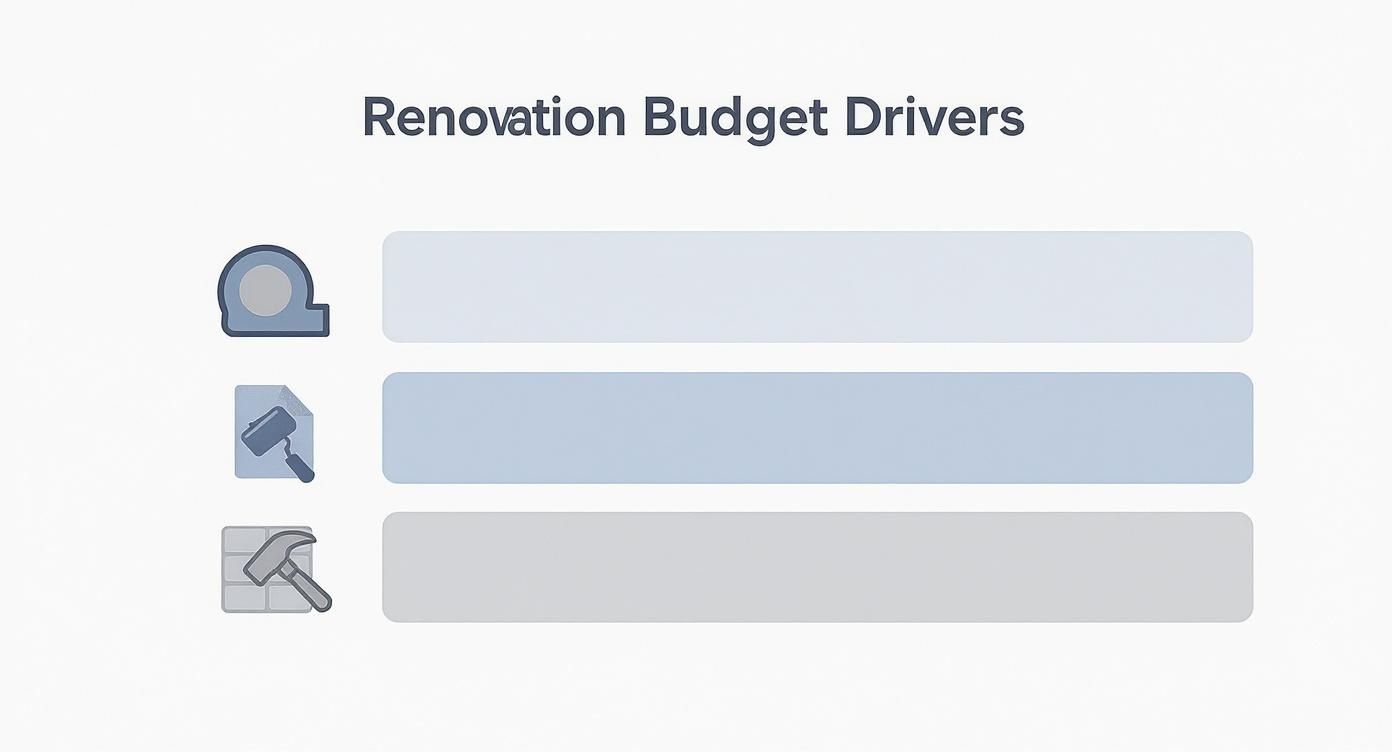
As you can see, the size of your property sets the baseline, but your choices in materials and any structural changes can really push the final cost up. Our in-house services are here to help you find the right balance, making sure you get the home you want without any nasty surprises on the final bill.
To give you a clearer idea of where the money goes, we've put together a table of typical costs for individual jobs. Think of this as your starting point for building a detailed budget.
Typical Costs for Individual Refurbishment Tasks
This table provides an itemised breakdown of average costs for common renovation jobs in a standard 3-bedroom UK house. Please remember these are guide prices; the final cost will depend on your specific property, location, and the materials you choose. Our in-house services can provide a precise quote for your project.
Refurbishment Task | Low Estimate | High Estimate |
|---|---|---|
Full Electrical Rewire | £4,000 | £8,500 |
New Central Heating System | £3,500 | £7,000 |
Window Replacement (uPVC) | £2,500 | £8,000 |
New Roof | £6,500 | £18,000 |
Exterior Rendering | £4,000 | £7,000 |
Full Replastering | £10,000 | £15,000 |
Painting & Decorating | £5,000 | £7,000 |
Bathroom Refit | £5,000 | £15,000 |
New Kitchen (Mid-Range) | £15,000 | £30,000 |
These figures highlight how quickly individual jobs add up. Planning for both the essentials and the finishing touches from the outset is absolutely crucial for keeping your project on track.
Core Systems and Structural Work
Let's start with the big stuff. The most critical—and often most expensive—jobs involve your home’s essential systems. These are the areas where you simply can't afford to cut corners, as they’re fundamental to your family's safety and comfort.
Full Electrical Rewire: An absolute must for older properties. A complete rewire for a standard 3-bedroom house will typically set you back between £4,000 and £8,500.
New Central Heating System: This involves a new boiler, radiators, and all the pipework. Expect to budget between £3,500 and £7,000, depending on your home's size and the system's complexity.
Window Replacement: Good windows improve energy efficiency and security. Costs vary massively based on the material (uPVC, timber, or aluminium), but a full set for a 3-bed house can run from £2,500 to £8,000.
Exterior work also represents a major investment. For those of us in coastal areas like Christchurch, protecting your home from the elements is vital. A completely new roof can range from £6,500 to £18,000, while rendering the outside of a semi-detached house might cost between £4,000 and £7,000.
Interior Finishes and Big-Ticket Rooms
Once the structural work and systems are sorted, you can finally turn your attention to the fun part: the aesthetics. This is where your personal style really shines through, but it's also where costs can climb if you're not careful.
Replastering walls and ceilings is usually needed after a rewire to get that perfectly smooth canvas for decorating. For a 3-bedroom house, this can cost between £10,000 and £15,000. After that, bringing in professional painters and decorators could add another £5,000 to £7,000 to the budget. Our in-house services cover all these trades, ensuring a high-quality finish.
Kitchens and Bathrooms: The Heart of the Refurbishment
Kitchens and bathrooms are, without a doubt, the most complex and expensive rooms to tackle. They demand a combination of plumbing, electrical work, joinery, and tiling—all of which adds up fast.
A complete bathroom refit, including a new suite, tiles, and labour, usually starts around £5,000. If you're looking at high-end fixtures and designer finishes, that figure can easily climb past £15,000.
The kitchen is often the single priciest room in the entire project. A new kitchen means cabinetry, worktops, appliances, flooring, and lighting. A budget-friendly option might come in around £8,000, but a more realistic mid-range project often falls between £15,000 and £30,000. For a high-end, bespoke design, costs can soar well beyond £50,000. To get a better handle on these figures, have a look at our detailed guide on the average cost of a kitchen remodel in the UK.
To see how individual room projects fit into the bigger picture, it helps to dig into specific guides, like this one on the cost to renovate a bedroom. This kind of detailed approach is the key to building a financial plan that's both comprehensive and realistic.
How to Handle Rising Material and Labour Prices
Trying to pin down the cost of house refurbishment right now can feel like hitting a moving target. Both material and labour prices have shot up recently, which makes careful, forward-thinking planning absolutely essential, especially for projects across Bournemouth, Poole, and the wider South Coast.
Getting a grip on these market shifts is the first real step to building a budget that won’t break. A perfect storm of global supply chain issues, inflation, and soaring demand has pushed costs higher than we’ve seen in years. This isn’t just a small blip; it's a major shift that will directly affect the final invoice for your project.
Navigating the Current Cost Climate in Highcliffe
The last few years have been tough on anyone trying to renovate. We've seen building material prices jump by over 37% since 2020. Some items have been hit even harder – insulation and pre-cast concrete have climbed by more than 60%.
And it's not just the materials. The cost of skilled tradespeople has followed suit. Electricians' rates have risen by 14.4%, and scaffolders by 9.3% in the year leading up to April 2025. It’s no surprise that these increases have forced more than half of UK homeowners to blow their initial budgets halfway through their projects.
So, how do you protect your wallet from all this pressure? It all comes down to proactive planning and making smart, strategic choices before the work even begins. Using our in-house services helps shield you from this volatility.
Thinking ahead and building a flexible plan is your best defence against rising costs. If you simply react to price hikes as they happen, you're almost guaranteed to overspend. A proactive approach, on the other hand, keeps you in control of the finances and your project on track.
Strategies to Mitigate Rising Costs in Southampton
Staying ahead of price changes is a challenge, but it's far from impossible. With the right approach, you can make a huge difference to the final cost of your house refurbishment. At Hallmoore Developments, our in-house structure is designed to manage these very factors, shielding our clients from the worst of the volatility.
Here are a few practical steps you can take:
Order Materials Early: As soon as your plans are locked in, get your key materials ordered. Things like windows, doors, and kitchen units often have long lead times anyway. Ordering early not only secures the current price but also prevents frustrating delays down the line.
Be Flexible with Your Choices: If the price of one material has become eye-watering, don't be afraid to look at alternatives. High-quality laminate flooring, for example, can give you the look of real wood for a fraction of the cost. You could also explore different sustainable building materials for modern homes, which often deliver better long-term value.
Phase the Project: If the budget is feeling tight, think about breaking the renovation down into manageable stages. Get the essential structural work done first, and save the cosmetic touches for a later date when funds have recovered or prices have hopefully stabilised.
Secure Your Trades in Advance: Good tradespeople in areas like Christchurch and Ringwood are always in high demand. Booking your team well ahead of time doesn’t just guarantee you get the people you want; it can also lock in their current rates before they go up.
Working with an experienced team like ours helps you navigate these choppy waters. We use our industry know-how and strong supplier relationships to source materials smartly and schedule trades efficiently, keeping costs down. Our goal is to ensure your project in the Poole area is finished to the highest standard, without any nasty financial surprises.
Budgeting and Hiring the Right Professionals
Getting a house refurbishment in Highcliffe or Bournemouth right comes down to two things: a solid financial plan and a team you can trust. Sorting out your budget and finding the right people aren't just the first steps; they're the foundation of a project that finishes on schedule, within budget, and looks exactly how you pictured it. Without them, even the most exciting vision can quickly turn into a source of stress.
This is where you move from dreaming to doing. To manage the cost of house refurbishment effectively, you need a detailed budget that covers every known expense and—crucially—prepares for the unexpected. At the same time, you need to find a team of skilled tradespeople who can bring your plans to life with genuine craftsmanship. This is where our in-house services excel.

Crafting a Bulletproof Budget for Your Southampton Project
Think of your budget as the project's roadmap, not just a list of costs. It guides every single decision, from the materials you choose to the scope of the work. The golden rule here is to be painstakingly detailed. Break down every task we've talked about—from the initial rewire to that final coat of paint—and put a realistic number next to it.
But let's be honest, no refurbishment ever goes exactly to plan. Old houses in Poole and Christchurch are famous for revealing a few surprises once you start opening up the walls. This is why a contingency fund isn't just a nice-to-have; it's absolutely essential.
Plan to set aside an extra 10-20% of your total project cost as a contingency. This buffer is your financial safety net, there to absorb unexpected issues like hidden damp, rotten joists, or sudden material price hikes without derailing the whole project.
When you're budgeting, it's also smart to think about the long-term wins. For instance, it's worth exploring resources for calculating the return on investment for major upgrades like solar panels to see how certain expenses can actually pay for themselves over time.
Finding and Vetting the Right Professionals in Ringwood
The contractor you choose is probably the single most important decision you'll make. The right team won't just deliver high-quality work; they'll offer invaluable advice, manage schedules, and keep you in the loop. The wrong one can turn your dream project into a complete nightmare.
Start by asking for recommendations from friends, family, or local community groups in the Southampton and Bournemouth areas. Look for builders who have a track record of completing projects similar to yours. Once you have a shortlist, the real vetting process begins.
Here’s a checklist for every potential contractor:
Get Multiple Quotes: Always try to get at least three detailed, itemised quotes. This lets you compare the final price and the breakdown of costs for labour and materials.
Check References Thoroughly: Don't just ask for references—actually call them. Ask previous clients about the contractor's reliability, communication, quality of work, and whether they stuck to the budget.
Verify Insurance and Credentials: Make sure they have public liability insurance and any necessary trade certifications. For any gas work, they must be on the Gas Safe Register.
Review Their Previous Work: If possible, ask to visit a completed project. A picture might be worth a thousand words, but seeing the quality of their finish in person is priceless.
The Advantage of In-House Services in Christchurch
Trying to manage multiple independent tradespeople—a plumber here, an electrician there, a plasterer, a decorator—can be a logistical headache. Juggling schedules and hoping everyone works together seamlessly adds a huge layer of stress and opens the door to costly delays. This is where our integrated, in-house services make all the difference.
At Hallmoore Developments, we handle every part of your refurbishment under one roof. Our team of in-house experts, from Gas Safe plumbers to skilled decorators, works together as one unit. This approach completely removes the coordination problems and communication gaps that often plague projects in the Ringwood and Poole areas.
This integrated model gives you several key benefits:
Cost Certainty: With one team managing the whole job, we can provide a much more accurate and stable quote from the get-go.
Streamlined Management: You get a single point of contact, which simplifies communication and ensures everyone is on the same page.
Consistent Quality: We uphold the same high standard of craftsmanship across every trade, guaranteeing a cohesive and professional finish.
By bringing all the necessary skills together, our in-house services give you the clarity and control you need to see your vision through. To see how this works and get a clear picture of your potential investment, we recommend getting a full renovation estimate to start your planning on the right foot.
Answering Your Top Refurbishment Questions
When you’re thinking about a major home project in areas like Poole and Bournemouth, the same questions tend to pop up. To give you a bit more clarity, we’ve tackled some of the most common queries we hear from homeowners. Think of this as your straightforward guide to planning your project with confidence.
How Long Does a Typical House Refurbishment Take?
This is the big one, and the honest answer is: it depends entirely on the scale of your project. A simple cosmetic refresh—say, redecorating a couple of rooms—might only take a few weeks. But a full-gut renovation with structural work, new wiring, and plumbing is a different beast altogether.
For a standard 3-bedroom house in a place like Christchurch, a complete top-to-bottom refurbishment typically lands somewhere between 4 to 8 months. That timeline covers everything from the initial designs and sorting out planning permissions to adding the final lick of paint.
A few things can stretch that timeline out:
The Scope of Work: If you’re adding an extension or knocking down walls, it will naturally take longer than just focusing on the interiors.
Lead Times for Materials: Bespoke items are lovely, but they don't appear overnight. Custom-made windows or a specific kitchen can have lead times of several weeks, sometimes months, which needs to be baked into the schedule from day one.
Finding Good People: The best tradespeople in places like Ringwood and Southampton are often booked up months in advance. Getting your team lined up early is absolutely essential.
At Hallmoore Developments, having our own in-house services is a huge advantage. It lets us manage the schedule tightly, coordinating all the different trades seamlessly to keep delays to a minimum.
Is It Cheaper to Refurbish or Just Move House?
It’s the classic homeowner’s dilemma, isn't it? And there’s no simple answer. The right choice really comes down to the state of your current place, what the local property market is doing, and what you personally want. Refurbishing lets you tailor your home to be exactly what you need, whereas moving gives you a clean slate without living on a building site.
Financially, you need to weigh up the total refurbishment cost against all the hidden expenses of moving. People often forget about stamp duty, estate agent fees, solicitor costs, and removal vans, which can easily pile up to tens of thousands of pounds. In many situations, especially if your home just needs a facelift rather than major surgery, refurbishing is the smarter financial move.
One thing to always keep in mind is the "value ceiling" in your area. You want to be careful that your refurbishment spend doesn't push your home's total value way beyond what similar houses are selling for on your street. This is key to protecting your investment.
How Can I Create a Budget I Can Actually Stick To?
Getting your budget right is probably the single most important thing you can do. A realistic, detailed budget is your best defence against overspending and stress, keeping the whole project on a solid financial footing. A great starting point is to get at least three itemised quotes from reputable contractors to get a real feel for labour and material costs.
But a good budget is more than just a list of costs; it's a complete financial plan.
Here’s how to build one that works:
Itemise Everything: Break the entire project down into individual jobs (electrics, plumbing, plastering, kitchen fitting) and put a price next to each one. Don’t forget the small stuff like skip hire, permits, and paint. It all adds up.
Add a Contingency Fund: This part is non-negotiable. Always, always set aside an extra 10-20% of your total estimated cost for surprises. With older properties especially, you never know what you might find once you start opening up walls.
Track Every Penny: Use a simple spreadsheet or a budgeting app to log every single expense against your plan. It lets you see exactly where the money is going in real-time and pull back in one area if another starts to creep up.
Because we have an in-house team, we provide transparent, detailed quotes right from the start. This gives you a clear financial picture for your project in Highcliffe or the surrounding areas, helping you build that budget with real confidence. Our in-house services make sure you're always in control of the costs.
Trying to navigate the world of house refurbishment can feel overwhelming, but you don't have to figure it all out on your own. The expert in-house team at Hallmoore Developments is here to guide you through every stage, from the first budget draft to the final handover. We manage all trades under one roof to deliver a seamless, high-quality finish for your home in Bournemouth, Poole, or Southampton. Ready to bring your vision to life? Visit us online to discuss your project and get a transparent estimate today.
Comments